E-Paper



Brics states to create $15 billion fund to aid, rebuild Covid-battered economies
The decision was made during a video conference of foreign ministers of Brics states convened by the current chair, Russia. The meeting also discussed a host of measures, ranging from healthcare to trade and financial sustainability, which could be part of a common approach to fight the pandemic.

 Prefer HTon Google


The members of the Brics (Brazil-Russia-India-China-South Africa) grouping on Tuesday decided to create a special fund of $15 billion to rebuild their economies and to overcome the impact of the global Covid-19 pandemic.
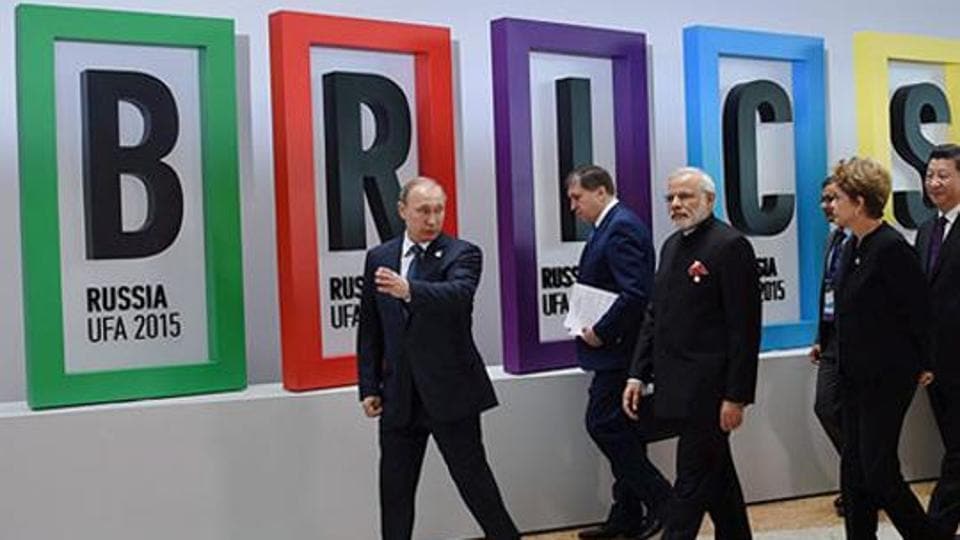
The decision was made during a video conference of foreign ministers of Brics states convened by the current chair, Russia. The meeting also discussed a host of measures, ranging from healthcare to trade and financial sustainability, which could be part of a common approach to fight the pandemic.
The New Development Bank (NDB), established by Brics to mobilise resources for infrastructure and sustainable development projects, will allocate up to $15 billion for loans to help the member states boost their economies amid the pandemic, Russian foreign minister Sergey Lavrov said.
“We decided to set up a special loan instrument to finance projects for the economic rebuilding of Brics countries. In total, we decided to allocate up to $15 billion to this, and we believe this can be a very good foundation at the stage our economies leave the crisis behind to restore economic activities,” he told a news briefing after the video conference.
The meeting, Lavrov said, discussed a “huge set of measures”, including cooperation in healthcare, trade, financial sustainability and employment, as part of a coordinated approach to the Covid-19 crisis. Further discussions on these issues will be held during upcoming sectoral meetings of the five countries, he added.
A virtual meeting of economic experts of Brics states is expected to be held on Wednesday, and healthcare experts are expected to hold a similar meeting on May 7.
Russia’s finance minister Anton Siluanov and finance minister Nirmala Sitharaman were elected chairperson and vice-chairperson of the NDB’s board of governors during a virtual meeting on April 22. That meeting also the discussed the creation of an “emergency assistance facility” of $15 billion to meet emergency needs of Brics states. The NDB said it plans to earmark $10 billion for crisis-related assistance, including support for the economic recovery of Brics states.
Addressing Tuesday’s meeting, external affairs minister S Jaishankar said the challenge posed by Covid-19 “underlines all the more the need for reform of multilateral systems and that reformed multilateralism was the way forward”, according to a statement from the external affairs ministry.
Brics, which accounts for almost 42% of the global population and has a substantial share of investment and trade, has an “important role to play in shaping the global economic and political architecture”, he said.
Jaishankar said the pandemic had severely impacted the global economy and output by disrupting trade and supply chains, and this had led to loss of jobs and livelihoods. “We need to provide support to businesses, especially MSMEs, to tide over the crisis and ensure livelihoods are not lost,” he said.
He spoke of India’s efforts to coordinate the response to Covid-19 in South Asia, including the creation of the Saarc Emergency Fund. India is also providing pharmaceutical aid to nearly 85 countries, including many in Africa, as grants.
Lavrov also said there was no alternative to a multilateral approach to combating challenges such as Covid-19 and that multilateral institutions were facing a test. The Brics states, he said, will deepen cooperation at global platforms such as the UN, G20, WHO, WTO and IMF.
The world community should unite to “ensure the most positive outcome of our efforts for our countries and our citizens”, Lavrov said. These efforts were being undermined by unilateral sanctions imposed on some countries, he added.
“We support the plea of the UN Secretary General and the UN High Commissioner on Human Rights to at least suspend, and at best lift, these unilateral sanctions, imposed by bypassing the UN Charter,” he said.
Asked about the US administration’s decision to cut funding for the WHO, Lavrov said the “common opinion” of Brics states is that UN’s health body is an “important instrument and a unique platform” that has the best professionals from around the world.
Besides Jaishankar and Lavrov, Brazil’s foreign minister Ernesto Araújo, Chinese foreign minister Wang Yi, and South Africa’s foreign minister Grace Naledi Pandor joined the video conference.