
 E-Paper



Ten Months of War to Gain 46 Square Miles: How Russia Is Failing on the Battlefield
Ukrainian forces have foiled Moscow’s offensive in the Donetsk region. The Russian army is making one more push.


 Prefer HTon Google


Russia entered the fifth year of its full-scale invasion of Ukraine with a clear objective: Seize the cities in the eastern Donetsk region that remained under Kyiv’s control.
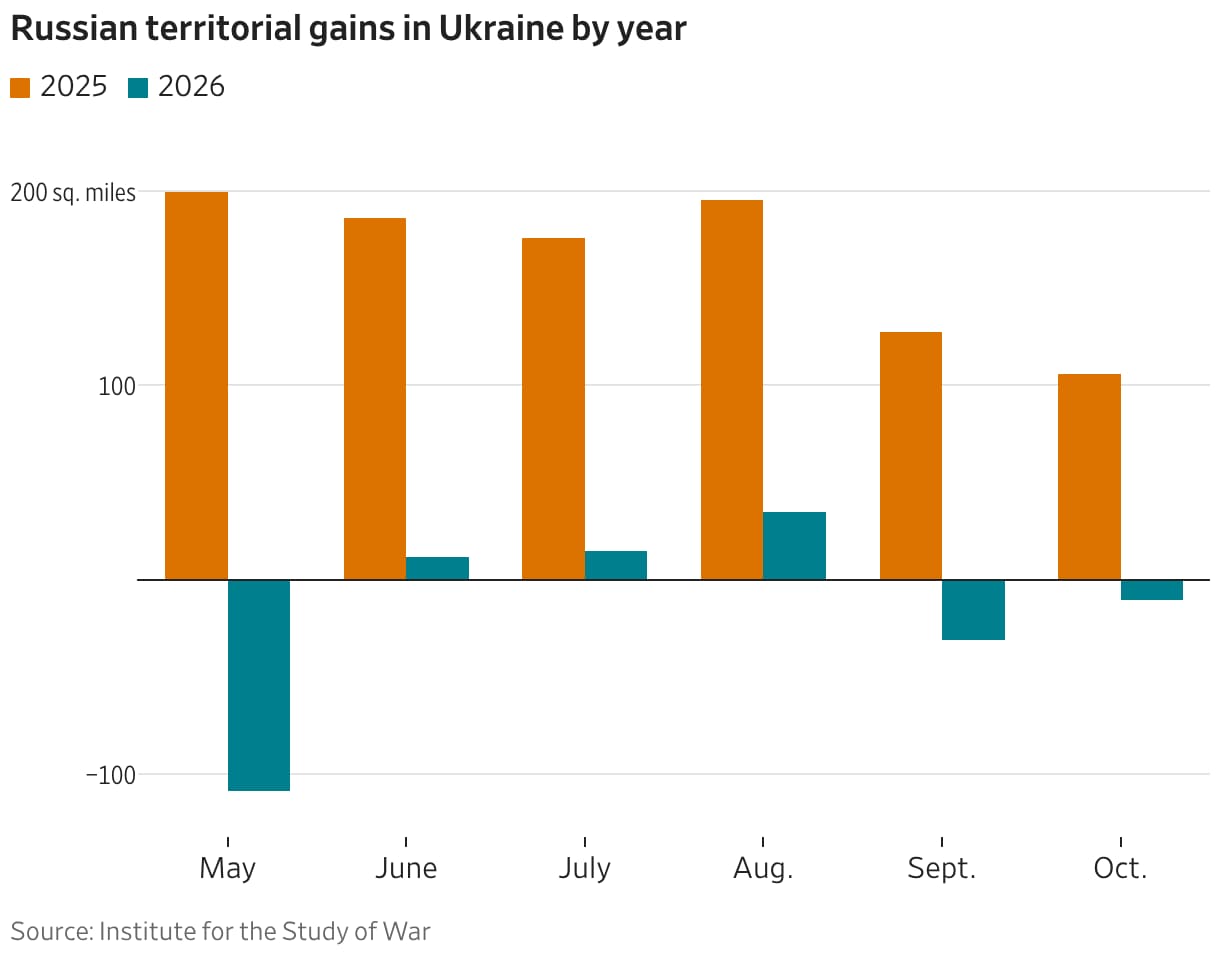
But 2026 hasn’t gone according to plan for Moscow. Through the end of October, its forces have gained just 46 square miles of territory in Ukraine, compared with 1,874 square miles in 2025, according to the Institute for the Study of War, a think tank in Washington. And for the past two months, Russian forces have lost more land than they gained, ISW says.
The Russians also suffered more casualties in October than in any previous month of the war, with 54,000 killed or severely wounded, according to Ukrainian President Volodymyr Zelensky. The estimate couldn’t be verified.
So what went wrong for Russian President Vladimir Putin?
“I attribute it to Ukraine’s midrange strike campaign—that’s a critical capability that they didn’t have in 2025,” said George Barros, an analyst at ISW.
Those midrange strikes have pummeled Russian supply routes behind the front lines with a variety of drones, most of them made by Ukrainian companies. The campaign has starved Russian front-line troops of ammunition and other resources, and made it difficult for Moscow to bring more men to the trenches.
“Russian logistics are disrupted—they haven’t really recovered from that,” Barros said.
Last year, by contrast, Russia could move supplies along the highways of occupied eastern Ukraine to within about 20 miles of the front line, with little fear that vehicles would be hit.
A pincer movement fails
Russia’s big plan for 2026 was to encircle the remaining cities of Ukraine’s Donetsk region, including Sloviansk, Kramatorsk and Kostiantynivka, which Ukraine has heavily fortified.
The plan was for a classic pincer movement. One Russian army would push south from around the city of Lyman. Another would push north from the city of Pokrovsk.
But this spring Ukrainian forces repelled Russian attempts to advance beyond Pokrovsk. And over the summer, the Ukrainians prepared a major counterattack in the Lyman area, called Operation Vivaldi.
First, Ukraine’s midrange drones degraded Russian supply lines. Then Ukrainian infantry and armor, working closely with drone units, launched their counterpunch in September.
Brig. Gen. Andriy Biletskiy, commander of Ukraine’s Third Army Corps, said that by mid-October Ukrainian forces had retaken 107 square miles of territory and 16 settlements in the area around Lyman. Russia suffered around 8,000 casualties in the operation, he said.
The operation put an end to Russia’s pincer plan.
Operation Vivaldi showed that tanks and other heavy combat vehicles can still be part of tactical maneuvers, even when the sky is full of drones, said Barros.
Ukraine’s shaping operations—targeting logistics, surveilling Russian positions and then hitting Russian drone pilots as the main attacks began—allowed armored vehicles to move forward in a way they haven’t since early in the war.
“It showed that, if you establish the prerequisite conditions, you can restore heavy vehicle movement on the battlefield,” Barros said.
He added that the Third Army Corps is one of Ukraine’s best, and was given ample resources to carry out the operation. It is now a question whether other Ukrainian corps can follow the same playbook.
One last push
With its encirclement plan thwarted, Russia is now pouring even more infantry into one last attempt to break through Ukrainian lines this year. Its target is the town of Dobropillia, southwest of Kramatorsk.
Russia is using the same tactics that it has used across eastern Ukraine since 2025: Again and again, tiny groups of infantry try to sneak past Ukrainian lines on foot, while Ukrainian drones hunt them.
Russian troops outnumber Ukrainians by about 6-to-1 in the area, said Kyrylo Dubrovskyi, a lieutenant colonel with the First Corps of Ukraine’s National Guard. In addition, he said, Moscow has deployed about a third of its elite Rubicon drone force to the sector—a sign of Dobropillia’s importance for the Kremlin now.
A drone pilot from First Corps said the Russians were making some territorial gains, but at a huge price. The corps posted a video showing dozens of Russian corpses on a road outside Dobropillia.
“Every attempt to advance comes at a major cost to the enemy,” Dubrovskyi said. “The losses increased in October. Most assault groups are destroyed while they’re still approaching our positions.”
Franz-Stefan Gady, a Vienna-based defense analyst who makes frequent trips to Ukraine, said Russian infantry have infiltrated Dobropillia, but they are a long way from controlling the city.
Russia’s setback at Lyman made Dobropillia even more important for Moscow, Gady said. A breakthrough there could open up further advances in the rear of Ukraine’s fortified lines.
Russia is likely “to keep grinding forward at Dobropillia, and may gain parts of the city over the winter,” he said. “But the operational plan behind this offensive…has failed. What remains is a slow, costly frontal fight for each city.”
Write to Ian Lovett at ian.lovett@wsj.com and Andrew Barnett at andrew.barnett@wsj.com


