E-Paper


At Arizona’s Biosphere 2, warmer conditions made drought kill piñon pines 28% faster; researchers projected fivefold more frequent regional die-offs
Scientists warmed piñon pines and cut off their water. The warmer trees died 28% sooner, hinting at more frequent forest die-offs in a hotter future.

 Prefer HTon Google


Piñon pines are adapted to dry conditions, but prolonged drought can still kill them. A group of piñons was deprived of water and left to endure several months in a laboratory setting. Raise the temperature by just a couple of degrees, however, and things go downhill rather quickly. Henry Adams and his colleagues quantified this phenomenon in a 2009 paper in the proceedings of the National Academy of Sciences.
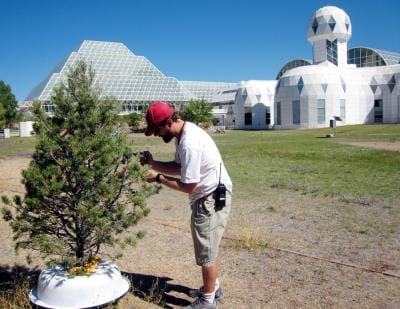
Twenty mature piñon pines were transferred from a ranch in New Mexico to a climate-controlled biosphere in Arizona. Ten trees were kept in conditions similar to their natural temperature, and the other 10 were placed in an environment that was approximately 4.3 degrees Celsius warmer than their natural condition. Water was withheld from five trees from each of these groups. According to the study, the unwatered trees in the warm room died after an average of 18 weeks, compared with 25.1 weeks for those in the normal room, a 28% shorter survival time.
Why did heat leave the trees starving?
The researchers examined what caused higher temperatures to shorten the trees' survival. Drought can kill a tree in two main ways. The first is that the tree can close up its leaf openings, not make its food anymore, and use up all its stored energy. The second is that it can be blocked by air bubbles from the flow of water inside. Because stored energy is depleted more quickly at higher temperatures, only the first mechanism would depend on temperature. As the measures of water stress were the same in both groups, there was no reason to think the trees had become hydraulically blocked. Photosynthesis declined rapidly in both groups of unwatered trees, approaching zero by the third week. Respiration rates began to diverge during the third and fourth weeks. The warmer trees consumed their stored carbon reserves faster.
An April 2010 interview with Southwest Climate Outlook, published by CLIMAS, offered a comparison to explain the findings. Adams compared two marathoners who had eaten the same meal before their respective races, one in Chicago and the other in Tucson in 100-degree Fahrenheit heat. The marathoner running in high temperatures exhausts his energy reserves earlier. Trees that stop taking in carbon dioxide continue consuming stored energy. As a result, warmer trees deplete their energy reserves sooner than cooler ones.
What can hotter droughts mean for the forest?
Adams and his colleagues also looked at history. The researchers analyzed 103 years of regional climate records from four southwestern states and found that the 2002 forest die-off coincided with a 26.1-week drought, the only six-month regional drought identified in their dataset. With survival time reduced by 28% in the heat, a drought lasting 18.7 weeks could have similarly devastating effects, and the records show at least five such droughts. Based on their model, the authors projected that temperature increases alone could make droughts severe enough to cause forest dieback five times more frequent. They considered this a conservative projection because it did not account for increases in drought frequency or bark beetle activity. They also cautioned that the experiment tested only one species.
The CLIMAS interview explains what is at stake on the ground. It says the 2002-2003 die-off hit about 4,500 square miles of piñon forest in the Four Corners region, leaving dry groves that raise fire risk and reduce the fall color that draws tourists. The interview also discussed a separate die-off in British Columbia that covered about 50,200 square miles and had placed pressure on the timber industry while releasing stored carbon into the atmosphere. Adams added that people rely on forests to absorb carbon dioxide, so large die-offs could undermine that role.
Adams was transparent about the limitations of the study. Because the trees were grown in containers for the experiment, he cautioned against extending the survival rates directly to wild trees, which would likely survive longer. The research team later replicated the experiment in Flagstaff, Arizona, by moving the piñons to a warmer site and using tarps to block the rain.