
 E-Paper



Ferozepur chillies spice up Dubai palate in Punjab’s first export
Ferozepur district recently exported its first consignment of 15 metric tonnes of green chillies to Dubai, a first even for Punjab

 Prefer HTon Google


Punjab’s border district Ferozepur has marked a milestone in its farm story, with its green chillies making their way into the markets of Dubai in what officials say is Punjab’s first overseas shipment of the crop.
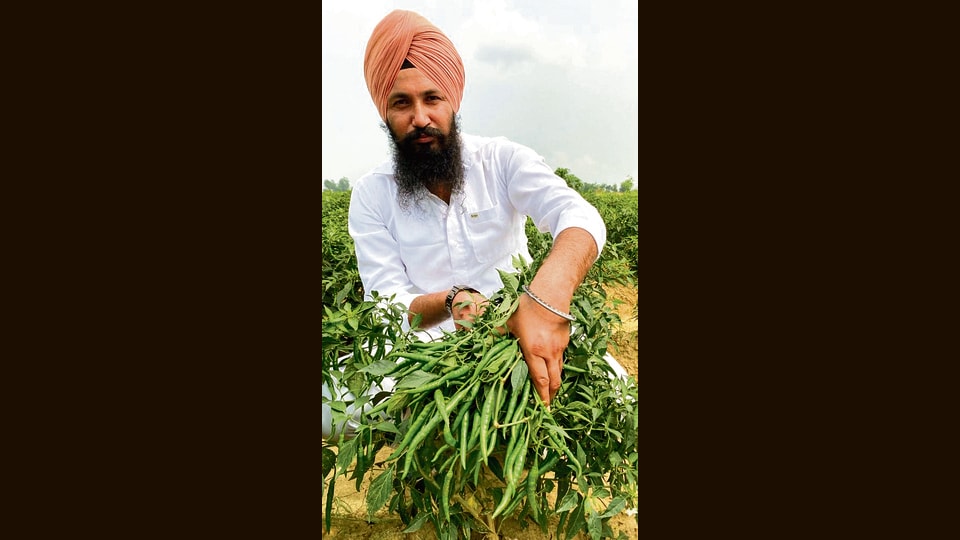
The district recently exported its first consignment of 15 metric tonnes of green chillies, reflecting farmers’ shift from the traditional wheat-paddy pattern towards more profitable, export-oriented crops.
With around 5,000 farmers engaged across nearly 12,000 hectares, Ferozepur leads the state in chilli cultivation, accounting for the largest share of Punjab’s 19,661 hectares under the crop. Statewide, production is estimated at 2,94,915 metric tonnes.
“Area under chilli cultivation has expanded from around 2,000 hectares in 2017 to nearly 12,000 hectares in 2024-25, with production now exceeding 20,000 tonnes annually,” said Ferozepur deputy commissioner Deepshikha Sharma.
She attributed the transformation to a coordinated institutional push. “The district-level export promotion committee, in collaboration with the Directorate General of Foreign Trade, aligned policy, quality standards, logistics and market linkages to position chilli as a priority export product under the One District One Product initiative,” she added.
To ensure export readiness, the administration adopted a pilot-to-scale approach, beginning with controlled cultivation in clusters such as the Makhu belt.
“Crops were grown under strict agronomic practices to meet international benchmarks before scaling up for bulk export,” said chief agriculture officer Balwinder Singh.
Horticulture development officer-cum-nodal officer (chilli), Punjab, Dr Simran Singh said scientific interventions and farmer-led innovations under programmes like GRIP 3.0 (Grassroot Innovation Programme) had strengthened productivity and quality.
“Strong linkages with exporters and food processing agencies have ensured assured offtake and compliance with global standards,” he said.
Higher returns, better soil health
The economic gains have been significant. Though chilli cultivation involves higher input costs, it offers nearly 3.5 times higher returns per acre compared to wheat, supported by six to eight harvest cycles in a season, ensuring steady cash flow.
Beyond economics, the model is addressing ecological concerns. The adoption of integrated pest management, bio-fertilisers and crop residue incorporation has reduced chemical dependency and improved soil health. Winter cultivation further lowers pest incidence, enhancing export competitiveness.
Farmer Manpreet Singh from Dastual Sahib said the model had also improved sustainability at the farm level: “Labour-intensive chilli harvesting has generated large-scale employment for women, strengthening household incomes and financial independence.”
Institutional support drives transition
Institutional support has played a key role. The establishment of a Chilli Development Centre under NITI Aayog’s Aspirational District Programme, along with schemes such as Pradhan Mantri Formalisation of Micro Food Processing Enterprises (PMFME) and the National Horticulture Mission, has strengthened training, processing and market access. Farmer producer organisations have further enabled aggregation and exports.
The Saragarhi Farmers Producer Company Ltd has been instrumental in facilitating exports. Rajya Sabha MP Vikramjit Singh Sahney highlighted the role of Sun Foundation in providing financial support to strengthen the initiative.
Punjab assembly speaker Kultar Singh Sandhwan congratulated farmers on the achievement, calling it a step forward in crop diversification.


