
 E-Paper



Ludhiana: Climate change making weed control harder, say experts
Scientists flag climate change and herbicide resistance, seek affordable solutions to curb annual losses of $12.6 billion

 Prefer HTon Google


Climate change, emerging weed species and herbicide resistance are posing fresh challenges to Indian agriculture, scientists warned at Punjab Agricultural University (PAU) on Wednesday, calling for affordable and technology-driven ways to tackle the problem. Citing an ICAR report, Indian Society of Weed Science (ISWS) president TK Das said weeds cause annual economic losses of up to $12.6 billion in India.
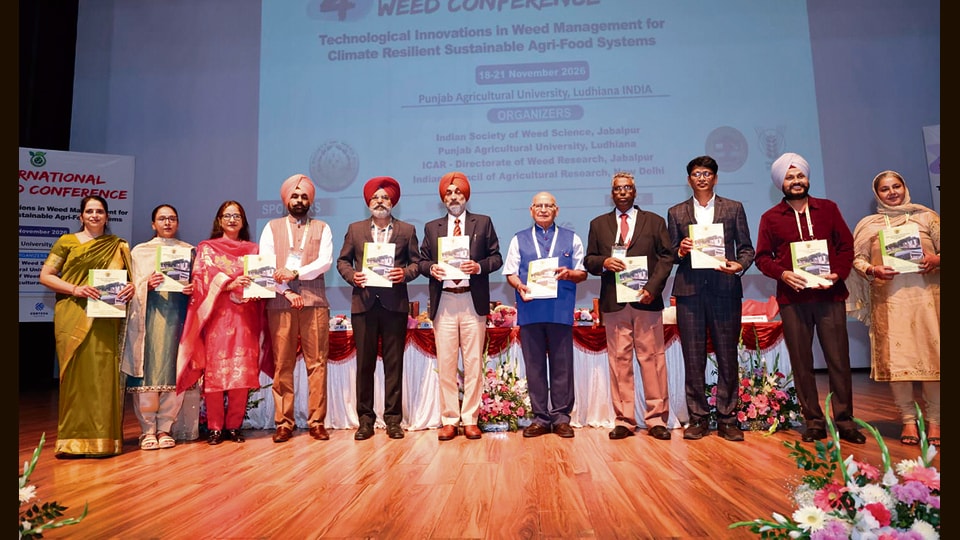
Addressing the inaugural session of the four-day fourth International Weed Conference (IWC-2026), PAU vice-chancellor Harvinder Singh Dhaliwal said, “Changing climatic conditions are leading to the emergence of new weeds and making their management increasingly complex.” Stressing the need for research into changing weed patterns and climate-smart, environmentally sustainable technologies, he said weed-management solutions must be affordable, accessible, convenient and practical for farmers. He also emphasised that technological interventions should protect crop productivity while supporting natural resource conservation and environmental protection.
Citing the 2026 report of the ICAR-Directorate of Weed Research (DWR), Das called for greater research into climate resilience, soil health, water-related challenges and herbicide resistance. He also advocated the development of organic and biological herbicides to improve farm productivity and profitability.
Guest of honour professor Baruch Rubin, an expert in herbicide resistance and weed biology from The Hebrew University of Jerusalem, Israel, stressed the need for stronger international scientific collaboration to address emerging challenges in weed management.
The conference, themed ‘Technological Innovations in Weed Management for Climate-Resilient Sustainable Agri-Food Systems’, brought together more than 500 scientists, international delegates, students, young researchers and industry representatives from 10 countries. Organised by the ISWS in collaboration with PAU, ICAR-DWR, Jabalpur, and the Indian Council of Agricultural Research (ICAR), New Delhi, the event will deliberate on integrated weed management, herbicide resistance, biological control, precision weed management, artificial intelligence and weed control in conservation agriculture.
MS Bhullar, director of extension education and chairperson of the local organising committee, said the discussions were expected to generate ideas for sustainable weed-control technologies.
The ISWS also presented national and international honours, including lifetime achievement awards, fellowships, gold medals and best scientist awards for 2024-25. Two publications, Biology and Management of Weeds in Asia and Africa and 57 Years of Research in Weed Management, were released at the inaugural session.


