
 E-Paper



AI-enabled traffic management system may offer some congestion relief on Delhi roads. What projections say
According to the study, the projected impact varies significantly across Delhi’s road network, with key arterial routes expected to yield far more modest gains.

 Prefer HTon Google


An artificial intelligence-backed traffic management system, which the centre recently announced to be implemented in phases, may offer much-needed relief to commuters navigating some of Delhi’s busiest corridors, even as simulation data suggests that the city’s most heavily clogged arterial roads may see only incremental improvements.
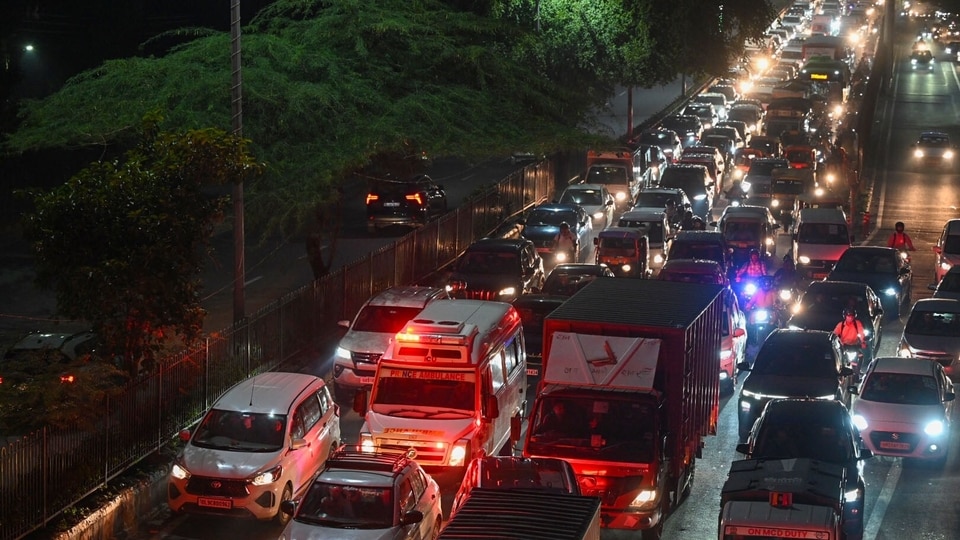
HT has accessed the list of 42 corridors where the Integrated Traffic Management System (ITMS) will first be implemented, and corridors include Nelson Mandela Road, Press Enclave Road, Africa Avenue, Mahipalpur, Mehrauli-Gurgaon Road (including Sri Aurobindo Marg, Prithviraj Road, Shahjahan Road, and Subramaniam Bharti Marg), Mehrauli-Badarpur Road, and Lala Lajpat Rai Marg–Lal Bahadur Shastri Marg, as well as major lifelines like the Ring Road, Outer Ring Road, and the DND Flyway- Ghazipur Road corridor.
HT has also accessed a simulation study conducted by the Delhi Traffic Police that assesses 42 key traffic stretches and projects notable gains once the ITMS is rolled out in its first phase.
The study estimates that stretches such as Nelson Mandela Road, the DND Flyway–Ghazipur Road corridor, Mayapuri Road, Payal Road, and National Highway 9 (NH-24) could see delays reduced by around 40%, with travel time reductions exceeding 25%.
To be sure, delay time means the amount of time spent in traffic, and travel time means the amount of time spent on the journey.
The figures are part of a technical assessment to measure traffic flow improvements through dynamic, real-time signal controls rather than static timers.
An officer aware of the study emphasised that "these metrics are simulation-based estimates derived from computer modelling and do not represent ground-level reductions achieved so far".
The officer refrained from sharing the process of how the study was conducted but said that a specialised team was set up for the purpose.
Key arterial routes expected to yield modest results
According to the study, the projected impact varies significantly across the capital’s road network, with key arterial routes expected to yield far more modest gains.
HT has repeatedly reported that both the Ring Road and Outer Ring Road remain perpetually congested, struggling under the weight of high vehicular density, persistent lane friction, and frequent vehicle breakdowns.
The police simulation indicates that technology may also face limitations on these heavily burdened lifelines. On the 48.09 km Ring Road, the study projects a modest 10% reduction in both delay and travel times. Meanwhile, the 26.47 km Outer Ring Road is expected to fare somewhat better under smart signal synchronisation, with delays estimated to drop by around 30% and travel time decreasing by over 20%.
"This is what we are expecting but we will have to see when it's really rolled out and that holds true for all stretches" a senior police officer said.
A detailed analysis of all 42 corridors in the study underscores this uneven landscape across the capital. While secondary connectors and localised stretches - such as the 2.65-km Lodhi Road, 3.32-km Press Enclave Road, 9.22-km Lala Lajpat Rai Marg–Lal Bahadur Shastri Marg, and 11.99-km Rao Tula Ram Road–Shantipath stretch—are projected to see delays drop by around 30% and travel times by over 20%, major high-volume transit routes struggle to show comparable gains.
Corridors with heavily saturated intersections and complex multi-directional flow fare considerably worse in the computer models. The 21.07-km stretch covering GT Road, New ISBT Flyover, Boulevard Road, and GT Karnal Road is estimated to see a negligible reduction of barely 2% in delays and travel time.
Similarly, the 23.79-km arterial stretch spanning Kali Dass Marg, Moti Nagar Flyover, Najafgarh Road, and Bahadurgarh Road, as well as Shyama Prasad Mukherjee Marg near Azad Market, shows a meagre 5% reduction in delays.
Other critical commuter routes—including the 20.28-km Mehrauli-Gurgaon Road and the Sri Aurobindo Marg stretch, the 20.48-km Mathura Road–BSZ Marg corridor, and the 20.35-km NH48–Sardar Patel Road–Connaught Place connection—are projected to achieve only about 10% relief in delays and travel times.


Stay updated with all top Cities including, Bengaluru, Delhi, Mumbai and more across India. Stay informed on the latest happenings in World News along with Delhi Election 2025 and Delhi Election Result 2025 Live, New Delhi Election Result Live, Kalkaji Election Result Live at Hindustan Times.


