
 E-Paper



Delhi govt plans Yamuna floodwater diversion to Bhatti Mines, floodplains to cut flood risk
The official said that after the 2023 floods, the department was asked to explore mitigation measures.

 Prefer HTon Google


Nearly three years after the 2023 floods, the Delhi government is exploring a plan to divert excess water in the Yamuna during the monsoon into Bhatti Mines pits and six floodplain storage sites to reduce flood risk and boost groundwater recharge, officials said.
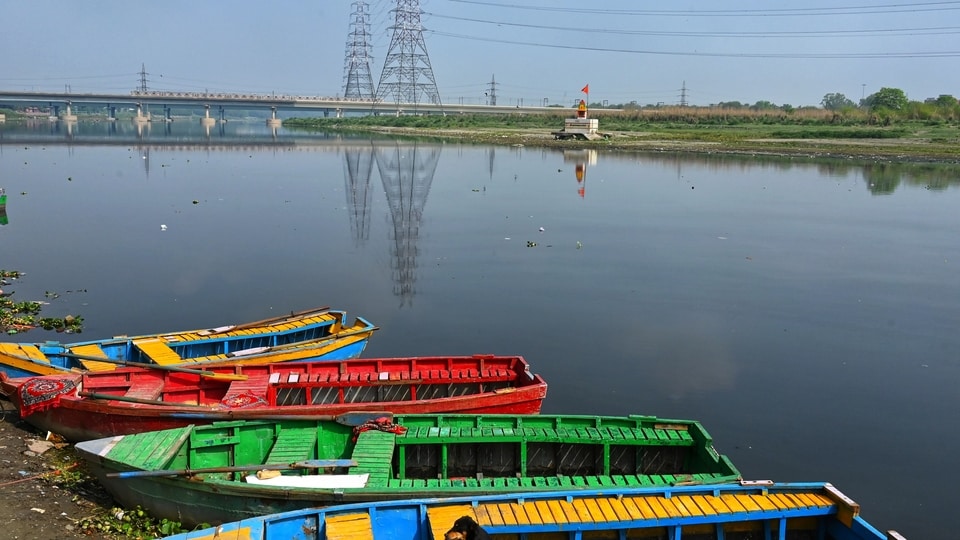
According to an assessment carried out by the irrigation and flood control (I&FC) department, the 15 identified mine pits, which developed due to mining operations between 1960 and 1990, can cumulatively hold 5,200 MLD (million litres per day) or 5,200,000 cubic metres of water per day.Similarly, the storage volume of the six floodplain sites is around 13,707,500 cubic metres, a senior government official said.
The official said that after the 2023 floods, the department was asked to explore mitigation measures.
“Japan uses floodwater diversion techniques, but developing massive underground tanks is expensive and may not be suitable for a river like the Yamuna, which carries excessive silt during the monsoon. Two options studied include storing water in floodplains and Bhatti Mines areas. These can help create a buffer and improve flood management,” the official said.
Also Read | Delhi rules out floodwater reservoirs, pushes for upstream Yamuna dams
What is happening?
The Bhatti Mines, located in south Delhi near Asola and Chhatarpur, are a massive industrial quarrying area that supplied red sand, silica, and stone for Delhi’s construction works from the 1960s to the 1980s. Some of the deep pits left by years of mining have turned into lakes and the area is currently undergoing ecosystem restoration as part of conservation efforts in the Asola Bhatti wildlife sanctuary.
A government official said that a preliminary study on Bhatti Mines was carried out by the Central Ground Water Board (CGWB). It identified 15 major pits that can be used to recharge groundwater. “Total capacity of these pits is about 5,200 MLD (5,200,000 cubic metres) per day. These pits can be filled with 4,200 million litres of surplus monsoon runoff from the Yamuna for 60 days in a year,” the study said.
Located in the Southern Ridge, the mines are underlain by Alwar quartzite of the Delhi System, dating to the Precambrian age. The pre-monsoon groundwater level is at a depth of 48.64 metres below ground level (bgl), improving to 39.17 metres bgl post-monsoon.
The CGWB had earlier undertaken artificial groundwater recharge in the Jawaharlal Nehru University and Sanjay Van areas between 1996 and 1998 by constructing four check dams in the watershed. “The recharge efficiency of pondage created through check dams is 95% to 99.7%. Due to repetitive filling, capacity utilisation of up to 300% was achieved,” the report states.

Plan cautions against using polluted water
An official said the pits can be filled at least three times a year, allowing up to 12,600 million litres (ML) of water to be stored, provided surplus monsoon water is available.
However, the plan cautions against using polluted water, citing the “highly fractured quartzite” terrain where the aquifer is directly exposed in the pits.
“The silt and topsoil already present in the pits must be removed before implementing the recharge project. Periodic desilting will also be required. Water quality monitoring stations need to be established,” it adds.
Furthermore, the I&FC department has identified six locations along the floodplain where water can be stored in pits up to 1.5 metres deep. Two sites have been marked on the right bank — north and south of the Old Bawana Escape — while four are on the left bank, including areas near Sabapur, south of the Wazirabad barrage, opposite Mayur Vihar, and between the railway bridge and the ITO bridge.
Also Read | Flooded Yamuna river wreaks havoc in Delhi; water enters relief camps, crematoriums
The Old Bawana Escape site, spread over 900,000 square metres, can store 1,350,000 cubic metres of water, while the South Old Bawana Escape site, covering 1,170,000 square metres, has a capacity of 1,755,000 cubic metres. The largest site, near Mayur Vihar, spans 3.12 million square metres and can store up to 4,680,000 cubic metres.
“The sites may not be adequate to handle peak flood flows, but they can provide a buffer period and enhance groundwater recharge,” an official said.
Bhim Singh Rawat, a Yamuna activist and member of the South Asia Network on Dams, Rivers and People (SANDRP), said that the proposal to divert water to the Bhatti mines has many pitfalls, and that Delhi should focus on the basics to improve its flood preparedness.
“It has the risk of contamination of the groundwater if polluted water reaches the point. Moreover, it will require pumping water, which may be energy-intensive. The water should be flowing from the ridge towards the river, not against it,” the actvist said.


Stay updated with all top Cities including, Bengaluru, Delhi, Mumbai and more across India. Stay informed on the latest happenings in World News along with Delhi Election 2025 and Delhi Election Result 2025 Live, New Delhi Election Result Live, Kalkaji Election Result Live at Hindustan Times.


