
 E-Paper


The East is now central to India’s maritime security
New Delhi’s approach is to strengthen ASEAN-led institutions while simultaneously building practical security partnerships with individual countries

 Prefer HTon Google


With West Asia caught in conflict, India’s attention is turning east. There is certainly enough happening in Southeast Asia to command New Delhi’s attention. The Philippines will host the ASEAN summit in Manila on November 16-18; the East Asia Summit, the India-ASEAN summit, and the long-deferred Quad leaders’ meeting are scheduled to be held in parallel. This provides a unique opportunity for India to advance its diplomatic, economic, and security interests in the Indo-Pacific.
Prime Minister (PM) Narendra Modi will be leading the Indian delegation and will likely have bilateral meetings with host President Ferdinand Marcos Jr as well as with US President Donald Trump, who will be there for a short while before flying to Shenzhen to attend the APEC summit. The APEC event will likely garner much more international attention, given the possibility of a Trump-Putin-Xi meeting. But for India, which is not a member of APEC, the ASEAN summits will be more rewarding.
The promotion of maritime security, digital integration, and new trade agreements will be India’s focus for the meetings. India has designated 2026 as the ASEAN-India Year of Maritime Cooperation. Given how the ongoing Iran war has played out, India will stress not only freedom of navigation but also the safety of seafarers. India’s public posture will be to press for adherence to UNCLOS and emphasise the centrality of ASEAN in its East Asian outlook.
But India’s policy moves in Southeast Asia will be difficult to sustain unless they are accompanied by stronger trade, investment and connectivity links. To this end, New Delhi will seek a fast-track review of the ASEAN-India Trade in Goods Agreement (AITIGA) to tackle current trade asymmetries and streamline market access. The need to build on the ASEAN-India Digital Work Plan will be another focus area, and India is likely to offer its indigenous Digital Public Infrastructure stack, comprising Aadhaar, e-KYC, and UPI, among others.
New Delhi will back initiatives on supply-chain de-risking both in the context of ASEAN and Quad. India’s priorities at the summits show a significant overlap with the goals of Quad on issues such as maritime security, supply-chain resilience and counter-coercion. India is part of the Indo-Pacific Partnership for Maritime Domain Awareness, whose aim is to track dark shipping and illegal fishing.
As for supply-chain resilience, Quad has established clear working groups on semiconductor supply chains, critical minerals, and open-RAN telecommunications. At the EAS, India puts these frameworks into action by backing regional connectivity projects and multi-layered economic infrastructure, directly implementing Quad’s tech-security goals across the wider East Asian landscape.
To counter the criticism that Quad is an Asian NATO, all four members explicitly pledge allegiance to ASEAN centrality. PM Modi uses the EAS — where ASEAN is the driving force — to prove this commitment. By strengthening the EAS, India ensures Quad remains a complementary economic and security anchor rather than an alienating alternative to Southeast Asian diplomacy.
India has significantly expanded its strategic and military footprint in the South China Sea, shifting from a cautious stance to active security and defence cooperation — most notably with the Philippines. Over 55% of India’s trade passes through the South China Sea and the Malacca Straits, making freedom of navigation and regional deterrence critical national interests. India has backed the 2016 Arbitral Tribunal Award that rejected China’s Nine-Dash Line.
In January 2022, India signed a $375-million deal to supply shore-based BrahMos supersonic cruise missiles to the Philippines. These missiles are deployed in western Luzon, facing the contested waters near Scarborough Shoal. Reports suggest that the two countries are in the final stage of talks to expand the deal to cover 60 more missiles.
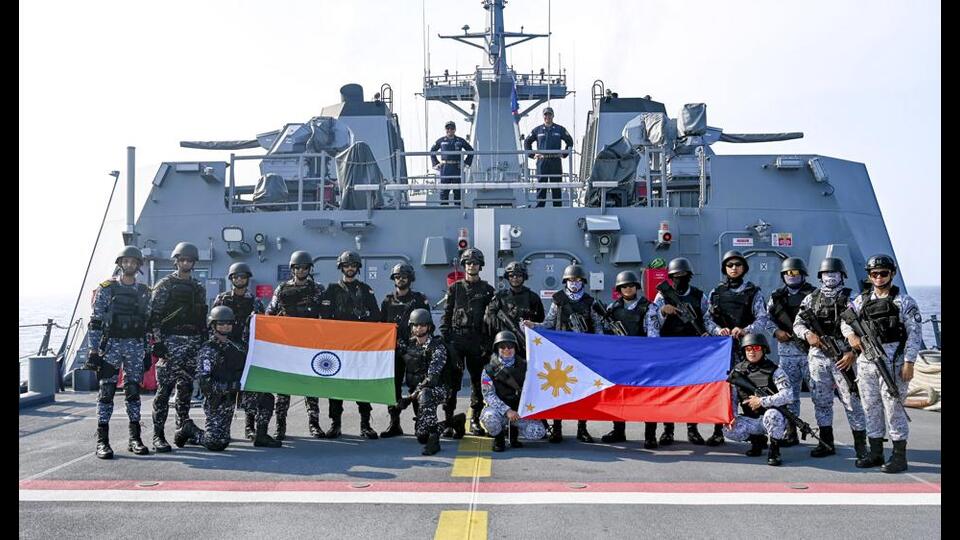
In August 2025, the Indian Navy and the Philippine Navy conducted their first-ever joint naval exercise inside the Philippines’ exclusive economic zone (EEZ) in the South China Sea, where they were shadowed by Chinese vessels. During the State visit of President Marcos Jr. to India the same month, the two sides elevated their ties to a Strategic Partnership and adopted a 2025-2029 Action Plan focused on maritime domain awareness, capacity-building, and defence trade. India has extended support for the Filipino Coast Guard, including offering utility helicopters and maritime capacity-building assistance.
By enabling the Philippines to build coastal and anti-ship deterrence (via BrahMos and joint patrols), India is subtly pushing back against the Chinese salami-slicing tactics it faces in the Himalayas. India’s ties with ASEAN are a means of displaying its strategic autonomy and establishing its credibility as a defence supplier and security partner in Southeast Asia.
India has long-standing maritime ties with ASEAN, considering it shares a maritime border with three ASEAN countries — Myanmar, Thailand, and Indonesia. In the 1990s, New Delhi hosted the MILAN exercises in the Andaman Sea with several ASEAN countries. Since 1994, it has held the SIMBEX exercise with Singapore, which is India’s longest uninterrupted naval exercise. It also conducts regular Coordinated Patrols (CORPAT) and joint maritime exercises with several ASEAN countries.
In 2023, India inaugurated a formal ASEAN-India maritime exercise (AIME), whose first edition was held off Singapore and the South China Sea. The second set of exercises was held between September 28 and Oct 2, 2026, off the Philippines.
The Manila summit will, therefore, be an opportunity for India to consolidate its growing engagement with Southeast Asia at a time when the strategic contest in the Indo-Pacific is intensifying. New Delhi’s approach is to strengthen ASEAN-led institutions while simultaneously building practical security partnerships with individual countries such as the Philippines. For India, the East is no longer simply an extension of its Act East policy; it is increasingly central to its own security, economic resilience and strategic positioning in the Indo-Pacific.
Manoj Joshi is a distinguished fellow, Observer Research Foundation, New Delhi. The views expressed are personal


