
 E-Paper


Experts say impact of cruise on Yamuna ecology not studied
Environmentalists questioned the newly launched Yamuna cruise service on Tuesday, saying it was introduced without an ecological impact assessment or navigability studies in one of the river’s last remaining relatively clean stretches

 Prefer HTon Google


Environmentalists questioned the newly launched Yamuna cruise service on Tuesday, saying it was introduced without an ecological impact assessment or navigability studies in one of the river’s last remaining relatively clean stretches.
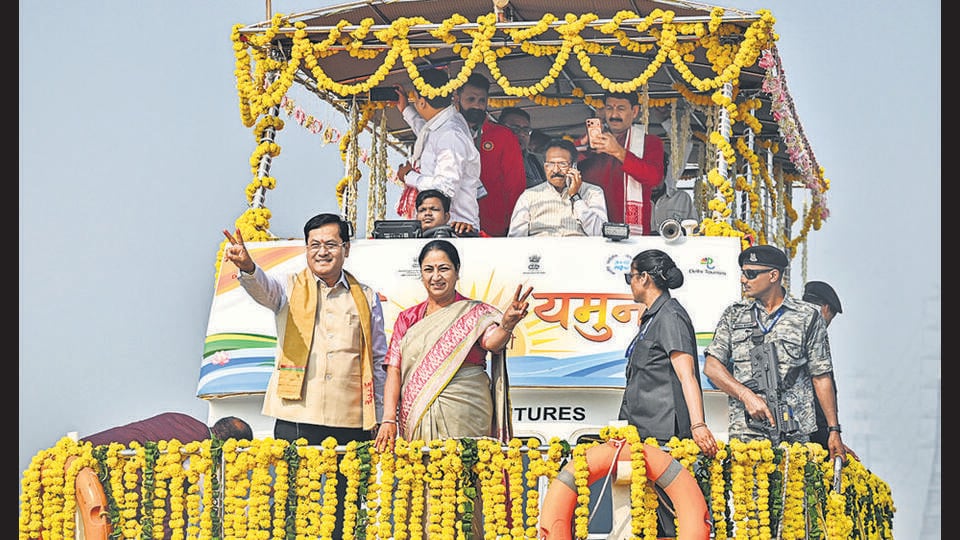
Bhim Singh Rawat, a Yamuna activist and member of the South Asia Network on Dams, Rivers and People (SANDRP), said the government should have commissioned an ecological impact assessment and a topographical study before allowing motorised cruise operations.
“This clean part of the river sees migratory birds, and efforts should be made to cause minimal disturbance. A similar plan to run a water taxi in this stretch failed in the past, but no lessons have been learnt. They should first assess the depth of the river and the requirements for boat operations, as this might adversely impact aquatic life,” he said.
Rawat said ecological restoration, rather than eco-tourism, should be the government’s priority, particularly along the Sonia Vihar–Jagatpur stretch, which supports aquatic life and attracts migratory birds. He also cautioned that motorised propellers could harm aquatic species, citing similar services in other cities. “Additionally, the river runs dry in May-June, exposing the riverbed. This year, we saw a monsoon deficit, and ecological flow in the river is missing. The river did not cross even the warning level once during the monsoon,” he said.
The concerns come against the backdrop of fluctuating water levels and poor navigability. During a ground visit in May, HT found that much of the proposed route between Sonia Vihar and Jagatpur had dried up, leaving shallow pools and narrow streams. The cruise boat, despite being ready, could not travel beyond a few hundred metres near the Sonia Vihar sports club because of inadequate water depth.
Diwan Singh, water sector expert and convener of Yamuna Satyagraha, echoed the concerns. He said, “The government should first prioritise cleaning the heavily polluted section between Wazirabad and Kalindi Kunj. Promoting eco-tourism without addressing the pollution avoids the primary issue. If the goal is to genuinely improve the public’s connection to the river, efforts and resources must be directed toward restoring the polluted stretches first.”
The 40-foot vessel, built by Mumbai-based Inspiration Marine Pvt Ltd, has a draft — the vertical distance between the water surface and the vessel’s deepest point — of three feet. It is powered by two 40-horsepower electric motors. While its operators have highlighted its shallow draft and electric propulsion, environmentalists say these features do not address the wider ecological implications of introducing motorised vessels.
Navigability concerns are not new. In June 2023, an 11-metre Indian Navy boat, Barasingha, brought to Delhi to assess the river’s navigability, got stranded because of insufficient water depth. It required a minimum depth of two metres, while the riverbed in that stretch had only 0.9 to one metre of water.
In 2015, the Inland Waterways Authority of India proposed a 16-km water taxi service between Sonia Vihar and Tronica City. The Delhi government rejected the proposal in 2021, citing severe pollution and inadequate water levels.
Environmentalists and opposition parties have said the cruise initiative must not compromise the river’s ecology, particularly when ensuring adequate environmental flow and restoring aquatic habitats remain unresolved priorities. The Palla–Wazirabad stretch is the only relatively clean part of the river, and Delhi draws raw water for two of its treatment plants from this area.

Stay updated with all top Cities including, Bengaluru, Delhi, Mumbai and more across India. Stay informed on the latest happenings in World News along with Delhi Election 2025 and Delhi Election Result 2025 Live, New Delhi Election Result Live, Kalkaji Election Result Live at Hindustan Times.


