
 E-Paper



NDMC 2nd among mid-size cities in Swacchta rankings
NDMC chairman said the “council’s objective is not just to achieve a better position in cleanliness rankings, but to provide a clean, healthy and better urban environment to the citizens.”

 Prefer HTon Google


The New Delhi Municipal Council (NDMC) on Wednesday secured second position in the Clean City category among 903 urban local bodies with a population between 50,000 and 3,00,000 population category in the annual national sanitation rankings Swachh Survekshan 2025-26.
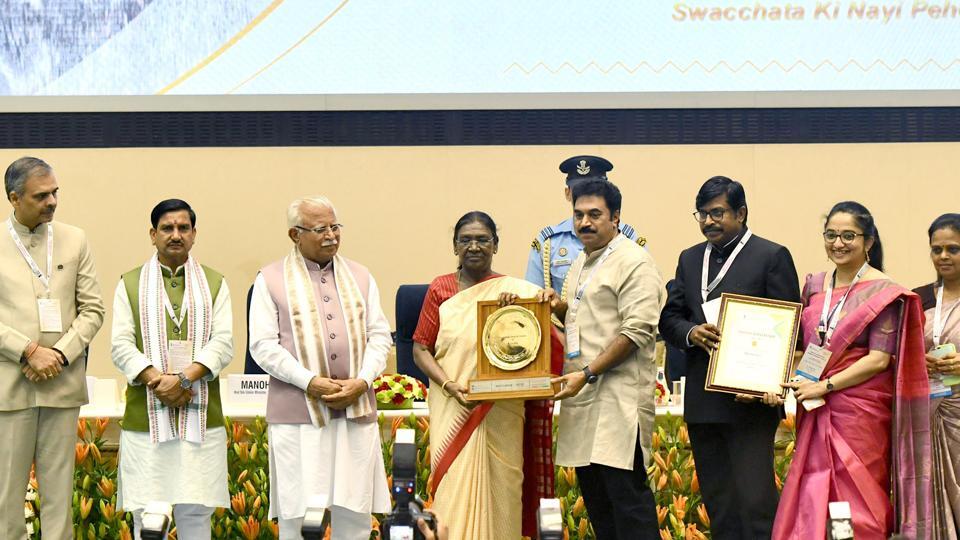
Last year too, the New Delhi area was judged to be one of the cleanest areas in its category while being declared a “Super Swachh League City”—a group of cities which have been constantly performing well over the preceding three years. No separate rank was awarded to the local body. It was among 23 cities recognised for their efforts in sanitation, waste management and green initiatives.
Dewas and Sagar in Madhya Pradesh secured the first and third position, respectively. Municipal Corporation of Delhi (MCD), the other agency in the Capital, did not list among the top cities that were awarded by President Droupadi Murmu in a ceremony at Vigyan Bhawan in New Delhi. Last year, MCD ranked 31 out of 44 urban local bodies in its category.
The larger rankings and assessment were still awaited.
The Lutyens’ Delhi areas, which come under the NDMC, have a much larger floating population in comparison to the residents. As per the NDMC report, the 42.7 sq km area has a resident population of 0.25 million and much larger floating population of around 1.6-2.0 million per day. It houses key offices of the central government, the Supreme Court, foreign embassies, diplomatic missions, historical and heritage sites, commercial centres, major markets, and tourist places.
NDMC chairman Manoj Kumar Dwivedi said the “council’s objective is not just to achieve a better position in cleanliness rankings, but to provide a clean, healthy and better urban environment to the citizens and every person visiting here.”
Vice-chairperson Kuljeet Singh Chahal said that the “council is committed to making New Delhi an ideal model of cleanliness through modern technology, mechanization, scientific waste management and public participation.”
NDMC has also built a record of recognition in successive cleanliness surveys. It was recognised as the Cleanest Capital in 2020-21, the Cleanest Small City in the 100,000 -300,000 lakh population category in 2022-23 and the Cleanest Union Territory in 2023-24. In 2024-25, it was placed in the Super Swachh League City category.
Chahal said, “Maintaining cleanliness in the NDMC area is a distinctive and challenging task. Due to heavy footfall and continuous public activities in these areas, maintaining cleanliness throughout the day is a major responsibility. Despite this, NDMC has maintained high standards of cleanliness with the help of modern technology, better management and dedicated sanitation workers,” he added.
NDMC currently processes around 300 tonnes of municipal solid waste daily against its available processing capacity of 509 tonnes per day. Eight micro-material recovery facilities, along with a network of reduce, reuse and recycle (RRR) centres, contribute to waste segregation and processing. The council is also promoting the concept of ‘Anupam Colonies’; model zero-waste neighbourhoods aimed at encouraging sustainable waste management at the local level. Nine colonies, including Bharti Nagar and DID2 Chanakyapuri, have already been declared Anupam colonies.
MCD, which covers most of Delhi, has consistently fared poorly in the annual rankings with challenges like poor waste segregation, saturated landfill sites, gap in waste generation and processing capacity and ongoing transition phases in quarter of the city where new private concessionaires are being hired.
MCD did not respond to a request for comment till the time of going to print.
Waste management expert Bharati Chaturvedi, founder and director of Chintan Environmental Research and Action Group, said that NDMC has done three key things in its area: the integration of informal waste pickers in the waste management system, training of cadre, and the deployment of RRR centres promoting recycling and reuse right at the doorstep level. “MCD on the other hand does not include waste pickers. Its concessionaires are displacing waste pickers. It seems to be stuck with huge amount of other jobs, it needs to overhaul its waste management division on lines the NDMC has managed,” she added.

Stay updated with all top Cities including, Bengaluru, Delhi, Mumbai and more across India. Stay informed on the latest happenings in World News along with Delhi Election 2025 and Delhi Election Result 2025 Live, New Delhi Election Result Live, Kalkaji Election Result Live at Hindustan Times.


