


 Live Score
 Teams
 Players
Unshackled India turn 225 into target practice
Samson and Abhishek scored at a rate that left little room for doubt who the eventual winners would be

 Prefer HTon Google


For India, New Zealand chose to reserve their best. Glenn Phillips turned it on with an unbeaten 40-ball 82, Finn Allen carved 45 off 24 balls, before Bevon Jacobs left India high and dry with 31 off 16.
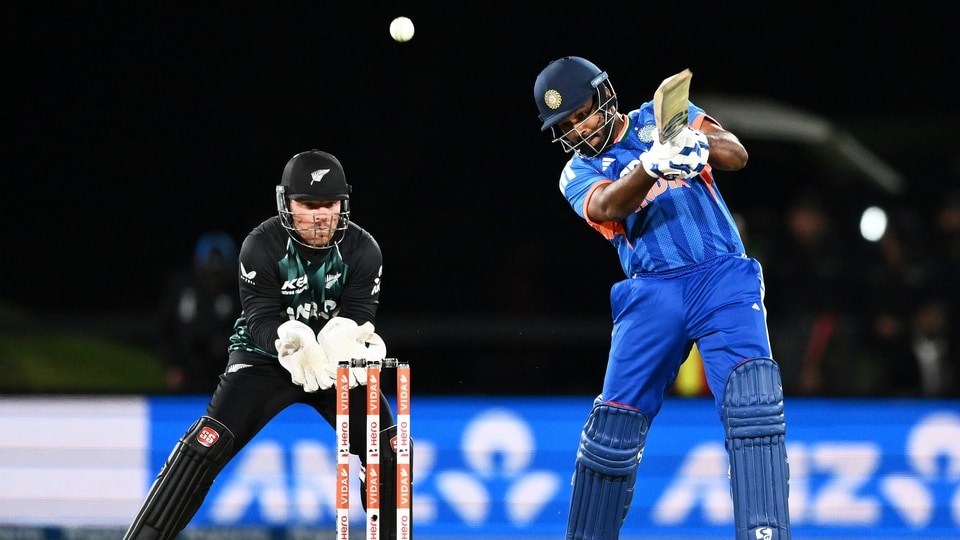
But evidently, even 225 wasn’t enough as India orchestrated a fascinating chase in the first T20I at Christchurch to ride into the record books. Primarily because Sanju Samson and Abhishek Sharma responded by treating this target as an invitation to attack. So spectacular was their unshackled batting that even a middle-order collapse could not derail a chase completed with two balls to spare.
The previous highest successful T20I chase by India was 209, against Australia at Visakhapatnam in 2023. That mark was surpassed with room to spare, the foundation was laid in a Powerplay that seemed to render the target almost irrelevant.
Samson made 67 from 33 balls, Abhishek contributed 29 from 12, and the opening pair put on 93 before Abhishek was dismissed, all before the powerplay could be completed. Their assault yielded 15.66 runs an over, leaving India needing 132 from the remaining 14 overs. For a side chasing 226, this was the kind of luxury very few chasing teams get.
“We just watch the ball and hit hard,” Samson said of his partnership with Abhishek, a wonderfully uncomplicated description of an approach that left New Zealand scrambling for answers. “We do have a lot of conversations happening in the middle, but nothing makes sense actually.”
It was not quite as simple or senseless as Samson made it sound. The opener had to contend with movement from Matt Henry early in the innings, but responded with a crisp pull and a straight drive before taking on Adam Milne and Lockie Ferguson. Abhishek supplied the more explosive counterpoint, launching Henry over cover for six and pulling Milne for towering blows. Ferguson’s second over cost 22 runs, while the fourth yielded 26 as New Zealand’s lengths unravelled under pressure.
Samson reached his half-century from 23 balls, with eight fours and four sixes, and India embarked on a start that made the chase appear likely to be completed long before the final over.
“We just felt like keeping the shape and having a very positive intent in the Powerplay,” Samson said. “Once we got off to a flying start, we felt the match could be finished in the first half as well.”
That confidence was not misplaced, but New Zealand’s spinners ensured the contest was not decided quite so early. Michael Bracewell removed Abhishek, caught at short third, before Mitchell Santner bowled Samson with an under-edge onto the stumps. Bracewell then dismissed Tilak Varma for six, and Santner had Ishan Kishan caught at long-on for one. India, having reached 93 without loss, were suddenly 122 for four.
The collapse was a reminder that attacking intent doesn’t entirely eliminate risk; it merely changes the terms on which a team accepts it. New Zealand’s spinners took four wickets for 76 runs in eight overs, while the pace attack managed only two wickets for 154 runs in 11.4 overs at an economy rate of 13.2. The distinction was decisive. India’s openers had dismantled the seamers, but the middle order had to negotiate a more difficult phase against spin.
Shreyas Iyer and Axar Patel did so with a 45-run partnership from only 24 balls. Axar struck a six and two fours before being caught at midwicket, but the stand restored some of the momentum lost in the middle overs.
Where Samson and Abhishek had made the target look vulnerable, Naman Dhir ensured the late wobble did not become a crisis with an unbeaten 42 from 15 balls.
Iyer credited the opening pair with setting up the pursuit, pointing to the importance of reaching 80 or 85 in the first six overs when chasing a total above 220. “That’s a tremendous start,” he said. “Once they get going, it’s just about the momentum they carry forward, and today was just an example of that.”
His assessment also offered an explanation for New Zealand’s imposing total. India had initially found the pitch a little slow, with the ball holding in the surface, and their bowlers had missed the hard lengths they wanted to hit. As dew arrived, however, the surface became flatter and the ball skidded on more.
Phillips exploited that with an 82 that acted as the innings’ centrepiece, with Allen and Jacobs providing the time-to-time push the innings needed.
The total still appeared formidable, but the conditions that had helped New Zealand also benefited India’s batters. Iyer said the dew made the wicket skid and the ball come on to the bat more easily as the match progressed. India’s response was therefore not simply an exercise in hitting harder; it was a willingness to exploit the changing conditions while maintaining a scoring rate that left little room for doubt who the eventual winners would be.


