E-Paper



The real world complicates textbook macro stabilisation | Number Theory
Here are three ways the fate of present and future macroeconomic stability lies beyond economics.

 Prefer HTon Google


This year’s Nobel Prize in Economics has been awarded to Robert E Hall and Michael Woodford, economists at Stanford and Columbia University. A far as Economics Nobels go, this year’s prize marks a recognition of the discipline’s technocratic achievements which build complex theoretical models to explain the real world. The broad ideological orientation of this year’s awardees is what is called the New Keynesian tradition which sought to improve the subject’s understanding about macroeconomic stability after the 1970s raised questions on the traditional Keynesian wisdom of managing cyclical fluctuations by raising or reducing government spending. A detailed explanation of the significance of this year’s awardees work follows in the newspaper. To be sure, even the Nobel Committee has underlined models cannot offer conclusive proof of how the real-world works but they definitely help us manage and understand things better. “In sum, while it is hard to prove beyond reasonable doubt that the relatively quick rebound after recessions in our economies over the past half century are due to better monetary and fiscal stabilisation policy, there does seem to be a consensus that they have played a very important role”, the Nobel Committee said in its detailed note.

What makes the real world more complicated is how politics shapes economic behaviour and policies, which economists have little control on. Here are three ways in which the fate of present and future macroeconomic stability is beyond economics.
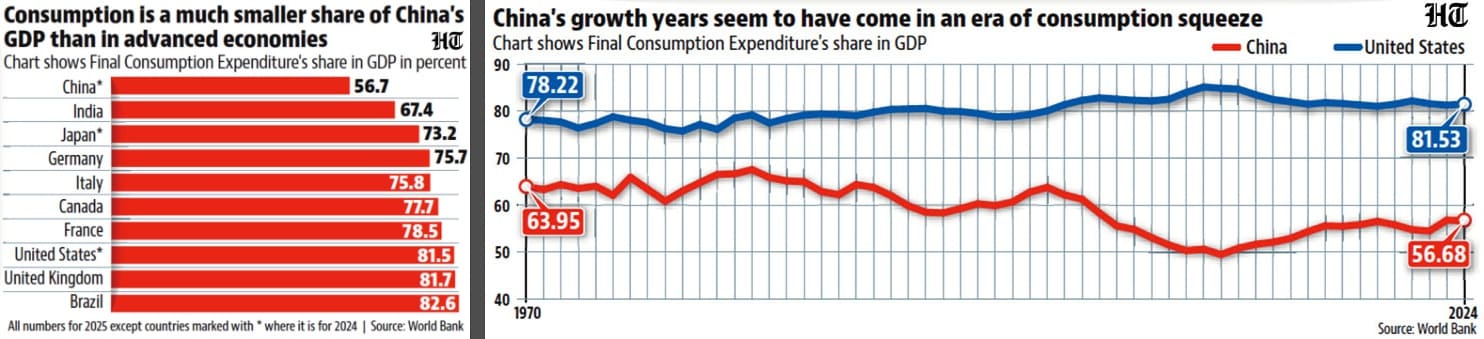
 China’s alleged consumption squeeze is one of the biggest economic disputes in the world todayOne of the biggest insights of Hall for which he has been awarded the top honour is the argument that present consumption is often driven by a desire to ensure a smooth future consumption. One of the biggest macroeconomic debates in today’s world is whether China has squeezed its domestic consumption to promote growth via exports. China’s consumption share in GDP, both at present and historically, shows that its consumption lags other major economies. However, when seen in view of things such as the Chinese government erasing all capital gains in the housing market --- this would entail a large negative wealth shock to households – it is eminently possible that Chinese households underspend on their own to rule out shocks to future consumption because of such policies. This is more theory than conspiracy theory in keeping with this year’s Nobel Prize.
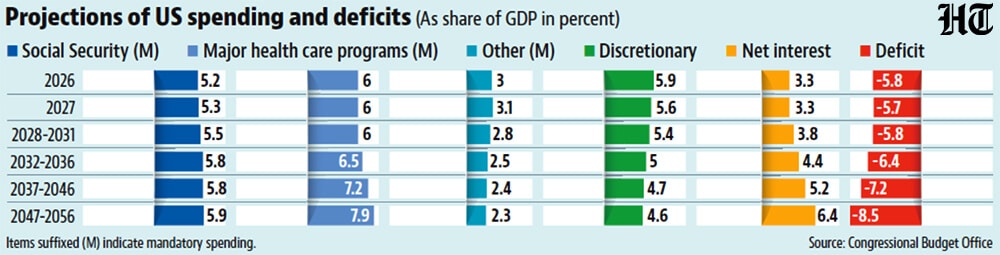
- US spending pushing its deficit is divorced from cyclical economic movements...The Reagan Thatcher neoliberal revolution buried the Keynesian consensus in economics. The advanced world should have moved to a period of high growth and low deficits after this intellectual realization. The reality today is exactly opposite. Advanced economies, the US and major European countries included, are facing very high deficit and debt levels and staring at unsustainable fiscal stress in the future. The reason for this imbalance does not seem to be difficult to understand if one looks at budgetary break-up. The US, for example, spends a lot more money on committed spending which is divorced from economic cycle which would be extremely difficult to do away with politically. This is not what Keynes prescribed.
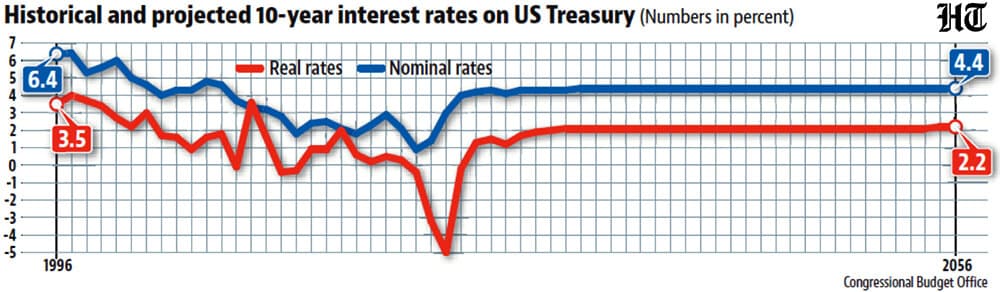
- ...Which will tend to undermine the efforts of an independent monetary authorityThe only other debate which has come close to animating, and, also agitating global economics wonks in addition to the China underconsumption theory has been US President Donald Trump’s attack on the independence of the US Federal Reserve (in setting interest rates). An independent Fed is pretty much the cornerstone of global financial stability in today’s world and any signs of its takeover by the US executive will create a situation close to a meltdown. However, what is often an unasked question is whether the US will be able to solve its macroeconomic problems as described in its unsustainable fiscal trajectory described above. The intuitive answer, given the bipartisan consensus in US politics on economic palliatives, is a clear no.
- Academics often deal with problems of the real world in abstract theoretical ways and in the process end up making us wiser about the real world. This year’s Nobel Prize in economics is a recognition of such endeavour. However, what we also need to remember is questions of macroeconomic stability as linked to the nature of capitalist accumulation as they are to government and central bank interventions. The latter is often more political than technocratic in nature and driven by the realities forced by the former.