E-Paper



What makes people flourish | Number Theory
.

 Prefer HTon Google


While humans have always been interested in well-being or happiness , scientific research into this is relatively recent, and global awareness around it even more so. One example of this is the World Happiness Report, which has been published since 2012 by a group of organisations – including the University of Oxford, Gallup, and the UN . A new survey – the Global Flourishing Study (GFS) – aims to expand on this work by generating panel data, so that same people can be followed over time; and by providing a broader range of assessments. The results from the first wave of GFS – it covered over 200,000 people in 22 countries across six populated continents – were published on April 30 in a paper in the Nature Mental Health journal. Here is what the paper shows.

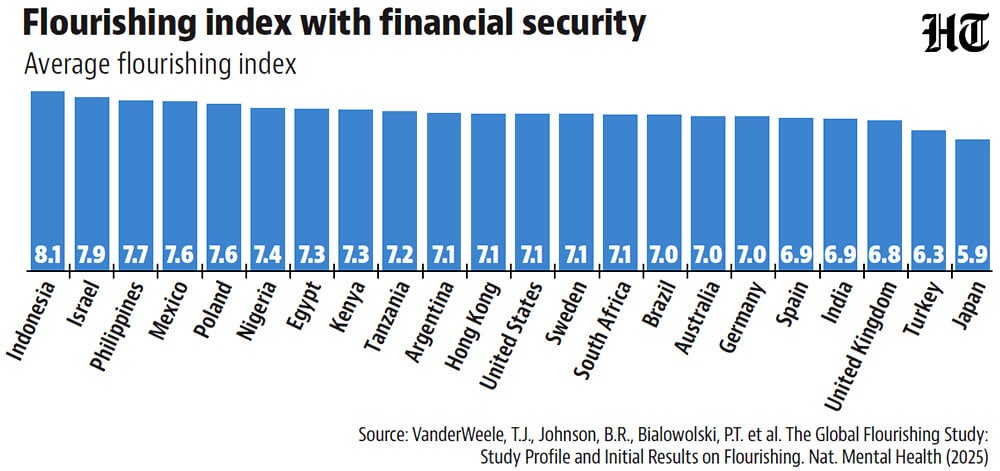
 India flourishes moderately relative to other countries until financial security is includedThe GFS asked respondents 12 questions, with two questions each across six domains: health, happiness, meaning, character, relationships and financial security. These questions were used to generate a so-called flourishing index, where well-being levels increase with higher values of the index. Irrespective of whether financial security was included or not, Indonesia is the most flourishing country among the 22 countries covered; and Philippines and Israel are among the top five countries. On the other hand, Japan, Turkey, and United Kingdom are the least flourishing countries either way. India and Brazil show a sharp drop in ranking if financial security is included in the index. They are ranked 12th and eighth most flourishing without including financial security and 19th and 15th after including it.
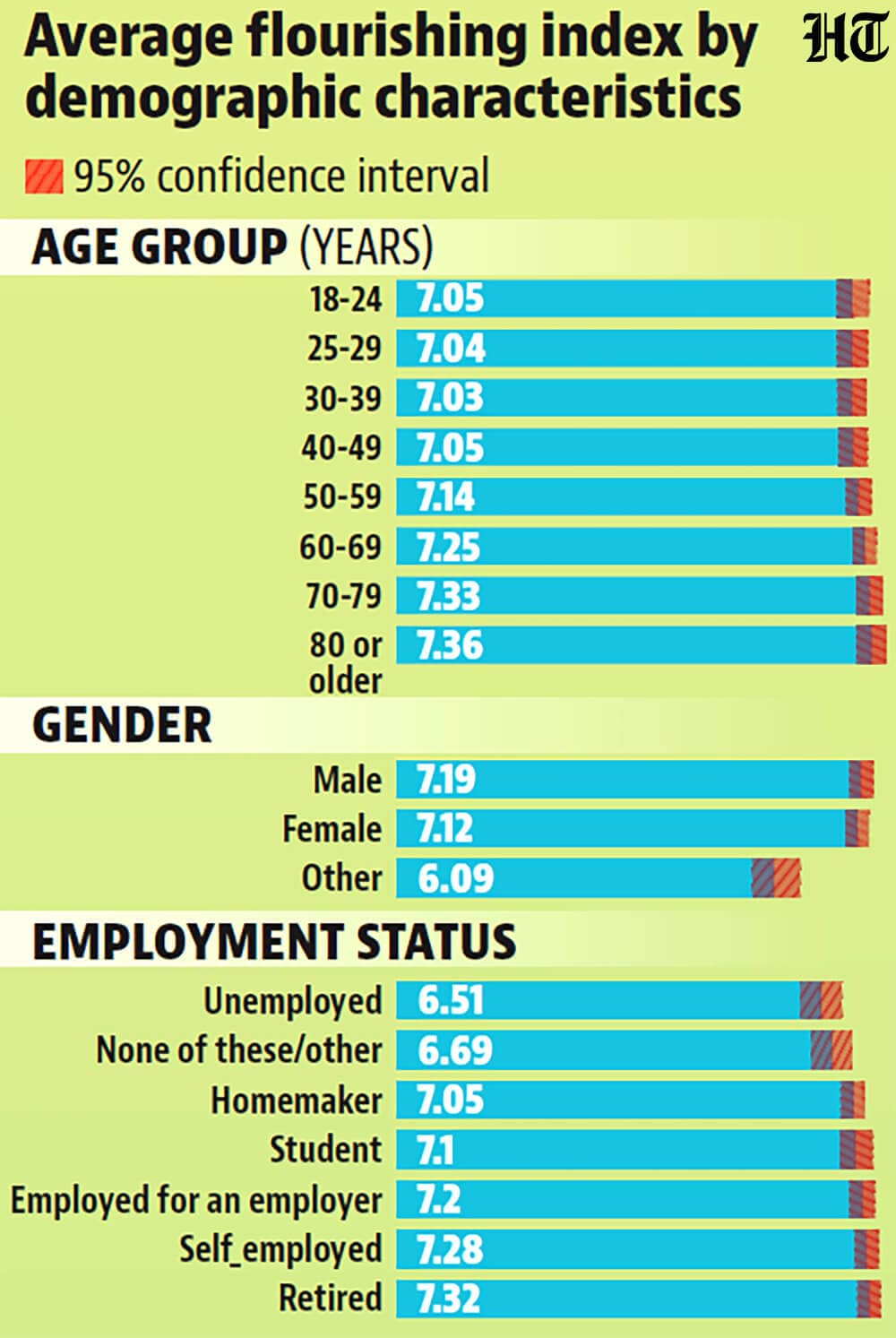
- Men, employed, educated, religious, older, and married people are generally flourishing more than othersThe paper also aggregated the index by different demographic characteristics. This shows that the index is relatively flat for age groups up to 40-49, but increases for every age group thereafter. To be sure, the error margins – shown in the shaded portion of the accompanying chart – suggest that the improvement in flourishing or well-being may not be significant for adjacent age groups. Similarly, while men are happier than women, the difference between them is not as significant as their difference with people who do not identify with either gender, whose well-being is significantly poorer. The same goes for married people, who are better off on average than people who either never married or are widowed, but significantly better only compared to divorced and separated people. Among other demographic factors, retired and employed people were better off than students, homemakers, and unemployed, a trend also suggested by education increasing the level of well-being. Being religious and not being an immigrant also contributed to higher levels of well-being.
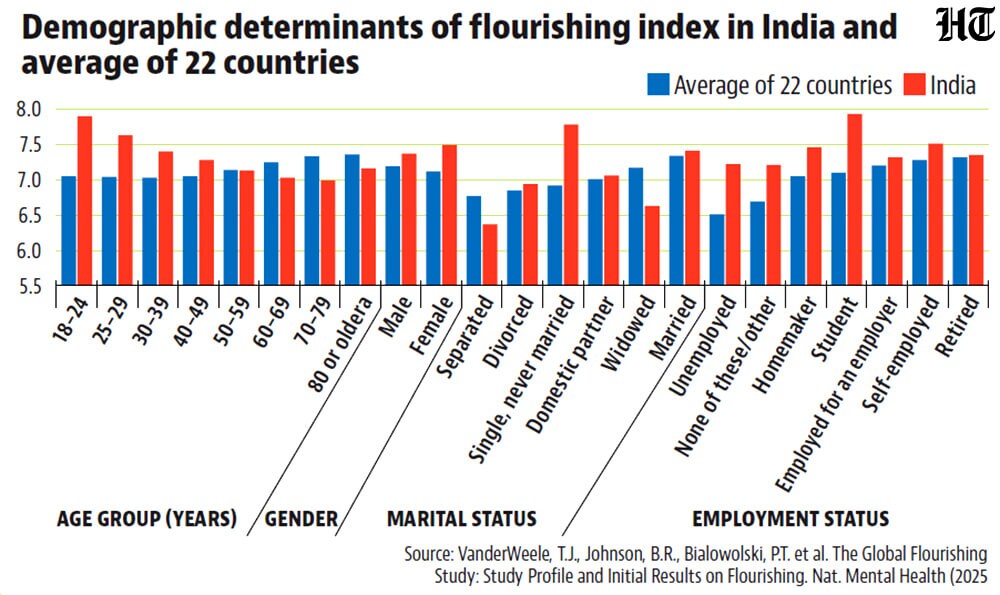
- Not all general determinants of flourishing apply to the Indian contextIdentifying local contexts of flourishing is another aim of the GFS. The importance of this can be understood from the demographic determinants of well-being in India, which differ from the average of 22 countries in some cases. For example, unlike the average, flourishing decreases in India with age, and the age premium of well-being only comes after one is 80 years of age, and it (the premium) is still not very significant. Similarly, unlike most countries, women flourish more than men in India. However, this may have to do with the fact that almost 60% of women in India do not participate in the labour force, discounting the possibility of unemployment. The unemployed flourish less than those in other kinds of employment status even in India. However, India is an outlier even in well-being’s correlation with employment status in one respect: students flourish more than the employed. Yet another aspect in which India is an outlier is marital status. People who have never been married flourish the most among different sections in India, unlike married people flourishing more elsewhere.