E-Paper



The Cauvery isn't just a water dispute — it's a river that runs through history, culture and livelihoods
How the Cauvery is a common link between Karnataka and Tamil Nadu's history, culture, politics and economic realities, which sometimes sets them apart.

 Prefer HTon Google


Every time Karnataka and Tamil Nadu argue over how much water flows south, they are fighting over more than irrigation schedules. The Cauvery has shaped cultures, empires and harvests for over a thousand years, and that history is what makes the modern dispute so combustible.
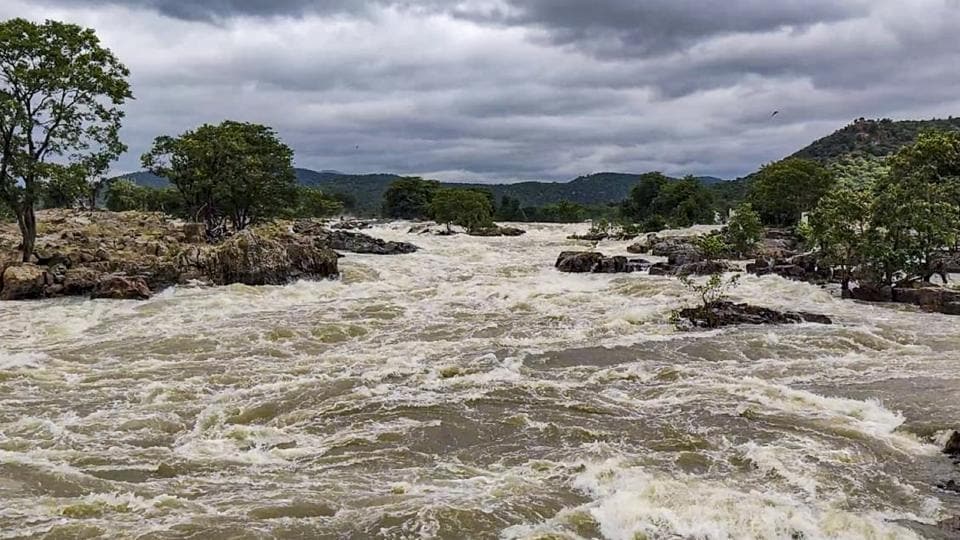
Where the river begins
The river is mentioned across religious texts, including the Puranas, which offer an origin myth: Lord Shiva filled sage Agastya's pot with water from the Kaveri, and Ganesha — in the form of a crow — tipped it over, sending the river across a drought-stricken land. The spot where this is said to have happened, Talakaveri in Karnataka's Kodagu (Coorg) district, takes its name from that story: "the head, or source, of Kaveri". Hindus regard the river as one of India's seven holy rivers, personify it as Goddess Kaveri, and know it in texts as "Ponni" — the golden one.
The river's course reads like a chronicle of the empires it passed through.
At Srirangapatna, it flows past the tombs of Hyder Ali, an 18th-century ruler of Mysore, and his son and successor Tipu Sultan, and past Adi Ranga, the first of three island temples dedicated to Ranganatha, a form of the Hindu god Vishnu, along its length.
At Sivasamudram, it drops 98 metres over a waterfall that became, in 1902, the site of Asia's first hydroelectric power station, close to a Someshwara temple linked to the philosopher Adi Shankara, the 8th-century founder of the Advaita Vedanta school of Hindu philosophy. Further downstream, The Hindu has reported, the river enters the old Chola heartland and encircles Srirangam, a key pilgrimage site for Srivaishnavites, followers of the Sri Vaishnavism tradition of Vishnu worship.
Devotional poets wrote the river into scriptures too. The Azhwar saints – Tamil poet-saints who composed hymns to Vishnu roughly between the 6th and 9th centuries – in the Naalayira Divya Prabandham, called the Kaveri holier even than the Ganga. And Krishnadeva Raya wrote it into his Telugu epic, Amukta Malyada.
Also Read | Why Karnataka-Tamil Nadu Cauvery dispute keeps recurring — a river that has changed, a framework that hasn't
The economics
Set against that history is a river key to livelihoods. Over three crore farmers across Karnataka and Tamil Nadu depend on the Cauvery, irrigating at least 40 lakh acres between the two states, according to Deccan Herald. The entire basin spans more than 14,000 villages, with roughly 9,000 in Karnataka and 5,000 in Tamil Nadu, according to the Cauvery River Basin Atlas.
A 2016 study presented at the Madras School of Economics, titled 'Game Theoretical Approach to Regulate the Public-Owned River Water Utilities: A case study of Cauvery River', said that 90–95% of the Cauvery's total flow goes towards irrigating a million hectares of farmland, with the rest feeding hydropower.
Much of that water goes towards a crop that delivers comparatively little for the volume it uses.
Rice, India's single largest consumer of irrigation water nationally, yields just 3.7 kg per hectare for every millimetre of water applied — well below sorghum (9 kg/ha), maize (8 kg/ha) and wheat (12.5 kg/ha).
![Salem [Tamil Nadu], Jul 06 (ANI): A view of Mettur Dam as its water storage has fallen has raised concerns over irrigation in the Cauvery Delta, with both Kuruvai and the upcoming Samba cultivation under threat, in Salem on Monday. (ANI Video Grab) (ANI Video Grab)](https://www.hindustantimes.com/ht-img/img/2026/08/13/original/ANI-20260706312-0_1786624780716.jpg "Salem [Tamil Nadu], Jul 06 (ANI): A view of Mettur Dam as its water storage has fallen has raised concerns over irrigation in the Cauvery Delta, with both Kuruvai and the upcoming Samba cultivation under threat, in Salem on Monday. (ANI Video Grab) (ANI Video Grab)")
Tamil Nadu's paddy-heavy cropping pattern compounds this inefficiency. Irrigation canals in the state supply water continuously across seasons rather than rotating supply, a practice the tribunal overseeing the dispute has said could be tightened by at least 5% through better management, according to the study.
Karnataka's cropping pattern looks different by comparison — ragi, jowar and pulses grown mostly under rain-fed or light-irrigation conditions, with rice and sugarcane confined largely to older irrigation projects, and sugarcane capped at 40,000 hectares under tribunal directives.
Also Read | Cauvery water row: SC to hear Tamil Nadu’s plea seeking Karnataka’s compliance on August 13
When water runs short, the paper 'The Cauvery Water Dispute: Political and Social Ramifications in Karnataka', by Dr Manu CN, traces a clear chain of consequences. Restricted releases cause crop losses for farmers growing water-intensive crops, which drags down agricultural output and, over time, hollows out rural economies, the 2018 paper in the International Journal For Innovative Engineering and Management Research (IJIEMR) said.
Labourers who can no longer find work on the land migrate to cities, straining urban centres even as it weakens the rural economic base they left behind.
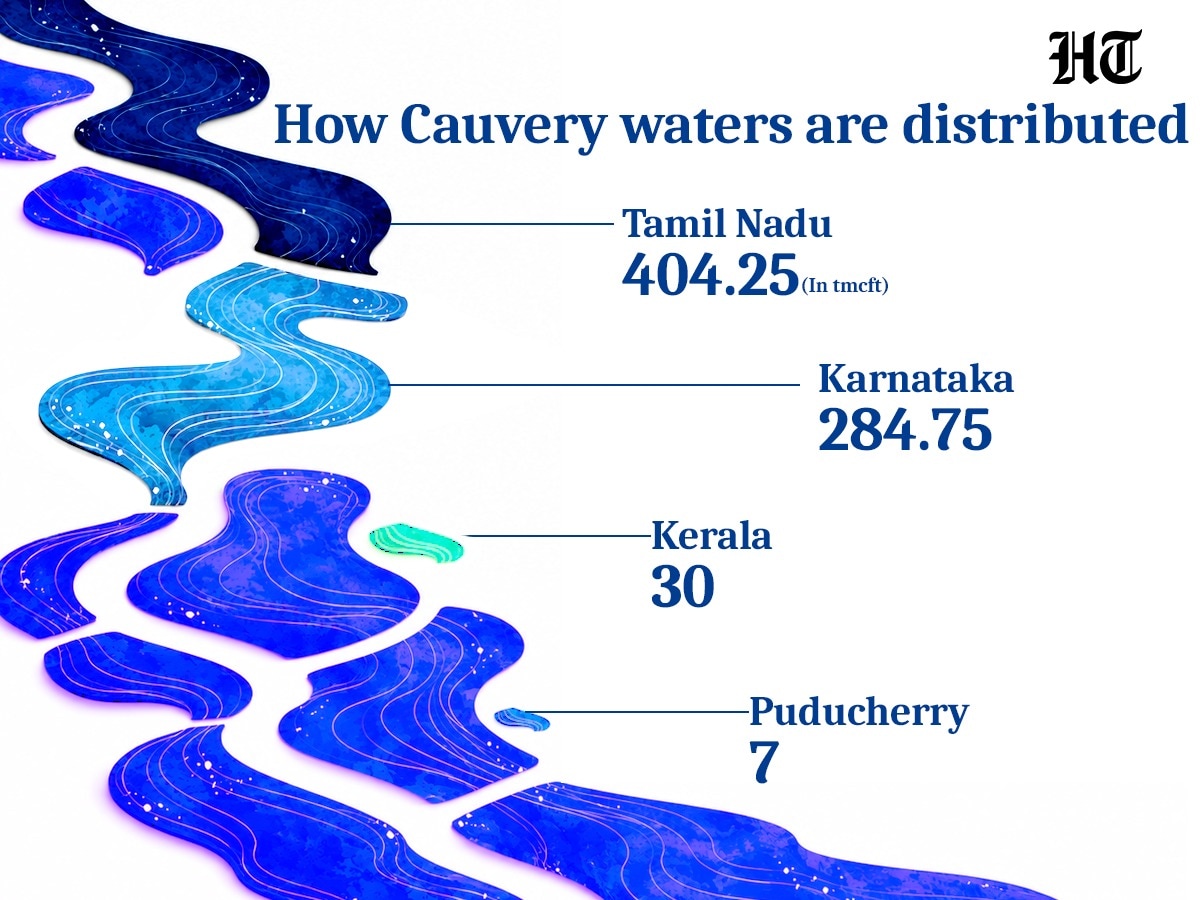
Dispute that spills into the streets
The social costs run alongside the economic ones. Dr Manu CN's research finds that repeated legal interventions and water shortages harden divisions between the populations of the two states rather than easing them.
Court orders directing one state to release water have, in the past, triggered street protests that turned violent, including attacks on residents from the other states and their businesses in some cases.
In 1991, a tribunal order directing Karnataka to share water with Tamil Nadu set off violence. In September 2016, after the Supreme Court ordered Karnataka to release water, riots in Bengaluru left one person dead and vehicles torched, with retaliatory attacks on Kannadigas and Karnataka-registered vehicles in Tamil Nadu.
Also Read | K’taka weighs Cauvery order amid water stress
On Thursday, Karnataka observed a bandh to protest against a Cauvery Water Management Authority order directing the state to release 12,000 cusecs of water a day to Tamil Nadu for 15 days. The bandh was largely peaceful.
Political and civic groups have also used the dispute to rally support around state identity, a dynamic that tends to hurt vulnerable and marginalised communities the most when water runs short.
The Cauvery Water Management Authority and the courts continue to weigh how allocations should work going forward, and their rulings will determine how the balance between farmers' needs and economic strain plays out in both states. Whichever way those directives go, the Cauvery will remain what it has been for centuries — a river carrying both scripture and irrigation schedules on the same current.