E-Paper



HT This Day: December 6, 1950 - Sri Aurobindo Ghosh passes
The Aurobindo Ashram and the entire town was in gloom on account of the passing away of the sage. He had been indifferent health keeping for the past fortnight, but the end was sudden and quite unexpected.

 Prefer HTon Google


SAGE OF PONDICHERRY
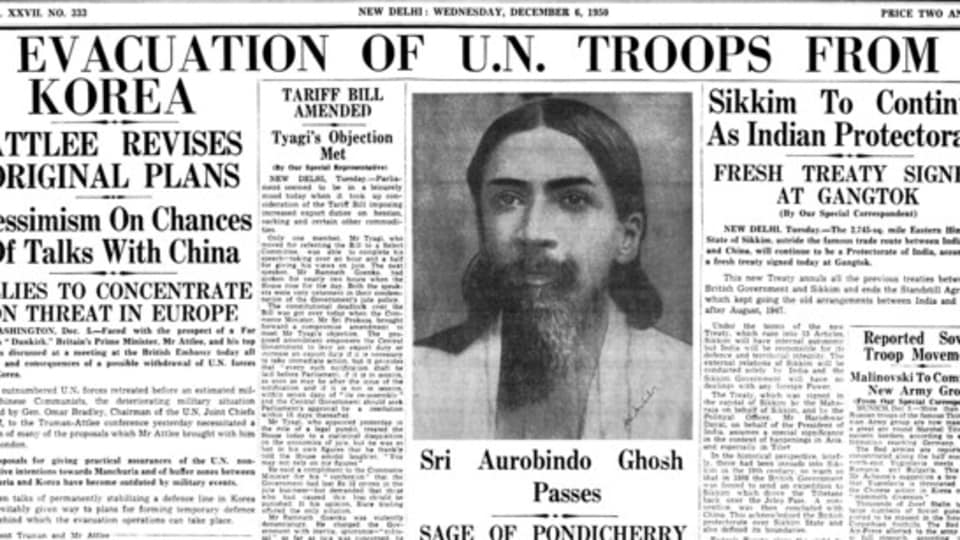
We regret to announce the death of Sri Aurobindo Ghosh. the Sage of Pondicherry, at 1-30 a.m. yesterday at Pondicherry. He was 78 years old.
The Aurobindo Ashram and the entire town was in gloom on account of the passing away of the sage. He had been indifferent health keeping for the past fortnight, but the end was sudden and quite unexpected.
Sri Aurobindo gave his last darshan to his disciples and devotees on November 24-the day he went in complete spiritual retirement.
Thousands of Pondicherry citizens, young and old, besides the ashramites have been standing in long queues in front of the Ashram to have the last darshan of the sage.
His body is lying in state on a cot in the same room in the first floor of the Ashram where he expired and where he had been in retirement since 1927.
All activities of the Ashram have been suspended for 12 days and educational institutions in Pondicherry were closed for the day in his memory.
Sri Aurobindo s body lay in state, and by 6 p.m. rnore than 60.000 people had filed past it in queues in absolute silence. A few attendants of Sri Aurobindo were squatting with their heads bent in the room where the body was lying in state.
A painting of Buddha from Ajanta adorned the eastern walls of the room which was strewn with flowers. The body of the sage was clad in white silk and was lying in a cushion covered with a spotless white sheet spread over a wooden cot. His serene appearance suggested more of one in sleep than in death. A remarkable feature was the peace and calm prevailing in the Ashram.
Among those who paid their homage to Sri Aurobindo today were India's Consul-General in Pondicherry, French India Ministers, French Indian officials and Aurobindo’s devotees from Madras and other parts of India.
An Ashram spokesman said that Aurobindr had an attack of uraemia. The funeral will take place on Wednesday. His body will be placed in a coffin at 12 noon and will be interred in the main courtyard of the Ashram at 5 p.m.
The Congress Working Committee at its meeting in Delhi yesterday adopted a condolence resolution on Sri Aurobindo’s death. The resolution described him as a pioneer in the struggle for India’s freedom and one of the greatest thinkers of the country.
WHO can write about a man whose life has been more a communion with God than with man? "No one," Sri Aurobindo once wrote to his devoted disciple, Dilip Kumar, "can write about my life because it has not been on the surface for man to see." And yet one must .gather together the little bits of information available about him, and read the heart-beats of the great spirit in them.
Parentage
In the district of Hooghly-that cradle of Indian renaissance, and the birthplace of Raja Ram Mohan Roy and Ramakrishna-was born, in a reputed Ghosh family of Konnager, Sri Krishnadhan, the father of Sri Aurobindo. While still a medico in Calcutta he married Swaralata of a noted Brahmo family. Krishnadhan went to England and returned an M.D., full of honours and plans for the future. A confirmed Westerner now, he wished India could transform herself overnight into another England. But "though perilously poised on the bleak slopes of agnosticism his innate humanity was as potent as ever." Refusing to perform penance for going abroad in contravention of the caste rules, he sold his property for a song and left Konnagar for good, moving from place to place as Government Civil Surgeon. Being, however, also a great admirer of Bankim, he was popular with Bengali society no less than with European.
Childhood
Aurobindo was born at about 5 a.m. in Calcutta on August 15. 1872. The completely Westernized Dr Krishnadhan sent five-year-old Aurobindo along with his two elder brothers to the Loretto Convent School at Darjeeling. Here in the shadow of the snow-capped Himalayas he was brought up. But for his two brothers, the rest of the students were all English. Aurobindo passed the brief period of his life here somewhat like a “careless beam." Two years later, the fond parents took Aurobindo and his two brothers to England and entrusted them to the Drewetts in Manchester, in order to keep them away from "oriental ways and ideas." The Drewetts grounded him well in Latin. In their garden he played cricket, though quite badly. In 1885, when the Drewetts left for Australia, Aurobindo was put to St. Paul s. London. The head-master impressed by the boy's intelligence and character, taught him Greek and then promoted him to a higher class in the school. Here he spent much of his time reading English poetry, French literature and European History.
In 1880, having acquired proficiency in the classics, he proceeded to King's College. Cambridge, with a Senior Classical Scholarship. Here he was able to win all the prizes in one year for Greek and Latin verse, and passed the first part of the Classical Tripos examination in first class. He, however, did not care to apply for the B.A. degree.
Aurobindo's early adventures in English verse had a Keatsian ring. The result, however, is '' invariably good verse and not seldom true poetry."
In 1890, he passed the I.C.S. examination, scoring record marks in Greek and Latin. But he asked himself: "Is service to be the be-all and end-all of my life?" It helped him to get himself disqualified for riding.
While at Cambridge, he made himself familiar with some other continental languages too. During the 14 years of his stay in England, he had been divorced from the culture of India. He, however, wanted a suitable job. James Cotton introduced him to the Maharaja of Baroda who drafted him into the Baroda State service. He left England with no regrets. Baroda was to be a stepping stone to the wider Indian scene. So he bade adieu to Europe and to her many-chamber culture and thought.
Home-Return
Before he arrived in India, the stout hearted Krishnadhan di ed of heart-failure on receiving wrong news of the ship-wreck of the steamer carrying Aurobindo home. The afflicted son proceeded to Baroda. He was appointed first in the Revenue and Stamps Department. Later, he became Vice-Principal of the Baroda College. Occasionally the Maharaja would send for him for writing for him important letters or for drafting his speeches. During the Maharaja’s Kashmir tour Aurobindo acted as his Private Secretary, though he was hardly an ideal servant for an Indian prince.
In the earlier years of his stay in Baroda, he was not attracted to Metaphysics. He found the disputes of dialectical ratiocination "too abstract, abstruse and inconclusive." Only such philosophical ideas as could be made dynamic for purposes of life, interested him. He was initiated in spirituality by the sayings and writings of Ramakrishna and Vivekananda. But he would not practise Yoga. While still in England, he had some spiritual experiences. In India their frequency and intensity grew. But still he did not take to Yoga. It seemed to him a retreat from life. After marriage with Mrinalini Dev, he seemed to have settled down to normal householder’s life. He read incessantly, he pondered over what he read, and he often spent the live-long hours writing poems and essays which bore the mark of future distinction.
His students (amongst them Mr K. M. Munshi) admired and loved him. All was not well with the younger generation. The state of affairs made him thoughtful-and sad. Reviewing the political situation in the country, he contributed a series of articles to Indu Prakash under the challenging caption. "New Lamps for Old." ....He felt that while our civilians were "badly educated hyena, devoid of culture, in instruction poor.......unmanly, uncultivated, unintelligent.' we as a nation were laying ' the foundations of social collapse like the British and of political incompetence like the French." Regretting that the Congress was swearing by false gods of British make, he declared: "The walls of Anglo-Indian Jericho stand yet without a breach and the dark spectacle of penury draws her robe over the land in greater volume and with an anger sweep.'......With a rare foresight and proper understanding of the Indian problem he felt it futile to appeal to the sense of justice of the British. For "our actual enemy is not any force exterior to ourselves, but our own crying weakness, our cowardice, our purblind sentimentalism." He would, therefore, appeal only to our reviving sense of manhood, to our own sincere fellow-feeling with the silent and suffering people of India.
All this was too much for the stalwarts of the der. Even the great ranade warned the proprietor of Indu Prakas against the possibility of prosecution for sedition. Aurooindo withdrew into his own solitary cell, and decided to come out only at a more opportune time
Light Through Yoga
Sri Aurobindo was fast re-Indianizing himself. He was already a convinced follower of the Sanatan Dbarm. On the occasion of his wedding he observed the age-old Vedic rites. Hi decided to seek Light through Yoga. With Teufelsdrockh he realised that "Thought without reverence is barren, perhaps po sonous "
He learnt Gujrati, Marathi, Bengali and Sanskrit. Sanskrit and Bengal literature simply thrilled him.
Of Macihusudan's poetry be wrote:
No human hands such notes ambrosial moved
Rather the god was voiceful in their birth
And of his hero Bankim, he wrote:
Thus moving in these iron times and drear
Barren of bliss and robbed of golden cheer
He sowed the desert with ruddy-hearted rose
The sweetest voice that ever spoke m prose
In The Haunts Of Muses
His Bengali and Sanskrit studies enabled him to revel in the raptures of Chandidas, Bhartrihari and Kalidas. His translations of the numerous works of these ancient Masters are "finished exercises in verse " and acquired a new name m the realm of English letters.
During years of political activity he wrote two deeply patriotic poems inspired by his growing philosophical preoccupations. ' Baji Probhu and (Word unreadable) are " historic in content but patriotic in tone, spirit and object.’
What is truly remarkable in all these ems of Sri Aurobindo is "their amazingly flawless metrical craftsmanship."
Pauses To Ponder
The question of how man should conduct himself on the "scaffold of life" agitated his mind. The spectacle of India, "drunk with the wine of Western civilization," and painfully writhing under the new dispensation, saddened his sweet soul. Strange aspirations shook his being. He must spend the greater part of his earnings on Dharmakarya. He must see God. Mother India which mental, moral and spiritual force-Brahma Teja.
Curzon in 1905 provided hint the occasion. He took indefinite leave and left for Calcutta to help the students who had boycotted Government educational institutions. The Bengal leaders founded the Bengal National College. On just one-fifth of the salary he was drawing at Baroda, he became the Principal of the College.
With Bankim and Tagore shining resplendent in the firmament, a new vision of rejuvenated India captivated the hearts of young and old alike. Anonymously, Aurobindo began to contribute to Bande Mataram, which soon became the spearhead of the nationalist movement in Bengal. "From the tutor of a few youths" he became "the teacher of a whole nation." He breathed "into the sinister spectre of anarchy, the vitalizing influence of religion," wrote the Earl of Ronaldshay. The Bande Matarom rocked Bengal. There was an outcry against it. He received information of a warrant of arrest against him. He surrendered himself to the police, but the Government dared not try him for sedition. Even the charge of violating the copyright of some paper failed. And the crestfallen Government, to cover up its defeat, sentenced a poor, illiterate printer to jail.
Meanwhile, the puzzle had been solved. The nation soon learned about the authorship of the articles that had roused it so much. Even while he was on trial, distant Punjab and Maharashtra bowed their heads in reverence to " the great Redeemer."
Through Alipore Crucible
When in a stray bomb-throwing incident in Alipore an English lady was injured, the Government, which had been lying in wait for suitable opportunity, pounced upon Aurobindo as the moving spirit of the whole terrorist Bengal. Though the outrage was denounced in the Bande Materam as having " no sanction in our ancient tradition and culture......," he was charged with having waged war against the King. A whole nation stirred itself to defend him. It was then that the poet-patriot Das came forward to toil and sweat to save " the poet of patriotism, the prophet of nationalism and the lover of humanity " He predicted to the judge: " Long after he is dead and gone, his words will be echoed and re-echoed, not only in India, but across distant seas and lands......."
For full one year the Alipore case dragged on. In jail Aurobindo experienced a spiritual rapture. In that solitary cell, 45 square feet wide, he sensed " the splendours of the Infinite." and learned to lose himself in the " vasts of God." In jail came the light. He said, ' World-existence is the ecstatic dance of Shiva which multiplies the body of the God numberlessly to the view." He now baffled "the Everlasting No and affirmed the Everlasting Yes" he had ceased to be a " traveller between life and death." and become instead "a Pilgrim of Eternity."
Keeps The Torch Burning
Though he was acquitted the repressive policy of the government continued in full blast. And Aurobindo reflected “That policy did not work out brilliantly in Russia and did to: save Russia from a Durna, the very thing that the Trepoffs and the rest of the ‘offs’ deprecated and detested." In his view " Repression is nothing but the hammer of God that is beating us into shape so that we any be moulded in to a mighty nation and an Instrument of His Work in the world., ..Without suffering there can be no growth ' And he asserted: - Our object, our claim is that we shall not perish as a nation but live as a nation. Are authority that goes against this object will be broken into pieces ."
A new awakening came to him. He felt that mere politics need no longer hold him from the pursuits of the spirit. And so be penned his " Open better to My Countrymen." This he characterized as his "last will and testament to his countrymen." The wave of terrorism was fast rising. He suspended his political activities. The country was not yet ripe for struggle. For the vital fountains of its life was dried up. The country must therefore wait for the man who is to come to move forward triumphantly.
The Ascent Into The Empyrean
Quietly he went to Chandernagore and as that was too near Calcutta, he later moved to Pondicherry. Where he sat became a temple and soon he found an ashram grow around him.
The unimaginative and unchaivalrous government charged him with sedition on the ground of the the objectionable nature of his 'Open Letter" penned eight months earlier. The High Court, however, held that it was not seditious. Unmoved through all this storm he lived here the even tenor of the sadhak's life
' The Arya"
The Ashrama started the Arya, an English journal under the able and devout management of the “mother” and Paul Richard to make a systematic study of the highest problems of life and form a vast synthesis of knowledge. The journal w-as named "Arya " not out of a sense of superiority of his own race but because “Arya means an effort or an uprising. The Arya is he who strives.... Self-perfection is the aim of his self conquest. " And the completed Arya.
" Although consenting here to a mortal body
He is the undying; limit and bond he knows not;
For him the aeons are a playground.
Life and its deeds are his splendid shadows."
It was in The Arya that the most significant works of Aurobindo appeared serially-" A Defence of Indian Culture," " The Renaissance in India," " Isha Opanshid," " The Secret of the Vedas," " Essays on Gita," " The Life Divine," " The Synthesis of Yoga." and "'the Psychology of Social Development,"
When C. R Das invited him back to politics. Aurobindo said:
" Man can never get out of the futile circle the race is always treading, until he has raised himself on to a new foundation.. . . . The true basis of work and life is the spiritual. I am determined not to work in the external world till I have the sure and complete possession of this new power of action not to build except on a perfect foundation....I may also say that I did not leave polities because li felt I could not do anything any more there. Such an idea was very far from me. I came away because I got a very I distinct adesh in the matter. I have cut connection entirely with politis.” To those who regretted his loss to politics he answered:
“as imperative and take precedence over all other claims, intellectual, ethical, social that belong to the domain of ignorance....Nothing can be sufficient substitute for the spiritual change that can realize the true and integral good because through the spirit we come to the root of action and existence."
In a similar vein he wrote to Romain Rolland:
“India possesses in her past, a little rusty and out of use, the key to the progress of humanity. It is to this that I am turning my energies, rather than towards mediocre politics. I believe in the necessity of Tapasya, in silence for education and self-knowledge and for unloosing of spiritual energies."
The Rishi
Sri Aurobindo travelled far afield indeed, but only along the same road, and always towards the same goal. The urge towards self-revelation and self-fulfilment had taken him progressively from literature to nationalism, dharma and spiritual self-evolution.
Rightly did Romain Rolland describe him as “ the completest synthesis that has been realized to this day of the genius of Asia and the genius of Europe."
Rabindranath Tagore's testimony ran thus:
" At the very first sight I could realize that he had been seeking for the soul and had gained it, and through this long process of realization had accumulated within him a silent power of inspiration....I felt that the utterance of the ancient Hindu Rishi spoke from him of that equanimity which gives the human soul its freedom of entrance into the All."
GOVT. OFFICES CLOSED
The West Bengal Government in a Press note has expressed its deep regret at the sad news -af the passing away of Sri Aurobindo and as a mark of respect to the memory of the departed saint all institutions under the Government of West Bengal remained closed yesterday. This has the concurrence of the High Court.