
 E-Paper



Issues such as Gyanvapi to be settled as per Constitution, says Nadda
In the BJP’s first official statement on the issue, Nadda said they will follow court orders in letter and spirit

 Prefer HTon Google


NEW DELHI: Bharatiya Janata Party (BJP) chief Jagat Prakash Nadda has said issues such as the Kashi Vishwanath Temple-Gyanvapi Masjid dispute will be settled in accordance with the Constitution and court orders in the party’s first official statement on the issue as a Varanasi court is hearing a plea seeking unhindered rights to Hindu worship in the mosque complex. He said they will follow the court orders in letter and spirit.
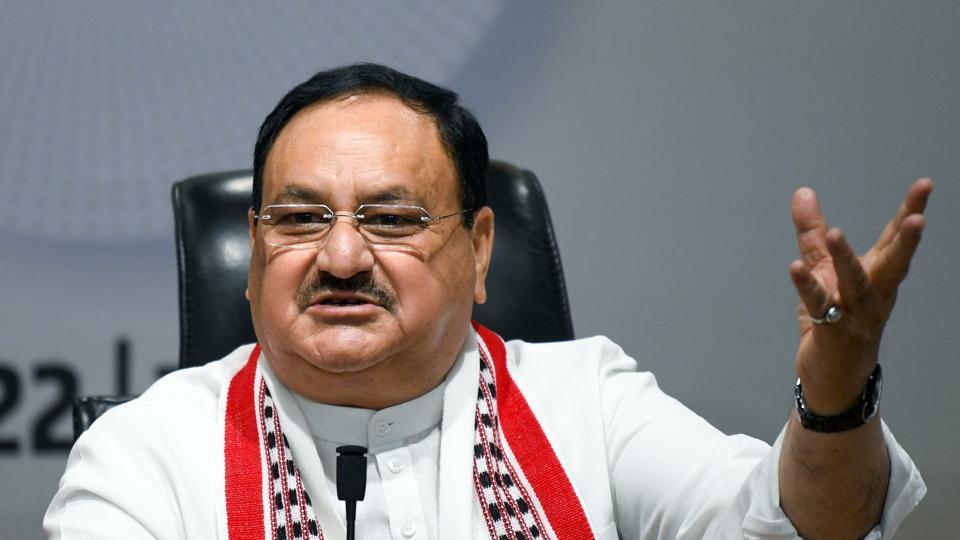
“We have always been talking about cultural development. But these issues are dealt with in accordance with the Constitution and the ruling of courts. So, the court and Constitution will decide on it...,” Nadda said on Monday.
Nadda said that the Ram Janmabhoomi-Babri Masjid issue was part of the resolution passed at the party’s national executive in Palampur in 1989. “[...] after that, there has been no resolution,” he said in response to questions about whether reclaiming temples at Varanasi and Mathura was on the BJP’s agenda.
BJP leader L K Advani led a campaign for the construction of a temple following the Palampur resolution in place of the Babri Masjid in Ayodhya, which was demolished in 1992. In 2019, the Supreme Court paved the way for the construction of the temple at the site after a protracted legal battle.
Nadda’s comments on the eve of the eighth anniversary of the BJP-led government at the Centre came even as a section of BJP leaders have supported the call from reclaiming the Gyanvapi Mosque in Varanasi and building a grand Krishna Temple at Mathura’s Shahi Eidgah.
Five Hindu women have filed the plea seeking the right to worship idols in the Gyanvapi Masjid complex. Lawyers for the mosque committee on Monday told a district judge the plea is not maintainable because it violates the Places of Worship (Special Provisions) Act, 1991. Judge AK Vishvesha posted the matter for further hearing on July 4.
Lawyers for the committee argued the women filed the case in their individual capacity and their view did not represent that of the entire Hindu community. The case, therefore, was not maintainable, they argued.
The plea prompted a local court in April to order a survey of the premises. The court later ordered protection for the site, where Hindu petitioners claimed a shivling was found during the exercise. The Supreme Court refrained from interfering with the survey but transferred the suit from the Varanasi civil judge to the district judge for deciding the committee’s objections against the inquiry.
The Muslim side has maintained a fountain has been mistaken for shivling. It has objected to the plea saying the 1991 law, which locks the position, or “religious identity” of any place of worship as it existed on August 15, 1947, bars it.
Similar pleas are pending in Mathura claiming the Shahi Eidgah mosque was built after partially demolishing the Krishna Temple. They have sought the return of the site to the Hindus.
Nadda also sought to dispel the perception that the BJP is fostering majoritarian sentiments, which have alienated minorities, especially in states the party rules. He insisted they believe in inclusive governance. “… When we work politically, it is our endeavour to take everyone along. There are many types of people in a society. Some respond earlier, some later, some after decades and some respond after much time has passed. It depends on them. But our conduct is on the principle of a strong nation, one nation. This is clear and everyone will have an equal share,” he said.
In response to a question on the implementation of a uniform civil code, which has been part of the BJP’s manifesto for decades, Nadda said some state governments are considering the issue. He added the Uttarakhand government has formed a committee to examine the possibility. Nadda underlined the BJP follows the principle of justice to all.
“… we have been saying that everyone must be treated equally. Our broad outline is justice to all, appeasement of none. This is our basic principle. We are working in accordance with it,” Nadda said.
Nadda credited Prime Minister Narendra Modi for changing the country’s political culture. “Today we see a responsible, proactive, and pro-responsive government. We see a government that is determined to serve everyone,” he said.
Nadda lashed out at the previous governments and said there was a culture of drafting and implementing schemes on paper. He added now under Modi’s supervision, last-mile delivery of schemes is ensured.
“Today, it is clear Modi hai to mumkin hai [it is possible because of Modi], and this is what the ordinary man says,” he said. He added the policy of appeasement, dynastic politics, and casteism have been confronted and challenged. “Policies are all-inclusive and especially to empower the poor and the marginalised and the women.”
Nadda called good governance, service, and welfare of the poor the hallmarks of the Modi government.


