
 E-Paper



Karnataka SIR: ECI withdraws discrepancy notice issued to Padma Awardee Hajabba
The Election Commission of India withdrew a notice to Padma Shri awardee Harekala Hajabba over name discrepancies, promising further examination.

 Prefer HTon Google


The Election Commission of India (ECI) has withdrawn a notice issued to Padma Shri awardee Harekala Hajabba regarding a discrepancy in his name found during the Special Intensive Revision (SIR) of the electoral roll in Karnataka.
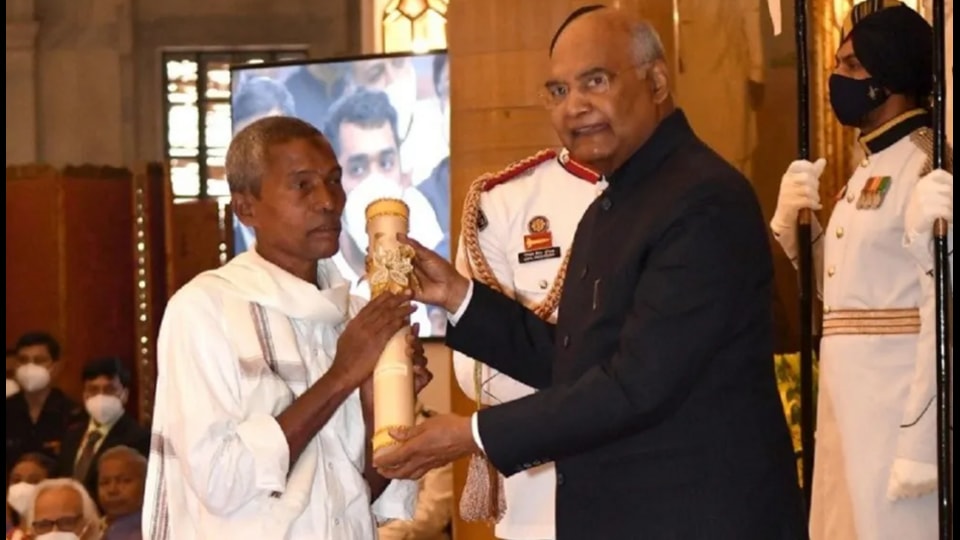
Hajabba was asked to appear at a gram panchayat on September 11 with original documents, and an accountant was to be present during the verification. His name in the 2002 electoral roll and subsequent records differed from the full name he provided during the SIR enumeration.
Hajabba said officials visited his residence after the notice became public and took it back, telling him they would examine the matter and get back to him. “I do not know what they will do next,” Hajabba said. He said he was confident that the issue would be resolved, pointing out that his documents since 2004 have carried his name as Harekal Hajabba.
The discrepancy arose because his name appeared as only Hajabba in the 2002 electoral roll, while his subsequent records identify him as Harekala Hajabba. His Aadhaar card, ration card, passport, and voter ID carry the name Harekala Hajabba. The same name also appears in documents relating to his Padma Shri and other awards.
Hajabba, a fruit seller turned education campaigner from Newpadapu in Mangaluru, became nationally known after using savings from selling oranges to establish a primary school in his native village. He received the Padma Shri, India’s fourth-highest civilian award, in 2020 for his contribution to education.
Over 4.381 million notices are expected to be issued as part of the SIR, which began in Karnataka on June 30, to voters whose names fall under the “no mapping” and “anomalies” categories. The disposal of claims and objections will continue until October 22. The final electoral roll is scheduled for publication on October 27.
In May, the ECI announced Phase 3 of SIR in Andhra Pradesh, Arunachal Pradesh, Chandigarh, Dadra and Nagar Haveli and Daman and Diu, Haryana, Jharkhand, Karnataka, Maharashtra, Manipur, Meghalaya, Mizoram, Nagaland, Delhi, Odisha, Punjab, Sikkim, Tripura, Telangana, and Uttarakhand.
Once the third phase is completed, the entire country except Himachal Pradesh, Jammu and Kashmir, and Ladakh will be covered. Around 400,000 Booth Level Officers were assigned to go house-to-house to 367.3 million electors ahead of the publication of draft electoral rolls from July 5 to October 21.
The first two phases of the SIR covered 13 states and Union Territories, and nearly 590 million electors. The latest SIR, an electoral roll cleansing drive, started with Bihar in June last year to remove bogus, duplicate, and ineligible voters, including deceased individuals and “illegal immigrants”.
The SIR sparked criticism from the Opposition, which alleged that the exercise is a strategic voter roll clean-up drive by the poll body to benefit the Bharatiya Janata Party (BJP).
The SIR in West Bengal was one of the most contentious in recent years. On April 10, the ECI announced the deletion of nearly nine million from the electoral roll. Out of these, around 2.7 million deletions fell under the “logical discrepancy” category.
The difference in absolute votes between the BJP, which swept to power in West Bengal for the first time, and the Trinamool Congress was similar to the total SIR deletions.


