
 E-Paper



Pay share for RRTS corridor to Alwar, Panipat in 7 days: Supreme Court to Delhi
Delhi has to pay a total of ₹6,119 crore over six years for the RRTS corridors to three districts in Uttar Pradesh, Haryana and Rajasthan.


NEW DELHI: The Supreme Court on Wednesday ordered the Delhi government to pay its share for the two corridors connecting Delhi to Alwar and Panipat under the Regional Rapid Transit System (RRTS), warning that it could revive a previous order to deduct the money from its advertisement budget in case of default.
The top court’s direction came on an application by the National Capital Regional Transport Corporation Ltd (NCRTC), the agency constructing the corridors, which complained about Delhi delaying payment of its share of ₹100 crore for the Delhi-Alwar corridor and ₹50 crore for the Delhi-Panipat corridor for 2023-24.
Delhi has to pay a total of ₹6,119 crore over six years for the corridors to three districts in Uttar Pradesh, Haryana and Rajasthan.
“You can’t get away like this. This is not fair. It seems you will make us reactivate our earlier order,” a bench of justices Sanjay Kishan Kaul and Sudhanshu Dhulia said, referring to its November 21 order that permitted deduction of the money from the state’s advertisement budget if the city government didn’t pay ₹415 crore for the corridor to Meerut.
Senior advocate ANS Nadkarni appearing for NCRTC said Delhi paid for Meerut after the order but not the other two corridors. Nadkarni underlined that the other states of Uttar Pradesh, Haryana and Rajasthan have contributed their share.
Senior advocate S Muralidhar, who appeared for the Delhi government, said there was a budgetary allocation for ₹150 crore but the payment will made after the central government clears the two projects.
Attorney general R Venkataramani, who appeared for the Union government, said the detailed project reports submitted by NCRTC were under consideration and the project would be approved soon.
The bench turned to the Delhi government. “You cannot make new excuses every time. Why will you not pay when other states can pay...Don’t make us reactivate our earlier order (of November 21),” the bench said, giving Delhi seven days to make the payment.
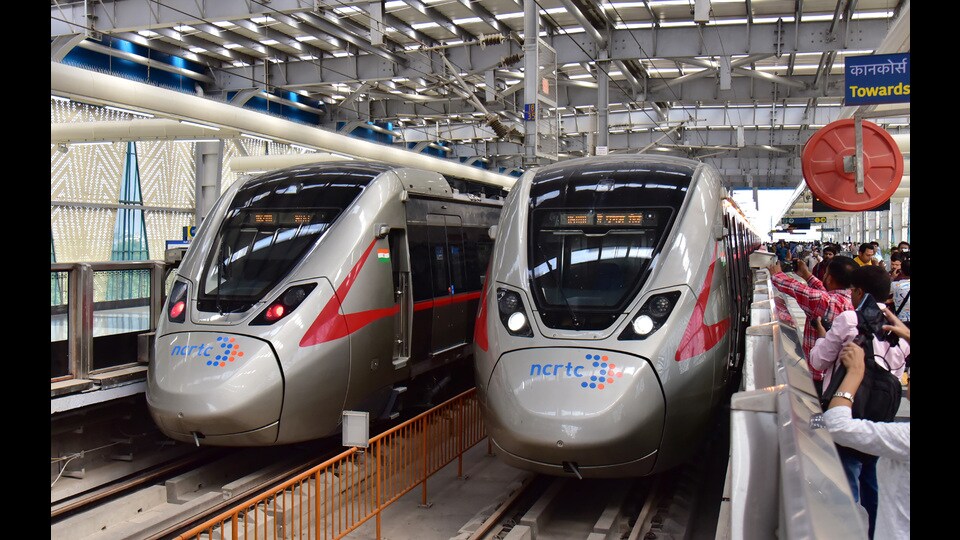
A section of the Delhi-Meerut corridor of RRTS was inaugurated on October 20 by Prime Minister Narendra Modi. It is currently running on a 17-kilometre stretch from Sahibabad to Duhai in Ghaziabad. The operational priority section of the Namo Bharat Rapidx trains have five stations at Sahibabad, Ghaziabad, Guldhar, Duhai and Duhai Depot. The entire 82-km corridor from Sarai Kale Khan in Delhi to Meerut is targeted to be operational by June 2025 with four stations in Delhi.
Senior advocate Aparajita Singh, who is the amicus curiae in the case, said every state linked with the project was supposed to pay but only Delhi dragged its feet.
On two occasions in the past, the Supreme Court allowed the Delhi government to pay Rs. 265 crores and Rs. 500 Crores towards the project out of the Environmental Compensation Charge (ECC) funds. This fund was collected as a green cess from commercial vehicles entering Delhi.
After the Delhi government sought to reason that it did not have money to pay for RRTS, the court on July 24 remarked: “If ₹1100 crore can be used for advertisement in the last three financial years, certainly money can be paid for the infrastructure project,” while directing the amount to be paid in two months.
The remaining two phases of Delhi-Alwar and Delhi-Panipat will require the Delhi government to pay ₹2,443 crore and ₹3,261 till 2028.


