
 E-Paper



An erosion of Indian democracy will be a disaster for US: Rahul
Congress leader Rahul Gandhi has argued that Indian democracy is a global public good and that its erosion would be a "disaster" for American national security. Speaking at a dinner hosted by diaspora member Frank Islam, Gandhi told attendees that the bedrock of an alternative vision to China?s production-based strategy had to be democracy. His comments come ahead of a visit to Washington DC by Prime Minister Narendra Modi and amid accusations from the ruling Bharatiya Janata Party that Gandhi is defaming India on foreign soil.

 Prefer HTon Google


Even as he emphasised that the battle for Indian democracy is an internal one to be waged by Indians, Congress leader Rahul Gandhi has said that Indian democracy is a global public good and that its erosion will be a “disaster” for American national security.
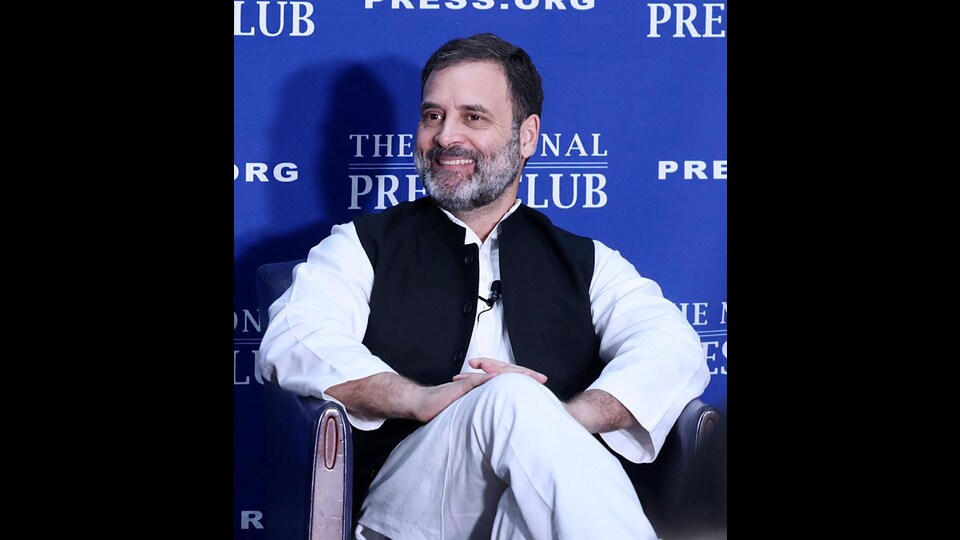
Speaking at a private dinner hosted by prominent diaspora Frank Islam on Thursday night, in response to a question on his message for American policymakers who believe that Prime Minister Narendra Modi is good for US national security interests as a counterpoint to China and for enabling US investments, Gandhi said, “Indian democracy is a global public good. If you remove India from the democratic equation, there is a tremendous decline in the number of democracies and the amount of people who are living in a democratic space.”
Gandhi said the bedrock of an alternative vision to China’s vision of production has to be democracy. “I personally don’t think that the erosion of democracy is beneficial for the national security of the United States. It is a disaster for the national security of the United States.” He said his messaging during the visit was two-fold, first to Indians who lived in the US and the second to American people who shared democratic values. “As they are important to you, they are important to us.”
Gandhi’s remarks on US national security come two weeks before PM Modi is scheduled to arrive in Washington DC for a major state visit, a sign of the deepening US-India relationship. The Congress leader was however careful not to offer specific advice to Washington when asked about it, and said, “Who am I to advise Washington on what they want to do? It is their choice. They have to decide about these things. It is pretty clear from our perspective there are certain values we protect and we are serious about protecting them.”
The Bharatiya Janata Party criticised Gandhi for his statements and accused him of defaming the country on foreign soil.
In a tweet, Union minister Dharmendra Pradhan said, “Rahul Gandhi and Congress should clarify whether their fight is with BJP or India? If it’s against the BJP, then fight a lot using forums present within the country, but stop insulting the country again and again outside the country. Rahul Gandhi should apologise to the nation for his statements.”
On Thursday, Gandhi spoke at a closed-door event at the Hudson Institute, addressed the press at the National Press Club, and met prominent American and Indian diaspora figures at Islam’s dinner in the Washington DC area. Senator Chris Van Hollen of Maryland attended the dinner, where he warned against India deviating from the path of Mahatma Gandhi and Jawaharlal Nehru, and said, “As a US senator, I am not taking the side of any candidate or party in India. That’s for the people of India. But the US needs to be on the side of democracy, rule of law, religious freedom and freedom of press and expression.”
Gandhi’s remarks at the events revolved around a description of challenges to Indian democracy and pluralism, his experience of the Bharat Jodo Yatra, and an optimistic assessment about the 2024 general elections since, he claimed, there was a “hidden undercurrent” of anger and anxiety against the government on economic issues. Gandhi said that his disqualification from Parliament was a “gift” that allowed him to redefine himself, claimed that opposition parties were in close dialogue about possible unity for the 2024 elections, it required give and take, and acknowledged that the Congress needed to show more “flexibility”. He also advocated broadening the India-US relationship from a “two lane highway” to a “15-20 lane highway” with a focus on production and manufacturing.
Gandhi said that the battle in India was between two visions, one which was “inclusive, compassionate, gentle, decentralised” and the other which was “aggressive, insecure, violent and hateful”. Saying that BJP generated hatred and polarised society, Gandhi claimed, “in India, pretty much all our avenues of conversation are shut. Instruments that normally support healthy democracy don’t exist. I am not proud to say this but it is a fact.”
Gandhi claimed that the media exaggerated Modi’s strengths and prospects of victory, but democratic values in India were deep rooted and Modi was “vulnerable” due to issues such as unemployment and price rise. “60% of India doesn’t vote for BJP or Modi. Remember that. The BJP has the instruments of noise in their hand. They can distort and yell. But they don’t have a majority of people in their hands. In the next three-four assembly elections, we will decimate them.”
Rejecting a comparison with Turkey, where Recep Erdogan has just won, Gandhi said that the two countries had different systems, parties, and ways of fighting elections. But responding to a question on electronic voting machines (EVMs), Gandhi suggested that it was a real issue but the Election Commission hadn’t shown an inclination to engage with the opposition on it.
Responding to questions about the future of Muslims in India, Gandhi emphasised at his interactions that while minorities were “certainly” being attacked, it was a part of a wider attack on poor and oppressed communities. But when asked about why his party, which claimed to be secular, was in alliance with the Muslim League in Kerala, Gandhi said, “The Muslim League is a completely secular party”.


