
 E-Paper



Tamil Nadu air quality poor after Diwali: Board
The Air Quality Index (AQI) for 12 hours observed from 6am on 24 October to 6 in the morning on 25 October found that the average value in Chennai ranged between 345 to 786 and the Air quality status was very poor. However, CPCB data for Chennai issued at 4pm showed that the AQI stood at 228.


Tamil Nadu Air Quality and Noise Level values observed on Diwali on October 24 have been found to be poor, an examination by the state pollution control board has found.
The noise levels were found to be are higher than the National Ambient Noise Standards which is 55.0 dB(A) during day time and 65.0dB(A) during night time,
The Air Quality Index (AQI) for 12 hours observed from 6am on 24 October to 6 in the morning on 25 October found that the average value in Chennai ranged between 345 to 786 and the Air quality status was very poor. However, CPCB data for Chennai issued at 4pm showed that the AQI stood at 228.
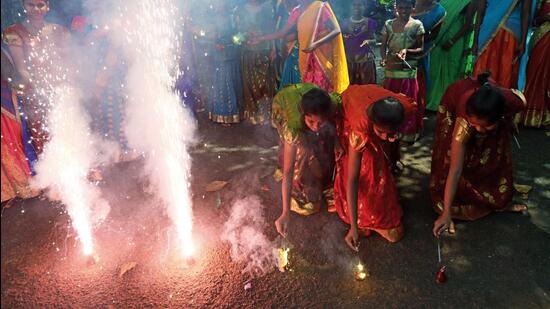
“This is due to a large number of people indulging in very active bursting of firecrackers (mainly night crackers and sky shots) and high relative humidity and low wind speed,” read a statement from the Tamil Nadu Pollution Control Board. “The climatic condition is not conducive for the effective dispersion of the smoke emanated from the bursting of crackers. This contributes to high value AQI on Deepavali day.”
The examination was based on the directions of the Supreme Court to carry out short-term monitoring for 14 days (commencing from 7 days prior to Diwali and ending 7 days after) for the parameters namely aluminium, barium and others.
Tamil Nadu’s Pollution Control Board conducted manual monitoring in seven different locations in Chennai which are in Besant Nagar, T Nagar, Nungambakkam, Triplicane, Sowcarpet, Valasaravakkam and Tiruvottiyur to monitor the impact of the Diwali celebrations by bursting of crackers for the Ambient Air Quality and also Noise pollution levels.
Tamil Nadu air quality and noise level values observed on Diwali were poor, an examination by the state pollution control board found on Tuesday.
The noise levels were found to be higher than the National Ambient Noise Standards, which are 55.0 dB(A) during daytime and 65.0dB(A) during nighttime,
The Air Quality Index (AQI) for 12 hours observed from 6 am on 24 October to 6 in the morning on 25 October found that the average value in Chennai ranged between 345 to 786, and the Air quality status was very poor. However, CPCB data for Chennai issued at 4 pm showed that the AQI stood at 228.
“This is due to a large number of people indulging in very active bursting of firecrackers (mainly night crackers and sky shots) and high relative humidity and low wind speed,” read a statement from the Tamil Nadu Pollution Control Board. “The climatic condition is not conducive for the effective dispersion of the smoke emanating from the bursting of crackers. This contributes to high-value AQI on Deepavali day.”
The examination was based on the directions of the Supreme Court to carry out short-term monitoring for 14 days (commencing from 7 days before Diwali and ending 7 days after) for the parameters namely aluminium, barium and others.
Tamil Nadu’s Pollution Control Board conducted manual monitoring in seven different locations in Chennai which are in Besant Nagar, T Nagar, Nungambakkam, Triplicane, Sowcarpet, Valasaravakkam and Tiruvottiyur to monitor the impact of the Diwali celebrations by bursting of crackers for the Ambient Air Quality and also Noise pollution levels.


