E-Paper



4 hatchlings of endangered bird washed away in Bijnor
Six Indian Skimmer eggs laid on the same sandbar — a partially exposed ridge of sand in a water body —were washed away earlier this month after supply into the barrage was turned up.

 Prefer HTon Google


Four Indian Skimmer hatchlings, born on a sand patch in a barrage in Uttar Pradesh’s Bijnor, have been washed away over the past couple of days, after an increased discharge of water into the dam, said conservationists who were observing the endangered bird.
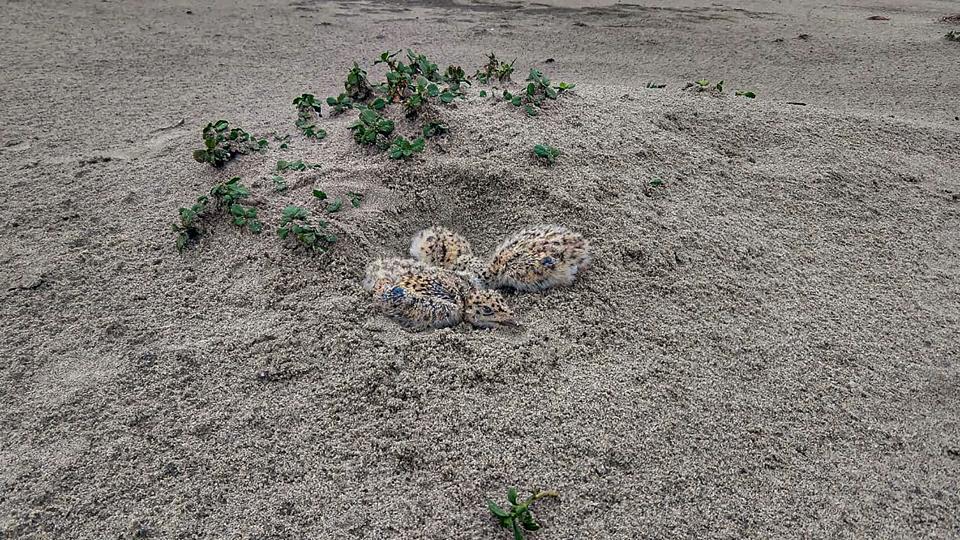
Six Indian Skimmer eggs laid on the same sandbar — a partially exposed ridge of sand in a water body —were washed away earlier this month after supply into the barrage was turned up.
The hatchlings would have taken flight in just around 10 days, said the conservationists, adding that the birds could have been saved had authorities cut off the flow of water into the barrage and held it at the upstream Haiderpur wetland.
“We observed that the irrigation department discharged more water than it usually does. This submerged the sandbar completely,” said Ashish Loya, who leads the nest guardian project at Wildlife Trust of India.
“They should have accumulated water in the Haiderpur wetland upstream. There were only 10 days left for the hatchlings to fly. But because of heavy rain, the river has swollen and there was discharge of more water,” he added.
This is the third time the rare bird’s hatchlings or eggs have been washed away from the barrage in two months. A current swept away 20 eggs in May, said conservationists.
Experts implored authorities to coordinate with experts to ensure the safety of rare birds in such situations.
“The Indian Skimmer normally nests around April and May. In May, they nested and laid 20 eggs, but all of them were washed away because of the increase in water level. From next year we should coordinate effectively and the Irrigation department should respond in time so that this critical habitat for Indian Skimmer can be retained,” Loya said.
Asad Rahmani, former director of BNHS and veteran ornithologist, said that improved preparation was vital to prevent such incidents.
“It may not be feasible to control the flow of water every time. But we can sensitise them to help the birds whenever possible. Indian Skimmers need sand bars surrounded by deep waters. That also keeps them safe from dogs. Let’s try to be better prepared for next year. They can be expected to nest around the same place,” he said.
HT reached out to DFO Kanahiyalal Patel for a comment but did not get one immediately
The Indian skimmer is found in the coastal estuaries of western and eastern India. It resides primarily on larger, sandy, lowland rivers, around lakes and adjacent marshes and, in the non-breeding season, in estuaries and coasts.
The bird, having an estimated population of 3,700-4,400 in south Asia, according to BirdLife International 2021, has been under threat as human activities gnaw away at its habitats.