
 E-Paper



Two Mumbai doctors who kept Jinnah's illness secret to get Pakistan's highest civilian honour
The doctors – physician Dr Jal Ratanji Patel and radiologist Dr Jal Dhaybho-Koo – have been nominated by Islamabad for the Nishan-e-Imtiaz award.

 Prefer HTon Google


Two Parsi doctors from Maharashtra's Mumbai will reportedly receive Pakistan's highest civilian award posthumously for keeping the illness Mof the country's founder, Muhammad Ali Jinnah, a secret.
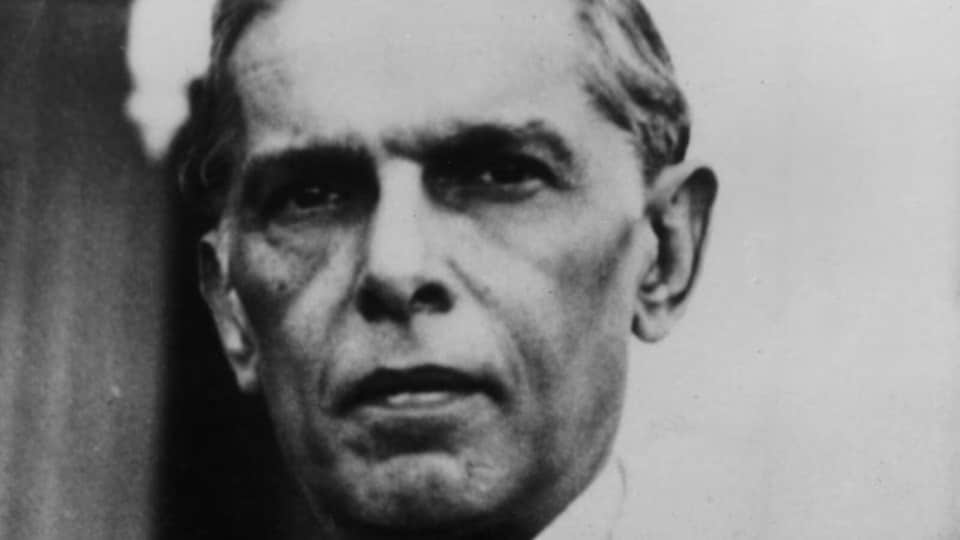
The doctors – physician Dr Jal Ratanji Patel and radiologist Dr Jal Dhaybho-Koo – have been nominated by Islamabad for the Nishan-e-Imtiaz award, which will be conferrred on them at a ceremony in March, 2027. The announcement was made on social media platform X by Ahsan Iqbal, federal minister for planning, development and special initiatives and head of the Awards Committee.
Both doctors had examined Jinnah's X-ray in 1946, and had diagnosed him with an advanced stage of tuberculosis, concluding that he had only a year or two to live, according to Larry Collins and Dominique Lapierre's book, ‘Freedom at Midnight’.
‘Faithfully guarded secret…quiet but extraordinary service’
In his post, the Pakistan minister said both doctors had “faithfully guarded the secret” of Jinnah's terminal illness. “I feel honoured to have had the privilege, as Chairman of the Awards Committee, of nominating for the Nishan-e-Imtiaz two remarkable doctors, a physician and a radiologist, both members of Bombay's Parsi community, who faithfully guarded the secret of Quaid-e-Azam Muhammad Ali Jinnah's terminal illness,” Iqbal said on X.
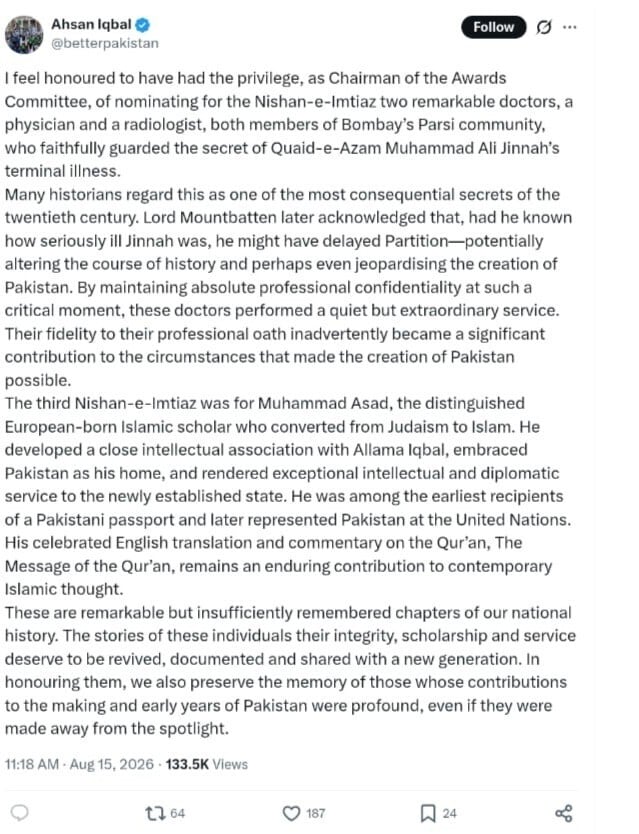
He said the doctors has maintained “absolute professional confidentiality” at what he said was a “critical moment”, adding that they had “performed a quiet but extraordinary service.”
“Their fidelity to their professional oath inadvertently became a significant contribution to the circumstances that made the creation of Pakistan possible,” Iqbal said.
Jinnah's illness: Why the secret was important to Pakistan's creation
Keeping the diagnosis secret was significant to the creation of Pakistan, as has been highlighted by Louis Mountbatten, the last viceroy under the British regime who planned and enacted the partition in 1947.
“Lord Mountbatten later acknowledged that, had he known how seriously ill Jinnah was, he might have delayed Partition—potentially altering the course of history and perhaps even jeopardising the creation of Pakistan,” Pakistan minister Iqbal said in his post.
According to the account in ‘Freedom at Midnight’, a book by Larry Collins and Dominique Lapierre, the knowledge of Jinnah's illness could have possibly altered the course of events leading up to the partition.
“If I had known all this at the time, history would have taken a different course. I would have delayed the decision to grant Independence by several months. Pakistan would not have come into existence,” Mountbatten told the reporters later.
Historian Akbar Ahmed, in his book ‘Jinnah, Pakistan and Islamic Identity: The Search for Saladin’, noted that Jinnah had been suffering from tuberculosis since 1930s, when the disease had no effective antibiotic treatment.
“Since 1938 he had been constantly complaining of 'tremendous strain' on his nerves and physical strength. After that, he began to fall ill regularly, although his illness was kept secret,” Ahmed wrote in the book. However, this secret was known by a very tight group of people, including Jinnah's sister Fatima and the two doctors.


