
 E-Paper



Annual Kankurang festival celebrates traditional Gambian culture

 Prefer HTon Google


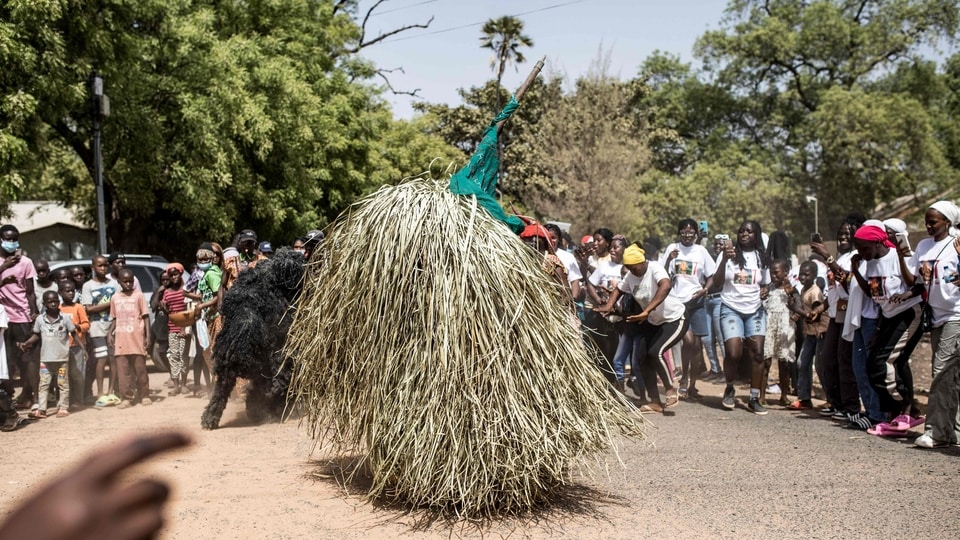
In the heart of Janjanbureh, Gambia, this annual event showcases the age-old rituals of the Kankurang, a revered figure believed to possess mystical powers.
By the light of the moon and a few spotlights, a figure almost completely obscured by bark and leaves makes his way through the frenzied crowd. Drums, whistles and shouts announce his entrance as he strides forward with machetes to hand. In the eastern town of Janjanbureh, on an island in the Gambia River, the annual festival celebrating the Kankurang, whose central character embodies almost mythical qualities, is in full swing.
The veiled figure is believed to ward off evil spirits from initiates to the Mandinka, a West African ethnic group historically from the kingdom of Mali. Onlookers offer money and call for his mercy as the initiate dances hypnotically through the crowd, swinging his arms and scaring off women and children. "We believe, supernaturally, the Kankurang is not human," said spectator Nichol Ndey. "It has this mystical power... it protects the people."
Guardian of tradition
The Kankurang -- a combination of the Mandinka words "kango" and "kurango" which literally translate as "voice" and "enforce" -- has been listed by UNESCO as Intangible Cultural Heritage since 2005. The initiation rite is associated with circumcision ceremonies. It is seen as a chance for young men to learn about the rules governing their community and to pass on traditional knowledge, such as hunting techniques and on medicinal plants.
It is still performed in certain regions of The Gambia, Guinea-Bissau and southern Senegal, particularly in the city of Mbour and in the Casamance region. But the gradual Westernisation of lifestyles, deforestation and the commercialisation of the practice is threatening the traditional ritual. The annual festival in Janjanbureh, around 250 kilometres (155 miles) east of the capital Banjul, has since 2018 attempted to breathe new life into Mandinka heritage, its director Muhammed Sardykhan said.
For three days, the town organises activities relating to the Kankurang, including a moonlit dance around a sacred baobab tree that attracts hundreds of spectators. The next day, the initiates stroll through the town under the watchful eye of frightened young children, who flee if they get too close. Janjanbureh describes itself as the guardian of tradition in The Gambia, a former British colony surrounded by Senegal that became continental Africa's smallest independent country in 1965.
Under threat
"Most of these cultures are getting extinct because of education, Western influence," said 30-year-old Nichol Ndey, a spectator originally from Janjanbureh who came to watch with her two children. "I want my kids to have this knowledge, to see what our culture is, to know where they come from," she added. Lamin Jarjou, in his 40s, was also keen not to miss the festival, which he sees as a means of keeping the threatened tradition alive.
"People even cut the trees we use to make our masks. Preserving our heritage also means preserving our forests," he said. For the last weekend in January, tourists and locals alike flock to Janjanbureh, filling hotels and providing a much-needed boost to the local economy. James Goswell, 35, took the opportunity to sell a few traditional items and souvenirs such as miniature Kankurangs, soap and T-shirts.
He sees the festival as a chance to make a bit of money in what he says is a difficult day-to-day life. Young people here lack opportunities, and many choose to emigrate abroad illegally. But the annual ritual is a chance to show the rich heritage of the town. "It's amazing, it's unifying, and it's cultural, and this is something that belongs to The Gambia and Senegal, so it's important that we hold this every year," said Jarjou.


