
 E-Paper



Said with a twang: A Wknd interview with archery coach Pravin Sawant

 Prefer HTon Google


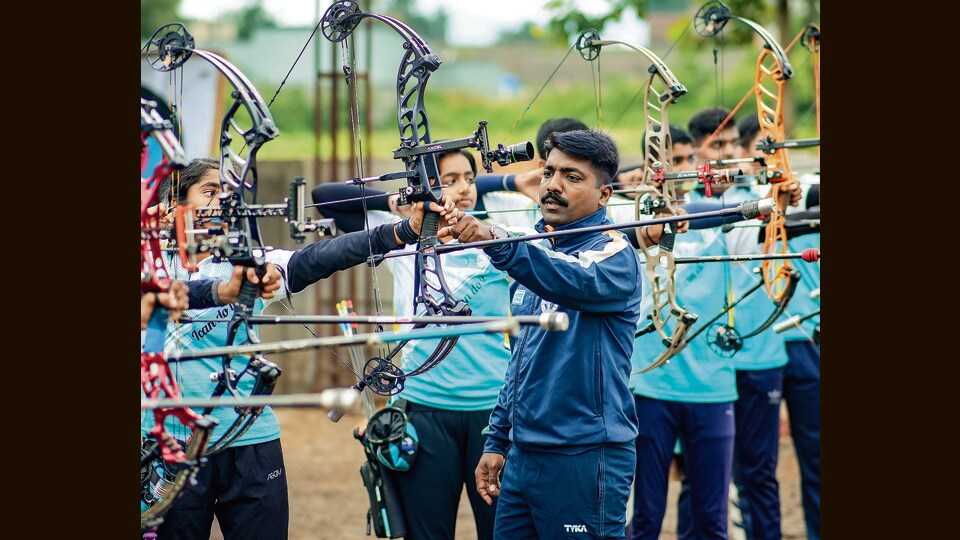
He could knock fruit out of any tree. He yearned to train, but was a ward boy instead. Now a coach, two of his wards just brought home world championship golds.
Two weeks ago, shouting and fireworks erupted on an otherwise quiet strip of the Satara-Lonand Road in southwestern Maharashtra.
Twenty children, bows hanging loosely on their shoulders, huddled around a jubilant Pravin Sawant. His Drushti Archery Academy had just produced two gold medallists in a couple of hours, at the World Championships in Berlin.
They’d all hoped for it, but no one really expected gold. “I still can’t believe it. I think I’m living a dream,” says Sawant, 32.
The “mad, unforgettable” day began with Aditi Swami, 17, prevailing over Mexico’s Andrea Becerra to become the first Indian to win gold at the archery world championships. Then Ojas Deotale, 21, beat Poland’s Lukasz Przybylski to become the first Indian man to win an individual world title in the sport.
“I am just so proud of the way they shot,” Sawant says. “Archery is a sport of the mind. From the outside, it may appear to be just about aiming and shooting, but you must be immune to the outside world, to be able to shoot that well.”
That kind of focus has been a hallmark of Sawant’s own trajectory.
Born in the village of Limb in Satara, he grew up poor, and occasionally hungry.
His parents owned a small plot of farmland, but it produced barely enough to feed the family of four (Sawant has a younger sister). His mother, Vandana Sawant, worked as a seasonal farm labourer to supplement the family’s income; his father, Parabati Sawant, worked in a nearby stone quarry.
“I would return from school and rush to the fields to help my mother. It was a back-breaking life. All I ever wanted was to get out of that crushing poverty,” he says.
He recognised early on that school offered a way out. He was diligent and hard-working and finished Class 10 with a 75% score. But he had no idea where to go from there.
He’d always had stellar aim; always managed to knock more fruit out of the trees than any of his friends.
He was 17 when the talent and the ambition finally collided. It was 2008. Sawant was watching the TV at home, and tuned into archers in competition at the Beijing Olympics.
“I was mesmerised,” he says.
By this time, he had earned a diploma in agriculture. He was looking for a job, and working in the family’s fields. He had yet to so much as hold an arrow. “An amateur bow would have cost upwards of ₹3,500 and we couldn’t afford it,” he says.
His first bow was one he made himself, with bent wire from an old umbrella.
Then he learnt that there was an archery academy about 25 km away, in Wai. But the bus cost ₹35 per return trip, money he did not have. “It was heartbreaking, but what can you do?”
***
One avenue, he was told, was to rejoin school at the Class 11 level, and train to compete at the national level in inter-school tournaments. He did this, and won silver at the 2009 school nationals, just nine months later.
At 19, he finally found work, as a ward boy at an orthopaedic hospital in Satara, and could afford the bus to Wai. He signed on for the night shift at the hospital, and began to train through the day.
“I would get some sleep on the bus and some after practice at the hospital. My father would hand me my lunch at one of the stops. On my way back, he would meet me again and hand me my dinner. This continued for 18-odd months. Hospitals can be depressing, but archery kept me going.”
He began to carry a large resistance band around, so that he could practice his form and continue his strength training.
At the hospital, pharmacist Mahindra Kadam heard about the archery-mad ward boy and was moved. Would Sawant like some training space on his 1-acre sugarcane field, he asked.
By this time, the young archer was realising that his career as a sportsperson was probably over. “I never had the means to hire a coach or chart my growth. I decided to give coaching a shot.”
By 2019, his informal classes for children were taking the shape of the Drushti Archery Academy. He was 28 by now, married, and about to become a father. His wife, Sayali Sawant, offered her wholehearted support. In fact, they mortgaged her jewellery for ₹2 lakh to build the initial structure.
Sawant had two goals when he set up the academy. It should be residential, so that children wouldn’t have to commute the way he had to. And it should be a place where young people could hear that they had potential, and then get the support they needed in order to realise that potential.
He is an instinctive coach. Largely self-taught, he was only recently certified by the National Institute of Sports in Patiala.
“I demand complete focus from my students. I ask them to become one with the bow and arrow,” Sawant says. “Archery is a deeply meditative exercise. It demands you listen to your body. Once you do that, everything follows from it.”
He focuses heavily on technique, fitness, and state of mind.
Swami joined the academy seven years ago as a scrawny child who didn’t like eggs. He convinced her to include them in her diet, and crafted an intense fitness regimen to build up her cardiovascular strength and stamina. “She is still very young and a work in progress in terms of fitness, but technically and mentally, she is very sound,” he says.
Deotale joined the academy only last year. “Technically, he was very much a finished product. His only problem was that he would dwell on his competitors a lot. He needed to gain confidence. He needed to hear that on his best day, he was unbeatable.”
***
Drushti now accommodates 25 trainees at a time. The coach, his wife and their four-year-old daughter (named Drushti, after the academy) live on the premises too. Sayali Sawant, 29, serves as academy secretary. There are plans to hire an additional coach soon.
Pravin Sawant, meanwhile, has earned a position as a police constable, via the sports quota. Stationed at the Satara police headquarters, he works fixed hours, “which means I can devote my evenings to coaching.” His colleagues have helped him achieve his dreams, he adds. “Everyone is very supportive.”
Despite his newfound fame — Sawant’s phone hasn’t stopped ringing since the wins in Berlin — he has no plans to quit the force. “I like my life the way it is. I want to stay in Satara and do something for the kids here. Who knows? India’s first Olympic medal in archery could come from here.”
A local businessman has extended sponsorship for the academy. There is word that Sawant may be included in the coaching staff for the Asian Games, as Swami and Deotale head to Hangzhou in September.
It’s a world far removed from the arid days of field work in Limb. Whatever path he chooses now, he knows that his parents won’t need to work as farm labourers again.
“At times, I do think about where I came from. We had absolutely nothing. I would share clothes with my dad, study from borrowed books, never really had a childhood,” he says. “Archery got me this far. I have no complaints. I am living a dream.”


