
 E-Paper



Score values: What Messi’s farewell note tells us about the man, the legend

 Prefer HTon Google


Isn’t it strange that one of the greatest in the world at what he does can carry a sense of not having done enough? Rudraneil Sengupta does a little unpacking.
We knew it was coming, but Lionel Messi’s retirement from international football still feels momentous.
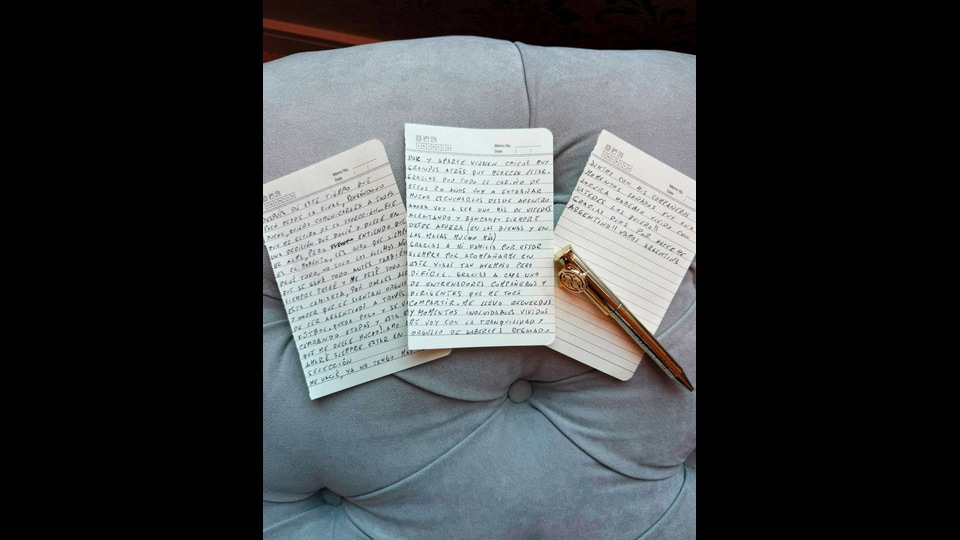
The 39-year-old Argentine great made his decision public on social media this week, posting an image that evoked a different era: three lined pages, torn from a notebook, carrying an emotional note written in his neat, childlike hand.
In 2005, when he made his international debut as a floppy-haired 18-year-old, pen and paper were what he would have still used at school, or in the La Masia academy classrooms. (The first iPhone was still two years away.)
In that debut match, against Hungary, the teen lasted less than two minutes before being sent off for a foul that, today, would likely have seen the red card overturned by a Video Assistant Referee (VAR).
His two minutes were still enough for the world to declare the arrival of a “new Maradona”, an idea that had been building since he singlehandedly won Argentina the World Youth Championship cup a couple of months earlier.
A “Maradona” tag can feel like a curse; how does one live up to that level of expectation: a footballer so gifted as to be considered a god, who won Argentina the World Cup at 25, with a performance so dazzling it was like nothing ever seen at a World Cup before (with five goals and five assists, Maradona carried the team to its win).
Twenty-one years on, Messi hasn’t just earned the tag; for many, he has surpassed his idol on pure footballing terms.
“The greatest ever” may be a subjective and perhaps meaningless term, but when it comes to numbers and accolades, Messi certainly is that. He is the most-decorated footballer of all time, with 46 trophies; the highest assist-provider and second-highest goal-scorer in the game’s history; has a record eight Ballon D’Ors, two Copa America titles (2021 and ’24) and a World Cup (Qatar; 2022).
But even the greatest among us can carry within them a sense of not having done enough.
Messi’s retirement note was a window to the vulnerable person behind the genius on the pitch.
“After the time that has passed since the final, thinking a lot, I want to let everyone know that I am retiring from the national team,” he wrote. “It is a decision that hurts my soul but I know it is time. I can say for sure that I always gave everything, not only in the last few years when we won everything [but] before as well, and I always fought and gave everything for the shirt, to give you joy and make you proud of being Argentinian through football.”
Half of Messi’s note is about him trying to prove he poured heart and soul out on the pitch.
“I love, have loved and I will always love being part of the national team. I have emptied myself: now I have nothing more to give,” he wrote.
For more than a decade after his debut, Messi failed to do what Maradona had done: drag the Argentine team, over-reliant on his skills, to a World Cup triumph.
In 2016, when Argentina lost the Copa to Chile, it was the fourth straight defeat in a major final for the team. A tsunami of criticism followed: he didn’t care for his country, he only played well for Barcelona, was only interested in individual glory, lacked the emotion and intensity that made Maradona great; they even claimed he didn’t sing the national anthem with fervour.
Perhaps now, after two Copas, a World Cup title and three World Cup finals, Messi can finally lay both the burdens and joys of wearing the blue-and-white colours to rest.
(Email Rudraneil Sengupta on rudraneil@ gmail.com. The views expressed are personal)


