E-Paper



What is Davidson Fellows Scholarship? 6 Indian Americans win US award in 2026; here's why it's important
Six Indian American students received the 2026 Davidson Fellows Scholarship, which awards up to $100,000 for impactful research projects in various fields.

 Prefer HTon Google


Six Indian American students are among the recipients of the 2026 Davidson Fellows Scholarship, a US program that recognizes young people for significant research and creative work with potential to make an impact beyond the classroom.
The scholarship, awarded by the nonprofit Davidson Institute, provides $100,000, $50,000 or $25,000 to students aged 18 and younger. Unlike awards based primarily on grades or test scores, the Davidson Fellows Scholarship focuses on substantial projects in areas including science, technology, engineering, mathematics, literature, music and philosophy.
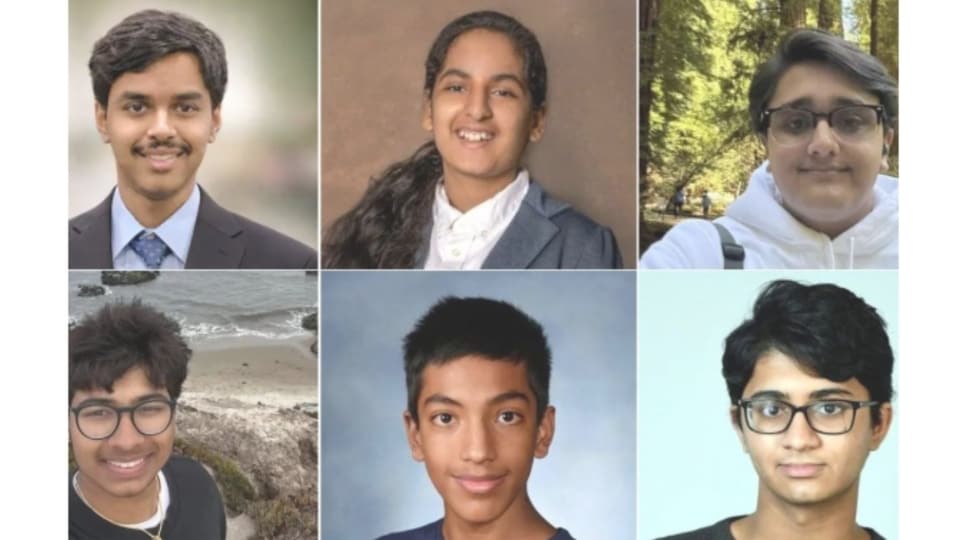
The 2026 Indian American recipients are Aditya Sengupta, Tanishka Aglave, Hitaishi Chillara, Praadhyumn Indaana, Rajarshi Mandal and Pavan Subramani. Their projects address problems ranging from clear-air turbulence and citrus disease to nuclear reactor safety, malaria prevention and drug discovery.
What is the Davidson Fellows Scholarship?
The Davidson Fellows Scholarship was established in 2001 by the Davidson Institute to recognize students who have completed a significant piece of work. The institute says eligible projects should demonstrate substantial achievement and have the potential to benefit society.
Also read: ‘Loopholes are closing’: US targets fake H-1B employers, sham jobs and visa mills in fraud crackdown
The program's emphasis on the work itself is what sets it apart from conventional student scholarships. Applicants are required to submit a project that is evaluated by experts in the relevant field. Judges assess factors including the significance of the work, its quality and the student's depth of knowledge.
The scholarship is open to students aged 18 or younger who meet the program's US citizenship or permanent-residency requirements. Awards are given at three levels: $100,000, $50,000 and $25,000.
The Davidson Institute says the program has awarded more than $10 million in scholarships since its creation.
Why does the scholarship matter?
The Davidson Fellows recognition comes at an unusually early stage of an academic career. The program identifies students whose work has already reached a level that judges consider significant, rather than simply rewarding academic performance or future potential.
The 2026 class illustrates the breadth of that approach. The recipients are using machine learning, computational science, mathematics, physics and biology to work on problems with applications outside their schools.
For Indian American students, this year's awards also highlight the range of research being undertaken by young members of the community across the US.
Also read: Trump extends $100K H-1B fee by 12 months; India, with 71% share, most affected
Six Indian Americans among 2026 winners
Aditya Sengupta, 18, of Bellevue, Washington, received the top $100,000 Davidson Fellow Laureate award for ForeCAT, a machine-learning system designed to improve predictions of clear-air turbulence.
Tanishka Aglave, 17, of Valrico, Florida, received $50,000 for research into citrus greening disease. Her project combines a bactericide derived from curry leaf extract, localized thermal treatment and computer vision to help assess disease severity.
Hitaishi Chillara, 17, of Leander, Texas, won $50,000 for a computational framework examining the relationship between galaxies and the supermassive black holes at their centers. His research combines cosmological simulations, telescope observations and machine learning.
Praadhyumn Indaana, 17, of Montvale, New Jersey, also received $50,000. He developed a physics-guided neural network aimed at improving predictions of critical heat flux, a key safety threshold in nuclear reactors.
Rajarshi Mandal, 16, of Lexington, Massachusetts, won $50,000 for a mathematical model focused on improving the distribution of insecticide-treated mosquito nets for malaria prevention.
Pavan Subramani, 17, of Morgantown, West Virginia, received $25,000 for computational drug-discovery research targeting the Receptor for Advanced Glycation End products, or RAGE, a protein associated with inflammatory diseases.