
 E-Paper



Personality clashes, humanitarian suffering mark one year of Myanmar’s coup
It is insufficient to understand Myanmar’s politics after the coup only through the prism of political personalities. When democracy is stifled, it is the people who are the most affected.

 Prefer HTon Google


On February 1 last year, as many in India were busy with news of the annual budget, distressing news poured in from neighbouring Myanmar. The tatmadaw (military), under the leadership of Senior General Min Aung Hlaing, arrested most of the ministers of the National League for Democracy (NLD) led government, including State Counsellor Aung San Suu Kyi and President Win Myint, in the early hours of the day. Thereafter, military convoys rolled through the streets of the capital in a dramatic fashion, breaking up the first Parliament session after the November 2020 election. When a year-long emergency was declared by the acting President and the reins of governance handed over to Min Aung Hlaing, there was no doubt that it was a full blown political coup, the third since Burma’s independence in 1948.
Most people who follow Myanmar’s politics are aware of what happened in 1988, when General Ne Win, who came to power through a coup in 1962, was forced to resign as chairman of the Burma Socialist Programme Party. The government that came to power after him was ousted in September that year, by General Saw Maung, a confidant of Ne Win. In short, it was a coup of the military, by the military, for the military. By that precedent and more, there is no denying that the tatmadaw feels it has a right over the governance of the country. Unfortunately, that has not changed. When that sense of right begins to slip away, political turmoil ensues in Myanmar.
This is exactly what happened last year. Min Aung Hlaing was approaching retirement in 2021 and Suu Kyi was accumulating power after the NLD’s clear victory in 2015 and 2020. As per the 2008 constitution, 25% of the seats in the Hllutaw (parliament) is reserved for the tatmadaw. Yet, it is to return to the barracks when peace, stability and development become a norm in Myanmar. Suu Kyi highlighted this after the NLD’s election victory. The tatmadaw, instead, complained of fraud during the elections. Nobody listened. In such a case, what better way for the junta to keep political control than use an old (and successful) trick?
On the other hand, experts also point towards the personal dislike that Min Aung Hlaing and Suu Kyi have for each other as one reason that negatively impacted the civil-military balance. Notwithstanding international criticism in the context of the Rohingya crisis, Suu Kyi has remained an icon of democracy for decades. But her stubborn attitude towards the tatmadaw, probably in the hope of sending the military back to the barracks for good, reeked of ignorance emanating from an ageing and insecure, yet over-ambitious leader.
As a result, not only did Min Aung Hlaing extend his term and declare himself Prime Minister of Myanmar by August 2021, but also called the National Unity Government (NUG) in exile ‘terrorist’. Importantly, he made enough arrangements to Suu Kyi’s career in politics through her house arrest. As the list of allegations against her mount, there is no doubt that so will the quantum of her sentence, which is currently two years.
It is insufficient to understand Myanmar’s politics after the coup only through the prism of political personalities. When democracy is stifled, it is the people who are the most affected. As of now, the State Administrative Council (the junta government) has assured multi-party elections in 2023. But people are not ready to get fooled by this anymore. People’s resistance has found new vigour in the country, despite no clear political face of the opposition.
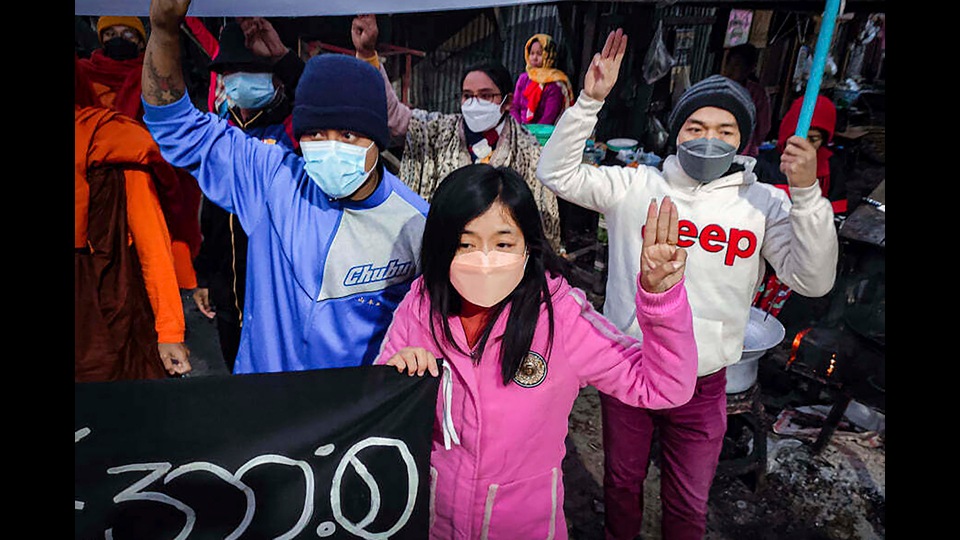
The junta’s way of dealing with protesters and opponents has been brutal. Who can forget the sight of the teenage girl, wearing a T-shirt saying ‘everything will be ok’, being shot in the head. Throughout the year, instances of villages being set on fire by tatmadaw men were reported. Human rights violations touched new highs in the country, with people even being burnt alive in some cases. Within a year, the death toll is reported to have reached 1499, with 11,801 arrests and 1,967 warrants issued (as of January 28). There are also reports of prison gallows, long out of use, being refurbished.
As assessments are made about the end of an era led by Suu Kyi, it does not automatically translate into victory for Min Aung Hlaing. Even after a year of the coup, the SAC struggles to find legitimacy and control. The Civil Disobedience Movement has remained strong. Meanwhile, the NUG announced the establishment of People’s Defence Forces to resist the military. Many have joined without fear. Interestingly, some Ethnic Armed Organisations, which are essentially seen as insurgent groups, have also joined hands against the junta (The Kachin Independent Army is an example). This is evidence that it is not going to be easy for Min Aung Hlaing to rule for an extended period, like some of his predecessors. Indeed, the politics and the people are very different today than in the decades that followed coups of the past.
Shrabana Barua is assistant professor, department of Political Science, Hindu College.
The views expressed are personal


