Earlier used as a prominent sign to identify friend from foe, flags have a long history and bear symbols and devices which connote and decode for certain characteristics, principles and values. This is why they fill us with so much joy.
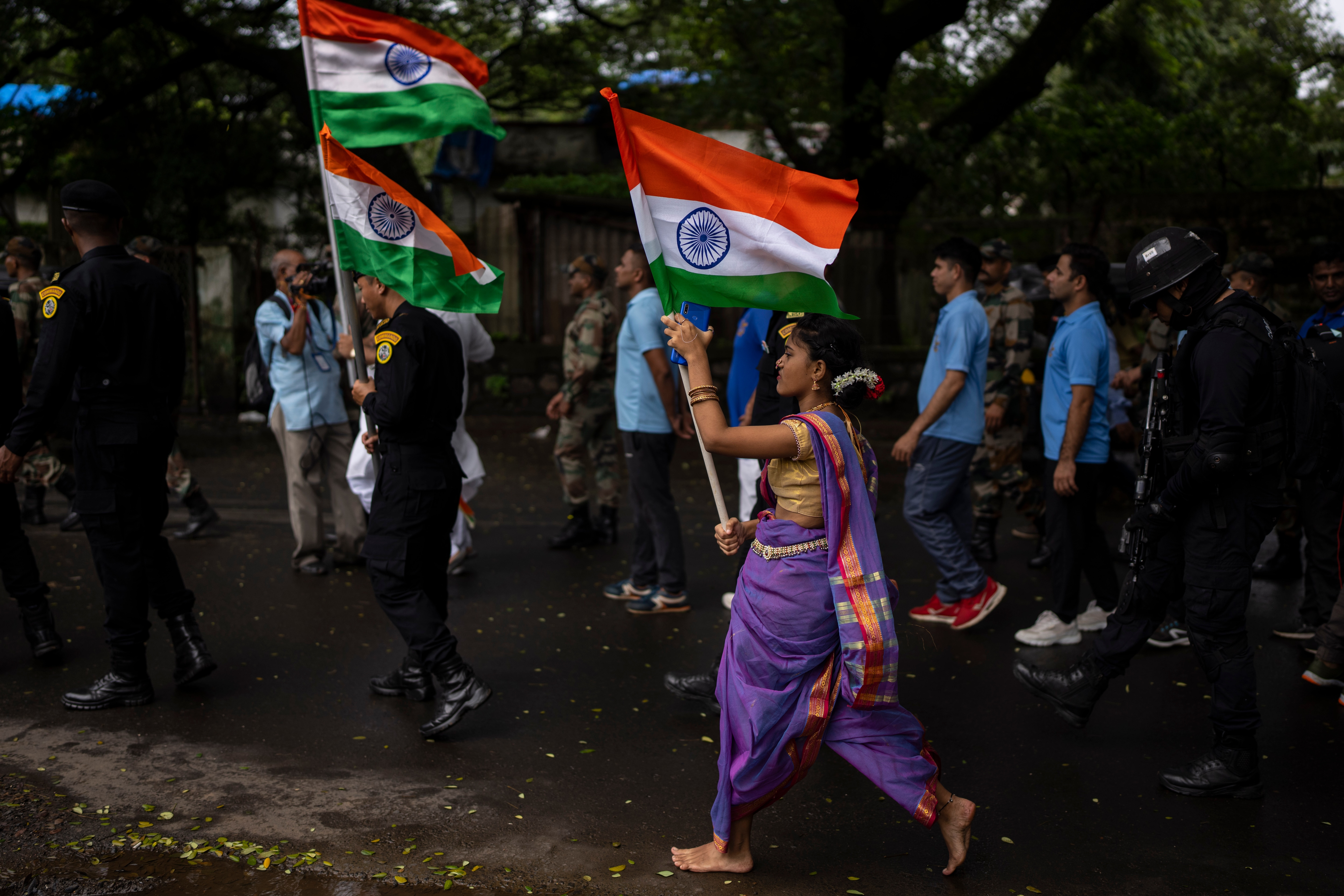
A month ago, we were all busy celebrating an important anniversary of our Independence. An initiative, which formed a big part of these festivities, was the campaign to prominently display the Tricolour in every home, in the three days ending Independence Day. Everyone — apartment coops, Resident Welfare Associations (RWAs), corporate bodies, government bodies from the Centre and municipal administrations — was busy distributing flags and exhorting people to fly them where they would be visible.
Honour your flag by all means, but be aware of why. Fetishising anything, flags included, only fuels intemperate stridency. (AP)
Did you participate in this campaign? Did you too fly the flag proudly from your window or balcony? Did it fill you with a sense of joyous patriotism? Did you ever pause to think why it elated you so?
It seems reasonable to assume that the answers to all these questions, for many readers of this essay, will be a hearty yes. This raises another question: Why?
Flags and pennants have a long history. Mankind began to form itself into cohesive groups about forty millennia ago. Cave paintings in Altamira, Spain, have been dated back at least 36,000 years and archaeological evidence gathered there, and elsewhere, suggests human settlements going a few thousand years further back. In that ancient past, as today, human beings divided themselves between “us” and “them”, with “them” being defined as “not us”. Problems would have begun to arise when these groups grew into tribes, and as the specialisation of skills and craftsmanship grew, large communities.
Multiple communities may have depended on a shared hinterland for sourcing primary materials — game meat, fruits and berries, wood for fuel and timber for construction, metal ores and so on.
Inevitably, this would lead to skirmishes, battles, and wars to control access to raw material sources.
Given their shared history, and identical heredity, it would have been impossible to distinguish members of different groups. This would constitute a mortal hazard in times of conflict, unless the feuding parties had some prominently visible signs to identify them. Any sign or symbol, which could be held aloft, and was recognisable as “ours”, would become a visual cue, for both comrade and adversary. Thus, the prototypical flag, as a parochial signifier, was born, amid blood and strife.
Our mythology is replete with flags. The Mahabharata describes in elaborate detail, the emblems flown on the chariots of all its great warriors. If Arjuna’s flag bore Lord Hanuman, who apparently quite literally resided in it, Jayadratha, who fought in the Kaurava alliance flew a wild boar pennant.
Even Lord Krishna, not an active combatant, as a charioteer to Arjuna, had his own flag, with the soaring Garuda, the eagle, one of Lord Vishnu’s vahanas or mounts. Each flag was distinct; each carried symbols and icons which signified something about the character and belief system of the warrior who flew it. Mounted high atop a flagstaff affixed to the side of the chariot, every flag worked both as a magnet and deterrent. Allies were drawn to a friendly flag, and adversaries abhorred and attacked it.
Our little excursion into myth provides multiple insights into why flags are imbued with overt and subliminal messages. And why we continue to venerate them.
Flags are unequivocal. You can either embrace them (a major global leader quite literally did) or repudiate them (or do both to two different flags, simultaneously). Popular discourse is suspicious of, even violently rejects, people who show indifference to them. In that recent moment of spirited flag waving, a politician wanted his followers to photograph homes which had not displayed the national standard outside their homes, because residents of such homes had, in his mind, revealed their disloyalty and were to be tarred with the “treason” brush.
Flags are typically flown from the highest available spot in the proximate terrain. This was originally designed for long-distance visibility. It marked the territory around the flag as being under the control or protection of a particular authority or nation-state. It constituted a resounding, if silent, bellow of “trespass at your own peril, or bow to my authority”. Most flag codes still stipulate that the flag must be flown at a significant height; with the original purpose having mostly been stripped away, this only whets people’s appetites for ever higher flagpoles and ever bigger flags. “Not only are we true flag lovers”, but it also seems to say, “we are truer than anyone whose flag is lower and smaller”. Form, unsurprisingly, overwhelms substance.
Flags bear symbols and devices which connote and decode certain characteristics, principles and values. The United States flag has 50 stars and 13 stripes, to represent the 50 states of the union, and the 13 colonies with which it originally began in 1781. The United Kingdom flag has two diagonal crosses superimposed on a vertical one, these three representing the three countries united under the British sovereign. The vertical red cross is the cross of St George, patron saint of England. The diagonal white cross on a blue background, is the cross saltire of St Andrew, the patron saint of Scotland. Finally, the diagonal red cross on a white background, is the cross saltire of St Patrick, patron saint of Ireland. As Scotland begins to get restive about its continued subjugation by its southern neighbour, the white on blue of the cross of St Andrew, no longer mixed inseparably with the other two, begins to grow in popular usage. It is unmissable that, in so doing, Scotland points unapologetically at the eventual deconstruction not merely of the British flag, but English hegemony itself.
Finally, flags provide a widely-accepted device for homogenising in diversity, a feature particularly consequential in countries as diverse as our own. No matter your religion, region, language, community or complexion, you may not, at the peril of boycott or banishment, deny the flag.
Flags are no more and no less holy than any other object. Honour your flag by all means, but be aware of why. Fetishising anything, flags included, only fuels stridency. True patriotism is the ability to love and embrace your country, warts and all.
Paritosh Joshi is a media professional with a keen interest in audience measurement

 E-Paper