E-Paper



Scientists uncover hidden Nile channel that may have helped transport stones for the Great Pyramid
A buried Nile channel found near Giza may explain how ancient Egyptians hauled stone to build the Great Pyramid.

 Prefer HTon Google


For many centuries, there has been one intriguing question regarding the Great Pyramid of Giza that has baffled historians and engineers alike. How did the ancient Egyptians transport millions of tons of stone across the desert without wheels or advanced technology? This question may have a partial answer in a study published in the Proceedings of the National Academy of Sciences.

Geoarchaeologist Hader Sheisha and her team examined fossil pollen buried deep in the ground near Giza, using it to reconstruct 8,000 years of water-level changes along a long-lost branch of the Nile. They named it the Khufu branch, after the pharaoh who commissioned the Great Pyramid.
Their findings indicate that the channel was sufficiently wide and deep during the reign of King Khufu, about 4,500 years ago, to allow boats carrying stones to move upstream toward the Great Pyramid from the harbor through a system of waterways. Instead of having to haul the stones for miles across desert sands, the ancient builders may have transported much of the material by boat.
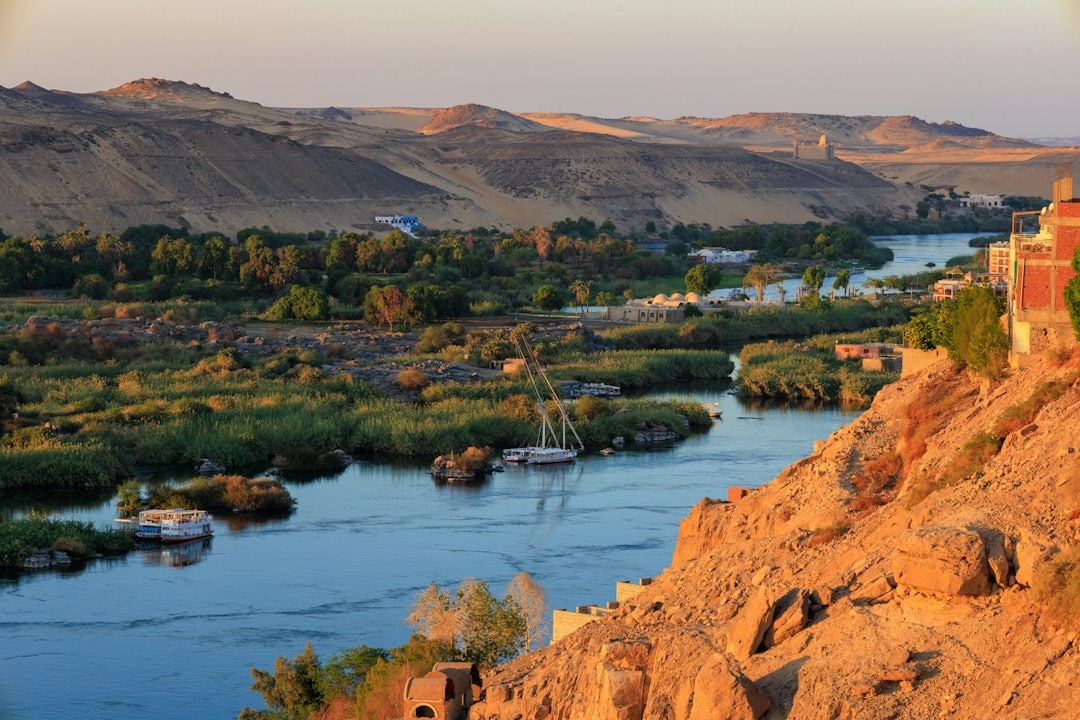
The lost river branch
The branch of the Nile that once flowed into the region where the Great Pyramid stands did not disappear suddenly. Sheisha's pollen analysis revealed how water levels in the river changed in response to climatic conditions over thousands of years, reaching relatively high levels around the time the Great Pyramid was built before becoming progressively drier.
Over subsequent centuries, farming, irrigation and accumulating desert sediments helped bury the old riverbed beneath what is now the Nile floodplain, making the former channel difficult to identify from the surface. Reconstructing its history required sediment sampling and analysis of microscopic plant remains preserved within the layers.
The discovery provides evidence that the Giza pyramid complex was built when a navigable branch of the Nile was still present nearby. Rather than treating the desert as the only route for moving materials, the findings suggest that water transport could have played an important role in bringing supplies toward the construction area. The location of the pyramid, harbor, and valley temple also fits with the presence of this ancient waterway.
A wider river network across Egypt
The Giza discovery is part of a broader effort to reconstruct Egypt's ancient river landscape. A separate study published in the journal Communications Earth & Environment, authored by geomorphologist Eman Ghoneim from the University of North Carolina Wilmington, identified a much larger extinct waterway farther south and west of the modern Nile.
Ghoneim's team combined radar satellite imagery with soil coring and geophysical surveys to trace a roughly 64-kilometer-long ancient channel that they called the Ahramat branch, using the Arabic word for pyramids. The channel once ran along the edge of the Western Desert Plateau near more than 30 pyramids dating from Egypt's Old and Middle Kingdoms.
Many of these monuments are located at the ends of causeways leading toward areas where the former river channel is believed to have flowed, while nearby valley temples may have functioned as access points to the water. The researchers suggested that the Ahramat branch could have provided a transportation route for workers and building materials to numerous pyramid complexes. Unlike the Khufu branch study, which focused specifically on the ancient waterway serving the Giza area, the Ahramat study examined a much larger corridor extending across multiple pyramid sites.
Together, the two studies provide evidence that ancient waterways played a wider role in the landscape around Egypt's pyramids. The Khufu branch helps explain the local water access available during the construction of the Great Pyramid, while the Ahramat branch points to a broader river corridor that may have connected numerous pyramid complexes to the Nile's ancient floodplain.
Practical significance of the discovery
Beyond shedding light on ancient Egyptian engineering, identifying former water channels also has practical applications. Mapping the locations of ancient waterways can help archaeologists identify areas that may contain additional archaeological sites, since settlements and other human activity in ancient Egypt were closely associated with access to water.
Such maps can also assist in protecting archaeological sites threatened by rapid urban expansion in Egypt by identifying historically significant areas before new development takes place. For monuments that have stood for more than 4,500 years, reconstructing the waterways around them adds another layer to understanding how ancient Egyptian builders used the landscape.