
 E-Paper



World Shooting Championships: Rifle marksman Niraj claims bronze, Olympics quota
The 26-year-old overcame windy conditions and quality competition to win the medal in Doha.

 Prefer HTon Google


Rifle marksman Niraj Kumar earned India its second quota for the 2028 Los Angeles Olympics on Wednesday, shooting a bronze medal in the 50m 3 Positions event at the World Championships in Doha.
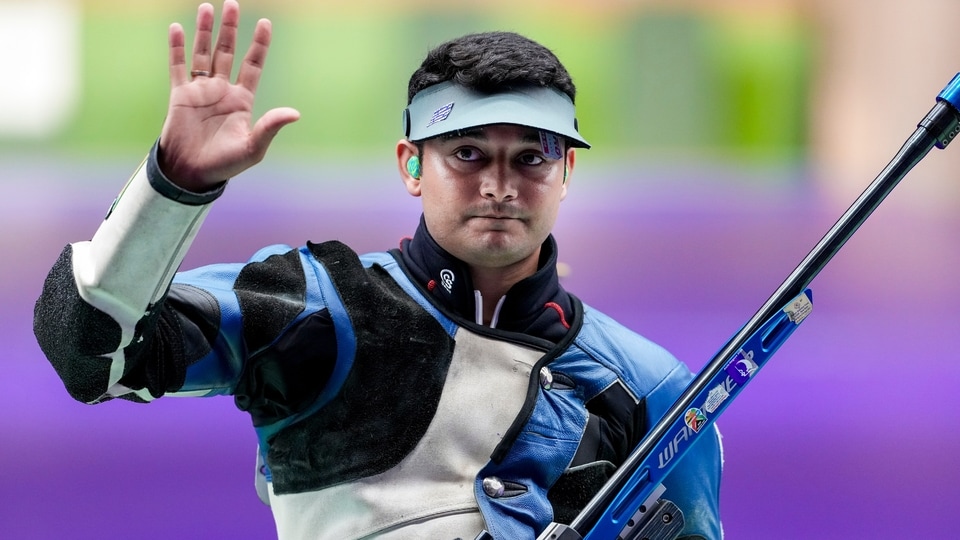
The 26-year-old from Hoshiarpur, Punjab shot 346.5 in the final to claim his first individual Worlds medal. He finished behind Individual Neutral Athlete (AIN) Dmitrii Pimenov, who won gold with a world junior record score of 362.8, and Slovakia's Patrik Jany, who took silver with 357.2.
Pimenov and Niraj won LA quotas but the third quota went to Norway’s Jon-Hermann Hegg, who was fourth (335.9). Jany didn't get the LA spot because under the Olympic qualification rules, an athlete can secure only one quota place for their NOC and the Slovakian had already secured a quota in the 10m rifle event.
It is India's second Olympic quota, after Jaypal Malviya earned one with his 10m air pistol silver.
Niraj was in contention for silver before a 9.4 on his 34th shot pushed him to third. Compatriot Aishwary Pratap Singh Tomar, a two-time Olympian, finished fifth with 323.7.
India also won the team bronze, with Niraj, Aishwary and Akhil Sheoran combining for 1,751 in the elimination round. They missed silver by a solitary point as Norway finished second (1,752) and the Czech Republic first (1,754).
Niraj was in fine form in the qualification round, shooting an impressive 591 to top the standings. In the final, the Navy shooter kept his calm and maintained a steady tempo in the high-intensity contest. Placed fifth in the eight-man final after the opening kneeling series, Niraj crept up to second after 30 shots before the slip-up in the penultimate competition shot.
"That blip apart, Niraj shot exceptionally well. We are very happy with his performance," national rifle coach Manoj Kumar told HT from Doha. "The 50m discipline has a lot to do with conditions, and they were tough in the elimination stages (on Tuesday) as well as in the qualification and final rounds," he added, referring to the windy conditions at the range.
"For perspective, the wind in Delhi's Karni Singh Shooting Range where we train is usually around 6-7 knots. Here, it was around 16-17 knots, but I am glad he adjusted well."
Soon after the elimination relays on Tuesday, the three Indian shooters sat with Manoj to discuss ways to counter the wind. "We decided to read the wind and stay patient. The way we line up the target varies according to wind direction. The way we shoot against the wind is different from the way we shoot when the wind is across us. In that case, we aim a little to the left or right, depending on the direction."
"These are standard practices, but it's tough to execute under the competition pressure. Niraj trusted his training and instincts and succeeded," Manoj said.
Part of the squad with Rudrankksh Patil and Tomar that won the 50m 3P team bronze at this year's Asian Games, Niraj hit the range soon after returning from Japan.
Also Read: Why Capri Sports bet on Indian women’s football league
"He wasn't happy with his performance. We expected more individual medals at the Asian Games but that didn't happen, so we went about course correcting," he said. First on the agenda was correcting Niraj's shooting in kneeling position.
"There were stability issues there. Kneeling was his weakest suit, and in many competitions, he would make the final but not win a medal only because he would mess up the kneeling round. It's the first round, so if you shoot bad, you fall back at the start itself, which also hits your confidence," the coach said.
The idea, Manoj explained, was to engage minimal muscles and increase Niraj's stability. His shooting jacket was tweaked as well, with the position of Target Shooting Sling — used to stabilise the rifle in kneeling and prone positions — being changed.
The sling is worn on the support arm high on the tricep and it connects to the rifle's hand stop. It transfers the weight of the rifle directly to the bones of the arm, allowing the shooter's muscles to relax.
"We realised the position of the sling was affecting his stability. The sling is worn on the jacket but you can't just move it around the arm because jackets are tailored to accommodate every such accessory. So, we got his jacket tweaked a little. We also worked on stabilising his heart rate, particularly in kneeling position," Manoj said.
Quota secured, the next goal, the coach said, is to achieve consistency. "This medal should open the floodgates for Niraj because he has the potential to be a world-class shooter," Manoj said.


