
 E-Paper



 Trending News
Wall Street Can’t Seem to Find Its Footing in the Chaos of the New AI Trade
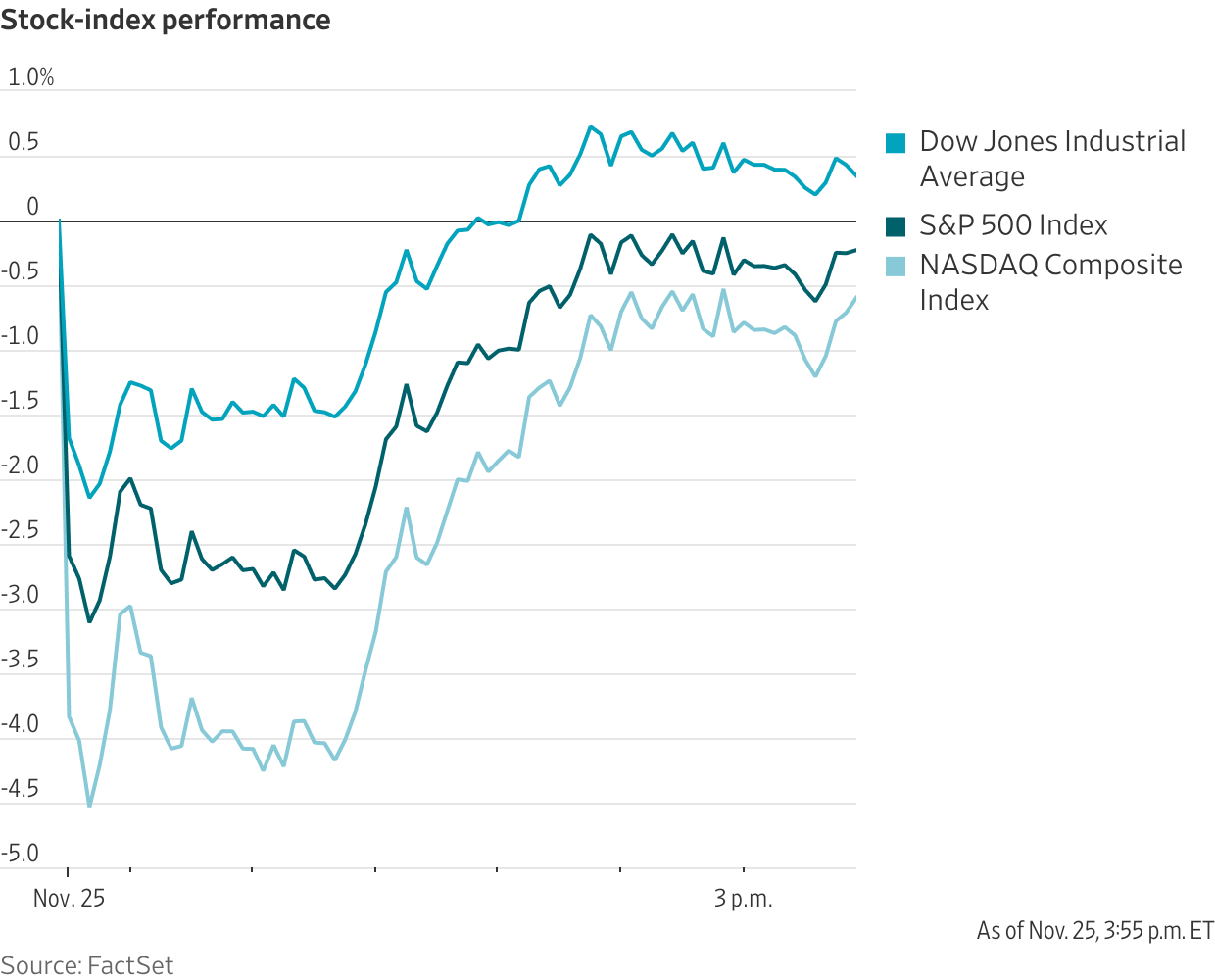
The Nasdaq composite plunged as much as 4.5% Wednesday before paring losses.


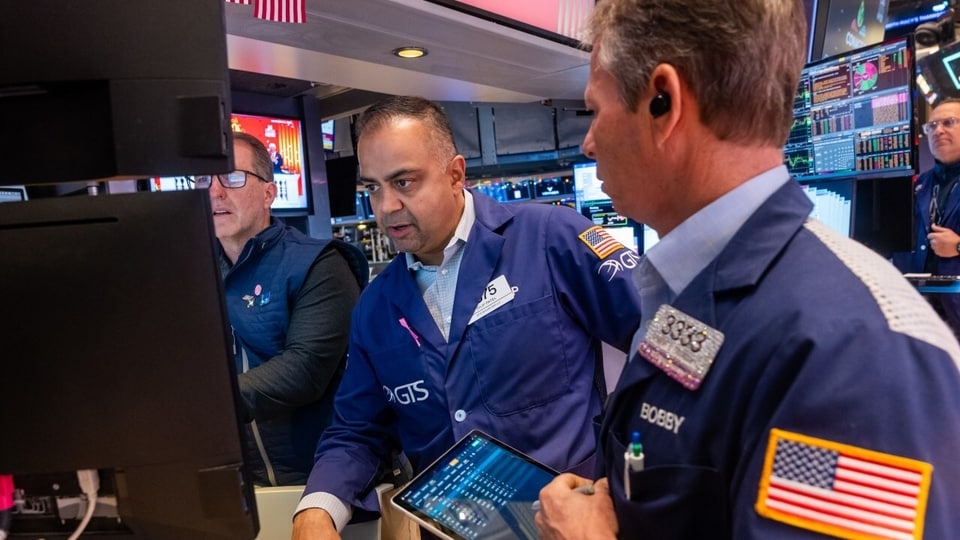
Two days after Jensen Huang’s return breathed new life into the flagging AI trade, Wall Street is laboring to make sense of the chaos unfolding in markets.
The sharp rally that followed the Nvidia CEO’s homecoming on Monday gave way to a hangover as stocks retreated. Then on Wednesday, investors found themselves on an unnerving roller coaster.
The tech-heavy Nasdaq composite looked headed to a 5% selloff at one point, before a furious rally—the greatest intraday rebound since April 2025. By the time traders were logging off for the Thanksgiving holiday, the benchmark was down 0.6%.
Deep Dive

Tech stocks accounted for much of Wednesday’s losses, reflecting investors’ ongoing unease about the AI boom. Nvidia shares dropped 3.9% and have now given up almost half the gains added since Huang’s return, while Oracle was among the other substantial losers. Many of the S&P 500’s worst performers were chip makers.
“This is bigger than Jensen Huang being removed,” said Joseph Zidle, executive managing director and chief market strategist at Cresset Capital. “This is skepticism that had been creeping into markets well before that.”
Concern that big tech companies are overspending on AI, and whether they can keep financing the massive commitments they have made to chip suppliers such as Nvidia, Advanced Micro Devices, Micron Technology and Sandisk are back in focus—even with the return of Huang, whose aggressive financing tactics have earned Nvidia a reputation as the “central bank of AI.”
Huang’s reinstatement sparked a huge rebound in its shares and the broader market. Those gains, some analysts said, were exacerbated by a rising tide of investors betting against the chip maker. As the stock rallied, the shorts scrambled to buy back shares to close out positions before their losses mounted.
On Wednesday, the S&P 500 fell 0.3%, its ninth loss in 10 sessions, while the Dow Jones Industrial Average added 0.3%, or 164 points.
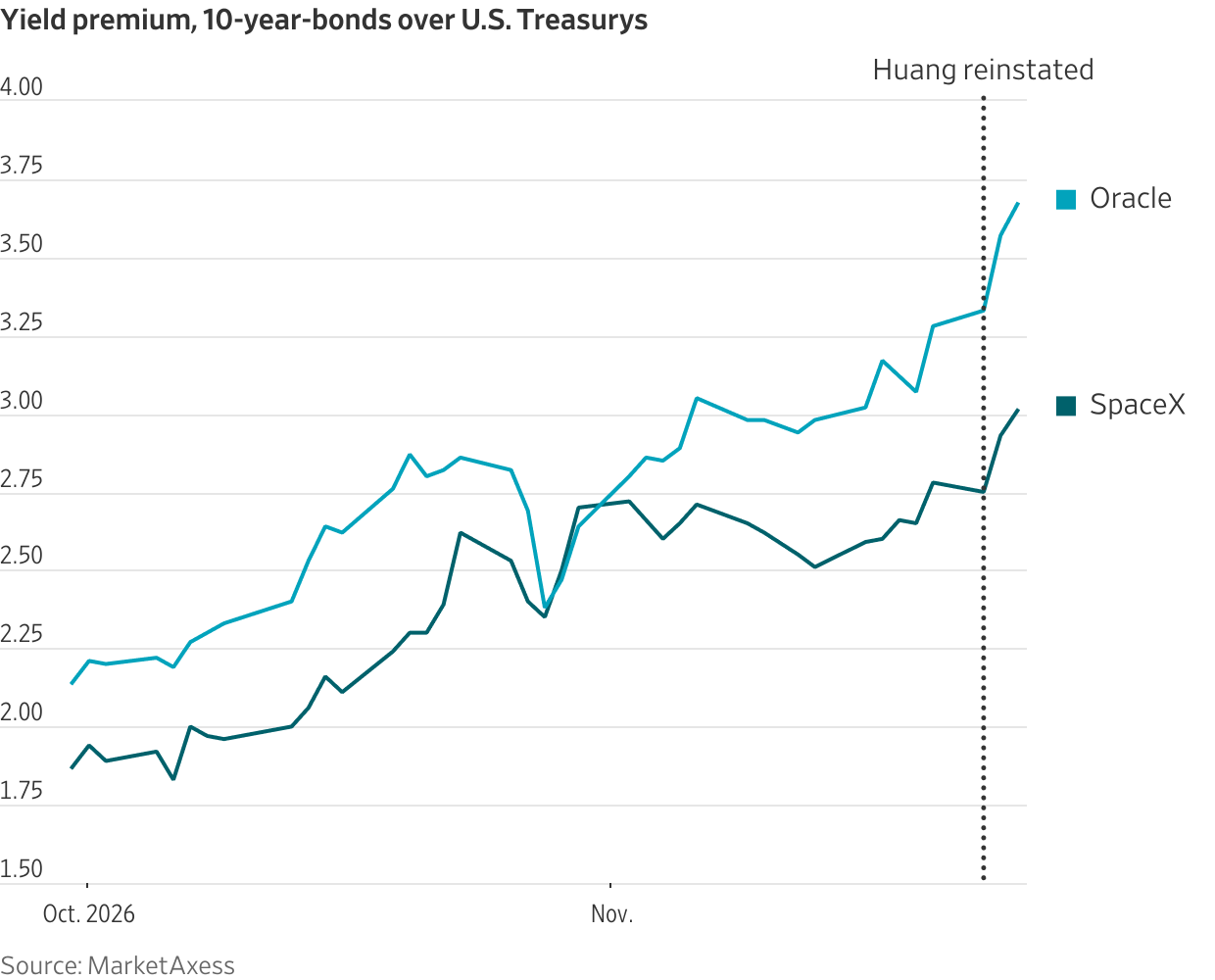
In a volatile week for stocks, debt investors’ consistent skepticism toward AI has stood in stark relief. Yield premiums for investment-grade corporate bonds—or the extra amount that traders demand to hold those bonds over ultrasafe U.S. Treasurys—barely budged on Monday, remaining near their highest level since May 2025 And yield premiums for prominent AI players such as Oracle or SpaceX have only kept climbing since.
Meanwhile, credit graders weren’t impressed with the Nvidia board’s’ break-up-and-make-up with Huang. S&P Global Ratings placed Nvidia’s sterling AA credit rating on negative watch Wednesday, saying that the episode “exposed vulnerabilities in Nvidia’s management and governance framework.”
The response from the debt markets is a signal that Nvidia’s C-suite shake-up wasn’t the only thing troubling the AI trade. Investors are increasingly concerned about the amount of debt that tech companies have taken on to finance the build-out and their ability to pay it all back.
“That’s the message to take much more seriously,” said Zidle. “Credit investors, who are really the lifeblood of this AI trade, are getting very nervous here.”
Bonds issued by the highly indebted AI cloud-computing provider CoreWeave have become one of the starkest examples of lenders’ nervousness. The company’s notes due in 2031—just issued in April—traded near 72 cents on the dollar Wednesday, a record low.
For much of the year, AI fervor helped stock indexes power through other concerns, such as the Iran war, oil prices, inflation and political uncertainty. Investors felt like the S&P 500’s strong performance was on solid footing, backed by huge profit growth.
But a single sector—semiconductors—has been the overwhelming driver of that profit growth, with some estimates attributing one-third of the S&P 500’s profit growth in the third quarter to Nvidia and Micron alone.
Now, some investors think the peak of the AI build-out is coming into view, and it is sooner than chip makers would like.
“Now there’s an investor expectation that hyperscaler capex maybe peaks next year, declines in ’28,” said John Belton, managing director for growth portfolios at Gabelli Funds. “I think that view has been getting priced in.”
With the tone on AI decidedly more cautious, investors are staring down some of the most volatile markets in recent memory.
Thorne Perkin, president of Papamarkou Wellner Perkin, said geopolitical conflicts, persistent inflation and the midterm election results are creating a “perfect storm.”
“Above all, markets hate uncertainty,” he said. “And we’ve had so much uncertainty over the last three weeks, that it is just a lot for any market to digest in a short amount of time.”
Write to Jack Pitcher at jack.pitcher@wsj.com, Hannah Erin Lang at hannaherin.lang@wsj.com and Jasmine Li at jasmine.li@wsj.com


