
 E-Paper



Bihar Assembly Election 2020: Regional parties lose bargaining power
Election observers feel the seat-sharing deals in both main alliances herald a larger political footing for the national parties BJP and Congress


As seat-sharing arrangements are finalised in Bihar, which goes to the polls from October 28, the bargaining power of the regional parties in the state appears to have diminished when it comes to dictating seat deals with their allies at the national level.
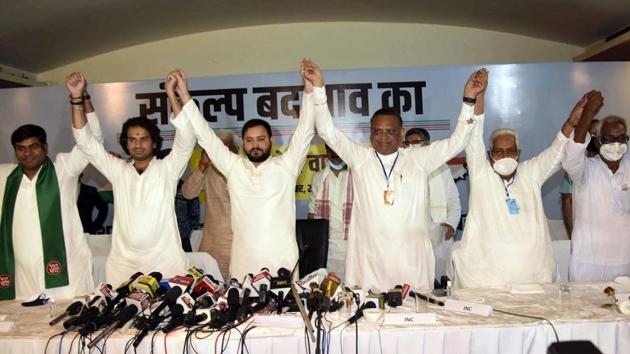
Election observers feel the seat-sharing deals in both the Bharatiya Janata Party (BJP)-Janata Dal (United) (JDU)-led National Democratic Alliance (NDA) and the Rashtriya Janata Dal (RJD)-Congress led Grand Alliance (GA) herald a larger political footing for the national parties, which have been dependent on regional parties since the 1990s when the BP Mandal Commission’s recommendations were implemented by the V P Singh-led National Front government. The decision gave 27% reservation to the Other Backward Classes (OBC) in government jobs. This was extended to educational institutions under the first United Progressive Alliance (UPA) government in 2006.
The aggressive caste-based polity in the backdrop of the Mandal Commission report is one important aspect of the rise and dominance of regional parties, mainly the Lalu Yadav-led RJD as well as the JD(U).
Also Read: Bihar assembly election: With Ram Vilas no more, test for Chirag to consolidate LJP
The BJP’s bid to clinch a deal with the JD(U) by contesting 121 seats and leaving 122 for the chief minister Nitish Kumar’s party is a case in point reflecting how the JD(U) has been nudged to climb down from its hallowed position of the big brother in the coalition in Bihar. As for the RJD-Congress-Left partnership in the GA, RJD, the senior-most ally, has ceded much space to the Congress allotting the party 70 seats and the three Left parties 29 seats.
“It’s true, the seat-sharing arrangement in the two main alliances has signalled the weakening of regional parties and allowing more space to national parties. It is because the regional parties are suffering from the fatigue of keeping their electoral stocks high and do not want to confront their respective allies at the national level any longer,” said DM Diwakar, a political observer and former director of AN Sinha Institute of Social Studies.
Many experts say that factors such as political flip-flops by the RJD and JD(U) in the last 10 years and flexing their muscles to browbeat their national allies on seat-sharing and other issues have stripped them of the upper hand this election.
One senior RJD leader, visibly unhappy with the party giving 70 seats to the Congress, said the JD(U)’s bid to re-align with the BJP in 2017 weakened socialist forces in Bihar and national parties are now taking advantage of that. “Had RJD and JD(U) stayed united, we would have remained strong in Bihar,” he said.
Senior JD(U) leader and minister Bijendra Yadav had recently advocated that the JD(U) should fight the elections alone, apparently upset over the JD(U) giving more space to the BJP in the seat deal.
The RJD rule from 1990 to 2005 ushered the era of coalition politics in the state with jailed RJD chief Lalu Prasad marginalising the Congress by boasting once that ‘he runs the grand old party in Bihar’. Even JD(U) chief Nitish Kumar’s catapult to national politics is credited to his alliance with the BJP after he broke it off with Lalu in 1993 to form Samata Party and later joined the JD(U).
But the flip-flops by regional parties paved the way for their slow downfall. RJD-Congress ties snapped during the 2009 Lok Sabha polls when Lalu offered only three seats to the Congress and allied with the Lok Janshakti Party (LJP). The same elections saw the RJD get marginalised by winning only four seats. In the 2010 Bihar election, the RJD-LJP alliance backfired with the RJD only winning 22 seats.
Post the 2005 assembly polls, Nitish Kumar created his own political space with a support base of extremely backward castes (EBCs), women and Mahadalits (all 22 sub groups of dalits), leaving the BJP to play the role of junior ally till 2010. But his bid to assert his independent identity by snapping ties with the BJP due to the elevation of then Gujarat chief minister Narendra Modi as Prime Ministerial candidate did not pay off big political dividends as the JD(U) won only two seats in the 2014 Lok Sabha polls.
“The regional parties have long thrived on their caste support, like the RJD on the Yadav-Muslim combination and the JD(U) on its support base of EBCs and Mahadalits. But now they have reached their limit and are playing a more inclusive game with national allies to hold on to their base,” said Nawal Kishore Chaudhary, political analyst and former Principal, Patna College. Chaudhary observed the JD(U), this time, had little option but to remain in the NDA because of the anti-incumbency factor and the decision of the LJP to fight alone whereas the RJD had to accommodate the Congress for Tejashwi Yadav to be accepted as the CM face of the coalition.
State president of RJD Jagdanand Singh disagreed that the RJD had conceded extra space to Congress or any other ally out of any compulsions. “We are contesting 144 seats and Congress has been an old ally. It is the NDA where the allies have been sidelined,” he said.
JD(U) spokesperson Rajeev Ranjan also said that the perception of the JD(U) losing its big brother tag in the coalition was wrong. “The JD(U) and BJP have been allies for over two decades and this seat-sharing deal is a natural alliance. One should not attach meaning to it. One can look at the bottle as half empty or half full,” he said.


