
 E-Paper



Punjab paddy harvest kicks off under farm fire cloud
59 stubble-burning cases recorded so far, 1 FIR registered; max incidents in Amritsar, Tarn Taran where early harvest varieties are sown

 Prefer HTon Google


As Punjab officially launched its paddy procurement season on Thursday, farm fires have already begun surfacing across the state, with 59 stubble-burning incidents reported so far. according to the latest Punjab Pollution Control Board (PPCB) report.
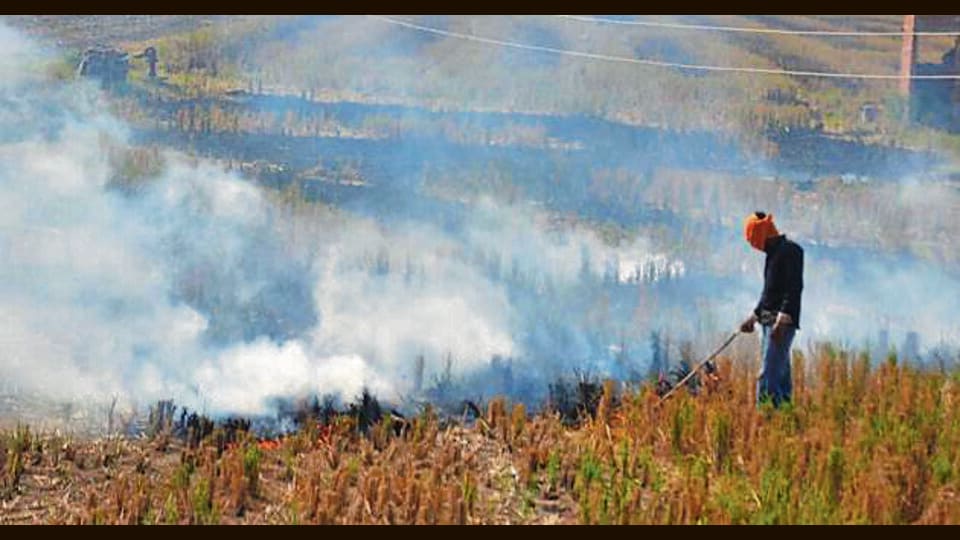
The border districts, Amritsar and Tarn Taran and Gurdaspur, where early paddy variety are harvested, account for 47 of 59 crop burning incidents.
While Amritsar has recorded 35 farm fires, Tarn Taran saw 9 incidents, followed by Ferozepur (5), Gurdaspur (3) and Moga (2). Faridkot, Fazilka, Hoshiarpur, SBS Nagar and Patiala reported one incident each.
On Wednesday alone, the state recorded seven fresh crop fires. Authorities expect incidents to climb as harvesting gathers momentum in the coming days. Punjab had recorded 95 farm fires during the corresponding period last year. The state has dedicated nearly 31 lakh hectares to paddy cultivation this season and expects to generate approximately 18.81 million tonnes (MT) of paddy straw, down slightly from 19.52 MT last year.
The state is expecting a bumper paddy harvest this season with the government setting a target of procuring 180 lakh metric tonnes (LMT) of crop. For the purpose, as many as 1,886 procurement centres have been established across the state.
To fund the drive, the Centre sanctioned a cash credit limit of ₹42,786.68 crore, while state agencies arranged roughly five lakh gunny bag bales. However, an acute shortage of warehouse storage space threatens to delay grain handling as arrivals hit the markets over the coming weeks. State godowns are already clogged with a backlog of around 280 lakh tonnes of unevacuated food grains from previous seasons, leaving procurement agencies and rice millers struggling for space to store the incoming crop.
According to the PPCB report, officials inspected 46 of the 59 reported fires, confirming 16 cases of stubble burning. Environmental compensation totalling ₹60,000 has been imposed in 12 verified cases.
In Patiala’s Samana block, authorities registered an FIR against an unidentified person under the Bharatiya Nyaya Sanhita (BNS) for violating stubble-burning norms. Officials made nine red entries in farmers’ land records and issued warning notices to supervisory personnel.
PPCB nodal officer Rajeev Gupta said that standard operating procedures (SOPs) have been issued to field teams. “Drones will also be deployed in the coming days as harvesting picks up pace. Field officers have been directed to strictly enforce SOPs and monitor fire incidents,” he said.
Farmers oppose plan to deploy drones
In Sangrur, local farmers and Union leaders are opposing the state’s plan to deploy drones for detecting stubble burning. Farm bodies argue the surveillance measures are punitive and unnecessary, maintaining that growers are forced to burn crop residue due to a critical shortage of management machinery.
Joginder Singh Ugrahan, the president of Bharatiya Kisan Union (Ekta Ugrahan), accused the government of resorting to forceful tactics instead of raising awareness or resolving operational bottlenecks.
“Farmers understand the issue, but they are not getting essential machinery like balers. Both in-situ and ex-situ machines remain inadequate and carry operational drawbacks,” Ugrahan said. “The government lacks a viable straw management scheme. Instead of addressing farmers’ grievances, they resort to crackdowns. No administration has shown genuine sincerity.” He warned that continued heavy-handedness would trigger agitations.
Jaswinder Singh Longowal, the leader of BKU (Ekta Azad), pointed out that farmers, many heavily indebted, are already trying to mitigate pollution using Happy Seeders and Super Seeders.
“Agriculture contributes barely 1% to 3% of total pollution, yet farmers are targeted while major industrial polluters face no action,” Longowal said. “Filing FIRs, inspecting fields, and making red entries in land records only tarnishes the image of farmers. Smallholders with 2.5 to 3 acres rarely get timely access to machinery—how can a farmer without a tractor afford expensive attachments?” He added that farmers would willingly curb burning if the government guaranteed minimum support prices across alternative crops.
Kulwinder Singh, a farmer from Nadampur village in Sangrur, backed these concerns, stating that required equipment fails to reach growers. Director agriculture Gurjit Singh Brar could not be reached out for his comment on farmers’ claim of machine shortage.
Defending the strategy, Rohit Singla, an executive engineer at PPCB, clarified that drone operations will be restricted to identified hotspot areas during peak harvesting windows. The move follows a Commission for Air Quality Management (CAQM) directive noting that while standard ISRO/IARI satellite tracking reduced daytime burning, violators shifted to late afternoon and evening hours—between 3pm and 9pm—to evade satellite thermal passes. Unmanned Aerial Vehicles (UAVs) are now mandated to capture time-stamped, geo-tagged visual evidence during these non-satellite observation windows.
A PPCB official said that drone purchases would be made according to the cases registered in the respective areas. The deputy commissioners have been given the authority to buy drones.
The PPCB has identified eight high-risk districts for priority monitoring: Sangrur, Ferozepur, Bathinda, Moga, Muktsar, Mansa, Tarn Taran, and Faridkot. These districts accounted for 3,454 of the state’s 5,114 stubble-burning incidents last year, representing 67% of total fires. While total fires declined from 10,909 in 2024 to 5,114 last year, enforcement remained strict, resulting in 1,963 FIRs under Section 223 (disobedience to order duly promulgated by public servant) of the BNS.


