
 E-Paper



Delhi’s Diwali pollution spike may be 49% higher than recorded: CREA
CREA's sensitivity analysis found the 24-hour average PM2.5 level could have reached 400 μg/m³, against the reported 269 μg/m³.

 Prefer HTon Google


A day after the Central Pollution Control Board (CPCB) said it has capped the upper limit of readings from all continuous ambient air quality monitoring stations (CAAQMS) at 1,000 micrograms per cubic metre (μg/m³) – meaning readings beyond this threshold will not be used to calculate the air quality index (AQI) and actually show up as a data gap, a new analysis – which fills in the missing PM2.5 hourly values with a reading of 1,000μg/m³ – finds Delhi’s 24-hour average pollution shoots up by around 49% on the day of Diwali.
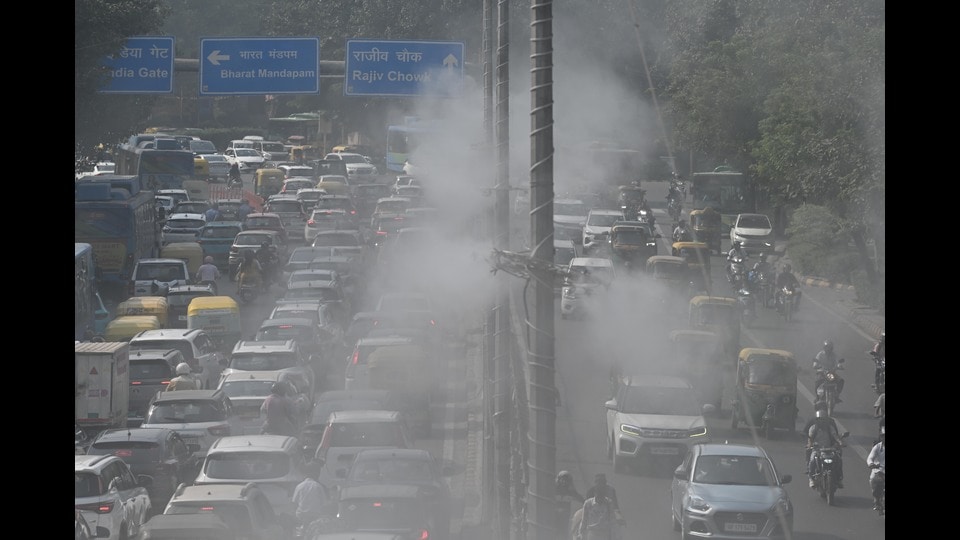
The Centre for Research on Energy and Clean Air (CREA), analysed hourly PM2.5 data from Delhi’s 59 monitoring stations and identified 255 missing station-hour observations between 4pm on November 8 and 4pm on November 9. These together accounted for 18% of the 1,416 observations expected during the 24-hour period used by CPCB to calculate the AQI.
“CPCB states that particulate matter analysers have a measurement range of 0-1,000 µg/m³ and that readings exceeding this limit are treated as out-of-range and excluded from AQI calculations. To examine the potential implications, we conducted a sensitivity analysis by replacing the 255 missing observations with 1,000 µg/m³, the upper measurement limit cited by CPCB,” said the analysis. It added that under such a scenario, the 24-hour pooled average across the expected station-hour observations rose from 269 to 400 μg/m³, an increase of nearly 49%. The peak hourly average also increased from 584 to 825 μg/m³.
Manoj Kumar, an analyst at CREA who was involved in the exercise, stressed that the analysis was a sensitivity assessment based on the CPCB’s stated measurement limit, and did not establish that all missing readings had necessarily exceeded 1,000 μg/m³.
“We have not independently established that all 255 missing observations resulted from concentrations exceeding 1,000 µg/m³. At the same time, it is a conservative measure, as we know from Delhi Pollution Control Committee (DPCC) data shows peaks over 2,000 and 3,000 too,” he said, stating the goal is to identify both peak hourly and 24-hour exposure to generate greater transparency.
CPCB’s clarification on Tuesday night had come a day after HT reported that more than two-thirds of the Capital’s 59 air-quality monitoring stations went offline between 10pm and 6am on Diwali, when exposure to pollution was at its highest.
Data subsequently released by DPCC, and acknowledged by the CPCB on Tuesday, showed readings as high as 3,744 μg/m³ at west Delhi’s Mundka at 2am on Monday, 3,023 μg/m³ at south Delhi’s JNU at 4am and 3,008 μg/m³ at NSUT West Campus at 5am. These readings were not used to calculate the AQI, but again, indicate, CREA’s analysis is also a conservative count of peak exposure.
Kumar said the existing AQI classification did not adequately distinguish between different levels of extreme exposure. PM2.5 concentrations above 250 μg/m³ fall in the “severe” category, meaning both the reported 24-hour average of 269 and the adjusted figure of 400 remain within the same category.
“While CPCB does not use these peaks to compute AQI, this shows maybe we need a higher grading, beyond severe, to highlight peak exposure to individuals at this time of the year,” he said.


Stay updated with all top Cities including, Bengaluru, Delhi, Mumbai and more across India. Stay informed on the latest happenings in World News along with Delhi Election 2025 and Delhi Election Result 2025 Live, New Delhi Election Result Live, Kalkaji Election Result Live at Hindustan Times.


