
 E-Paper



Delhiwale: Door Sutra, Part 2
Intro: A quest for doorways in the cityMetal bars run horizontally across a doorway’s width, a mosquito-proof jaali fitted behind

 Prefer HTon Google


Intro: A quest for doorways in the city
Metal bars run horizontally across a doorway’s width, a mosquito-proof jaali fitted behind. Another door has a cloth bag hanging limply from its handle for the delivery man to leave a 1-litre double-toned milk packet or half a kilo of masoor dal. Neither has a place outside to sit with chai.
Early in the week, this page looked at Old Delhi’s disappearing doorways in a dispatch titled Door Sutra. Beyond Old Delhi, vastly different doorways flourish across the many new Delhis, in the capital’s suburbs and housing sectors of Gurgaon, Ghaziabad, Faridabad, Noida and Greater Noida. They rarely receive the attention given to a haveli doorway. Yet most of us Delhiwale come home through them.
These doorways generally have no patience for arches, taaks, or built-in seats for gossip. Wooden panels, metal grilles, locks and mesh secure households against intruders and mosquitoes. Sometimes the inner door stays open, while the outer jaali-door remains shut. A caller must wait until someone inside sees his face on the video doorbell’s screen.
Truth be told, these doors generally lack the elaborate details of old doorways. Even so, residents make them their own. Consider two neighbours, Payal and Ruchi, in a suburban apartment tower.
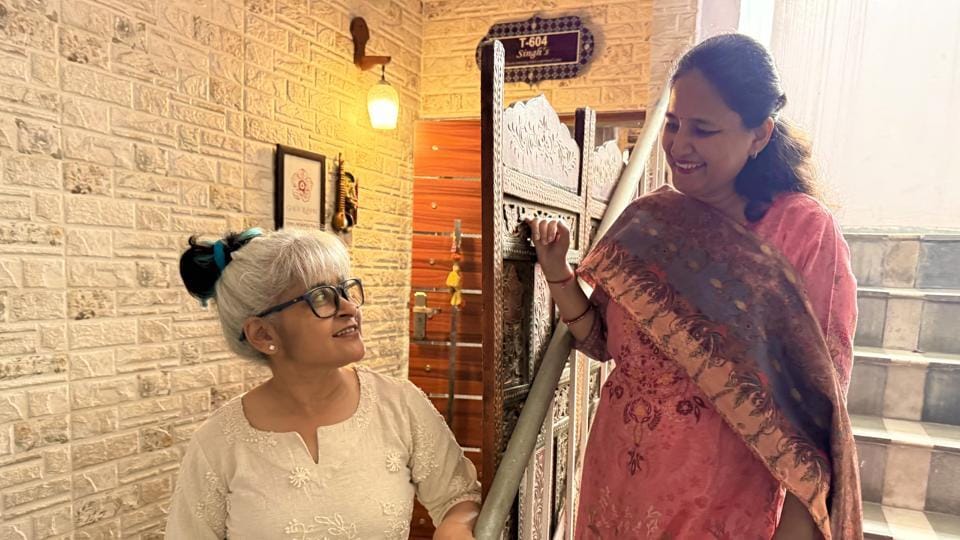
Payal’s sixth-floor door stands beside the tower staircase. The door’s long handle carries tassels, pompoms, cowrie shells and little bells. A purple disc says “on GOD’s timing.” The nameplate above also announces: “You are entering into a spiritual zone.” On the adjoining wall, Ganesh ji sits within a display piece incorporating a veena and a bansuri. (Which is apt, since Payal’s husband sometimes plays the harmonium, and their daughter sometimes sings.) Then there is the wooden jharokha separating the doorway passage from the staircase, its folding panels dense with carved flowers and leaves. Payal purchased the jarokha 15 years ago. It originally divided her living room into a temple and a sitting area.
Ruchi’s doorway faces Payal’s. A sign welcomes visitors to a “Happy Loving Caring Home.” A sacred Om is fixed near the top. Above hangs a bandarwar of rose decorations, with loops of beads. Her friend Aarti had made it last Diwali. Ruchi has let it stay for “shubh” luck. The doorway includes a tiny corridor, with a jhalar hanging at its opening beside the tower’s lift. Its strands of white flower-shapes and golden beads, each ending in a bell, resemble the sehra a dulha wears to veil his face during the wedding. In fact, whenever one particular friend comes visiting, the friend playfully hides behind the jhalar, theatrically emerging from the strands to sing the Nusrat Fateh Ali Khan qawwali “Dulhe ka sehra suhana lagta hai.”
This afternoon, both neighbours tactfully admire each other’s doorway, agreeing to pose beside one for a portrait. See photo.


Stay updated with all top Cities including, Bengaluru, Delhi, Mumbai and more across India. Stay informed on the latest happenings in World News along with Delhi Election 2025 and Delhi Election Result 2025 Live, New Delhi Election Result Live, Kalkaji Election Result Live at Hindustan Times.


