
 E-Paper



‘Dying in jail is not enough’: 1984 survivors react to Sajjan’s death
For victims and survivors of Delhi’s 1984 anti-Sikh riots, the death of former Congress leader Sajjan Kumar brought little comfort

 Prefer HTon Google


For victims and survivors of Delhi’s 1984 anti-Sikh riots, the death of former Congress leader Sajjan Kumar brought little comfort. After four decades of waiting for justice, many said his death in jail felt like an abrupt end to a battle they had hoped would culminate in the harshest punishment.
Ganga Kaur, 49, carries memories of the violence from a childhood she has never been able to leave behind. She lost her father, Kirpal Singh, two uncles and three cousins. She was seven when her father was called outside their home and burnt alive in front of her. “Even if you are a child, you can’t forget this,” she said.
The family, she said, could not even perform his last rites. “All the bodies were just thrown in the Yamuna,” she said.
Kumar, who was lodged in Tihar Jail, died at Safdarjung Hospital. He had been sentenced to life imprisonment by the Delhi high court in December 2018 for his role in the killing of five Sikhs and the burning of a gurdwara during the riots.
She said Kumar’s death offered limited satisfaction. “He died a natural death. If he was sentenced to death, we would have felt better, of course. But I still feel a little satisfaction that he died in jail and not around his family,” she said.
Others said they had spent decades hoping to see Kumar face a harsher punishment.
“We have been saying this for 40 years – it would have been better if he had been hanged,” said Popri Kaur, 75, a witness in one of the cases against Kumar. “There are two more cases pending against him. We will continue to fight as long as we breathe.”
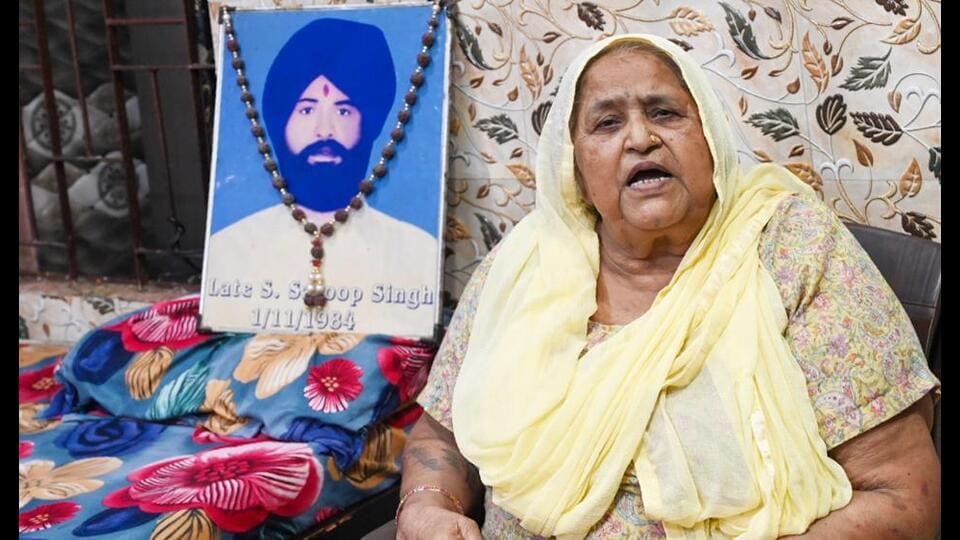
Sitting in the office of the Victims of 1984 Anti-Sikh Riots Society in Tilak Vihar, she recalled the violence in Sultanpuri, where her husband, Swaroop Singh, was killed. She has appeared in court several times over the years.
The passage of time has not softened her anger. She said she would feel rage every time she saw him in court. “I wanted to kill him myself. But I couldn’t take the law in my hands,” she said.
Her losses did not end with the riots. She lost one son to jaundice four months ago and another about 20 years ago, while a third died from an illness around 12 years ago. “I could not afford adequate treatment. If my husband was alive, maybe he would have done something,” she said through tears.
Similarly, for Atma Singh Lubhana, 66, Kumar’s death left a sense of an unfinished battle. “We wanted him to get the death penalty,” said Lubhana, vice-president of the Delhi Sikh Gurdwara Committee and chairman of the victims’ organisation.
Lubhana was 27 and working as a Haryana Police constable when the riots broke out. He had returned to his home in Sultanpuri as violence spread and said he saw Kumar, then a Congress MP, at a meeting inside a house in Mangolpuri on the evening of October 31, 1984.
Lubhana lost his paternal uncle, two nephews, his niece’s husband, two maternal uncles, his father-in-law’s brother and his wife’s two brothers. “For us, the punishment should have been hanging. Till the time Congress was in power in the country, nothing happened to him,” he said.
The survivors said the eventual conviction in December 2018 could not make up for the decades spent waiting.
Surjit Singh, 53, was 11 when violence engulfed Trilokpuri. He lost his father, Sawal Singh, and five uncles. He remembers his mother disguising him as a girl to protect him. “She made me wear my sister’s clothes, opened my hair and pleated them. That’s how I survived,” he said.
He estimated that 250-300 Sikhs were killed in Trilokpuri and said women were raped. He acknowledged that Kumar was not present in Trilokpuri.
But for Singh, Kumar’s death has deepened a larger sense of unfinished justice. “We would have been more satisfied if he died by hanging. He was 84, he had to die at some point, but that hope for justice is now gone,” he said.
His fight, he said, will continue. “Verdicts in two more cases are yet to come. Even after death, he should be sentenced for the crimes he committed.”


Stay updated with all top Cities including, Bengaluru, Delhi, Mumbai and more across India. Stay informed on the latest happenings in World News along with Delhi Election 2025 and Delhi Election Result 2025 Live, New Delhi Election Result Live, Kalkaji Election Result Live at Hindustan Times.


