
 E-Paper



Costs, infra gaps hindering electrification of school buses: Experts
Delhi’s EV Policy 2026 has already set a phased electrification mandate for school buses.

 Prefer HTon Google


Electrifying India’s school buses could reduce children’s exposure to road-transport emissions, but high upfront costs, inadequate charging infrastructure and financing constraints remain major barriers to wider adoption, industry and policy experts said at the India Clean Transportation Summit (ICTS) 2026 on Wednesday.
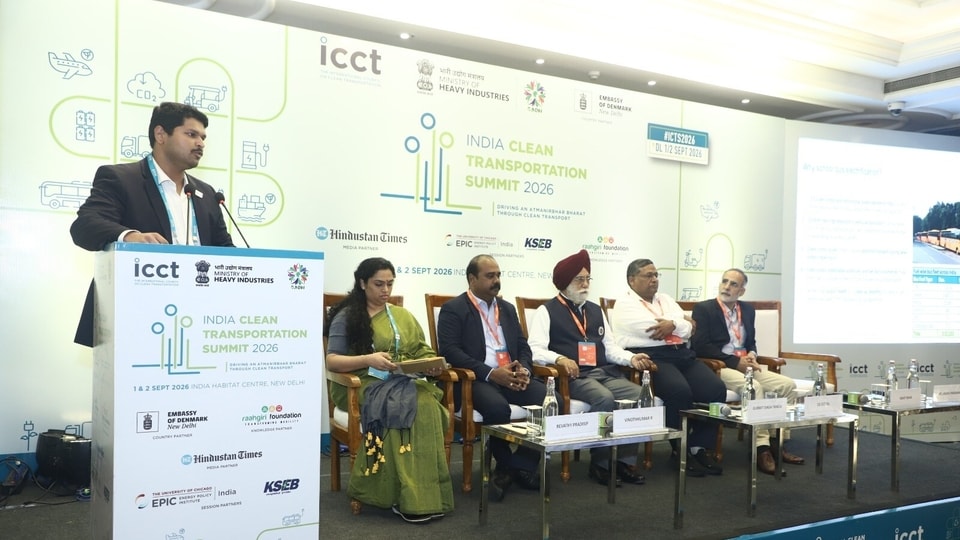
During a session titled “Generation E: Electrifying India’s School Bus Fleet”, operators said the economics of switching to electric buses remained a concern, while manufacturers and experts called for purpose-built vehicles and financing models tailored to the school-transport sector.
“School transport is fundamentally a social service focused on safely transporting children; electrification adds environmental benefits, but cost remains a major barrier,” said Gurmit Singh Taneja, joint secretary, Bus and Car Operators Confederation of India (BOCI). He also flagged inadequate charging infrastructure, charging time, limited OEM workshop facilities and the need to update motor-vehicle regulations for electric buses.
Also Read: Local battery push can make EVs cheaper, create 7.2 million jobs: Study
CK Goyal, chief operating officer (SPV Operations) at PMI Electro Mobility Solutions, said manufacturing capacity was increasingly available, but cost remained the biggest hurdle. “Schools are reluctant to pay a significant premium simply to transition to electric,” he said, adding that the market lacked sufficient cost-optimised electric school-bus models.
Goyal said schools were increasingly looking for an integrated package covering buses, charging infrastructure and assured fleet availability, with aggregation potentially making such solutions more viable. He also pointed to Delhi’s proposed plan to allow private buses to use government charging infrastructure and subsidised electricity.
Also Read: No curtains, black films: Delhi tightens bus safety rules after Greater Noida gangrape
“DTC has proposed that it will allow charging of private buses at its depots at a small cost. This is a good opportunity wherein after the morning school drops, buses can easily park and charge at the nearest DTC depot and be back at the school by afternoon,” said Goyal.
Vinoth Kumar R, head of planning and strategy at Switch Mobility, said India’s school-bus segment presented a strong opportunity for purpose-built electric mobility.
“Unlike city buses, school applications have lower utilisation and long idle periods, making them well suited to right-sized batteries and simpler architectures. A 30–40-seat electric school bus can offer a more compelling financial proposition, with manageable charging requirements and lower operating costs. The first 1,000 electric school buses by 2030 could provide an important starting point for the segment, helping build market confidence and charging infrastructure. To accelerate adoption, the industry should focus on purpose-built products, while policy support evolves beyond subsidies towards mandates, tax measures and enabling infrastructure,” Kumar said.
Dr Laghu Parashar, senior transport specialist at the World Bank, said school buses were suited to electrification because their daily utilisation was relatively low, with many operating around 50-60 km, while long idle periods could provide time for charging. Schools also often have access to land that could be used for charging infrastructure.
Also Read: Delhi to get comprehensive road-grid plan within 3-4 months, says Centre
For private operators, however, total cost of ownership alone may not determine adoption, Parashar said. “What matters is whether monthly cash flows work from the beginning,” he said, suggesting longer loan tenures, lower equity requirements, leasing models and risk-mitigation mechanisms.
Delhi’s EV Policy 2026 has already set a phased electrification mandate for school buses. Schools must ensure that at least 10% of their total fleet is electric within two years of the policy’s notification, rising to 20% within three years and 30% by March 31, 2030. The mandate applies to owned, leased or hired buses, with the education department responsible for ensuring compliance.


Stay updated with all top Cities including, Bengaluru, Delhi, Mumbai and more across India. Stay informed on the latest happenings in World News along with Delhi Election 2025 and Delhi Election Result 2025 Live, New Delhi Election Result Live, Kalkaji Election Result Live at Hindustan Times.


