
Sign in

Nine teams formed to keep a check on waste burning and pollution in Gurugram

Gurugram deputy commissioner Nishant Kumar Yadav said that with the implementation of Grap on October 1, teams have been instructed to inspect all areas

Updated on: Oct 4, 2023, 06:44:04 IST
By , Gurugram
Share
Share via
  • facebook
  • twitter
  • linkedin
Copy link
  • copy link

The district administration and Municipal Corporation of Gurugram (MCG) formed nine special teams on Monday to check waste burning and sanitation across the city, officials aware of the matter said on Tuesday.
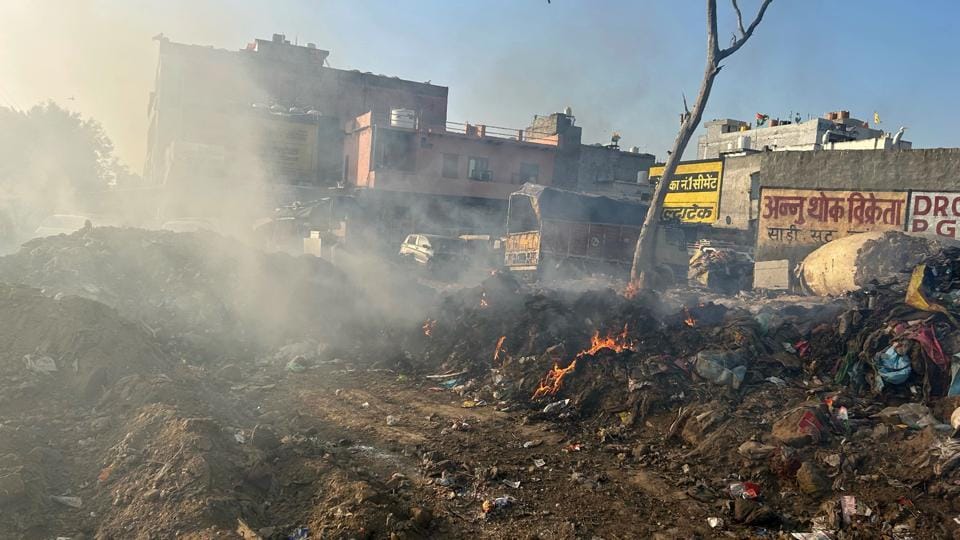
Garbage burns at the dump site at Sector 12 in Gurugram on Wednesday. (Parveen Kumar/HT Photo)

Gurugram deputy commissioner Nishant Kumar Yadav said that with the implementation of the Graded Response Action Plan (Grap) on October 1, the teams have been instructed to inspect all areas where waste burning is suspected or reported and to ensure compliance with Grap norms. “The teams have been asked to report daily to ensure that the pollution level is under control. Teams will take action against waste burning and penalise offenders based on the city’s average air quality index (AQI), which is still moderate. The Sector 51 monitoring station has recorded poor air quality in several zones with high construction activity for the past two days, and teams have been directed to check those areas,” he said.

He added that the Haryana State Pollution Control Board (HSPCB) has formed special inspection teams to check the operation of diesel generators that are not used in emergencies. “These teams will investigate violations and penalise offenders. We have written to both MCG and the Municipal Corporation of Manesar (MCM) to ensure that garbage is not burned in the city. Residents have been asked to report such incidents so that appropriate action can be taken,” he said.

When air quality is poor (AQI between 201 and 300), actions under Stage I of Grap are taken, which include ensuring proper implementation of dust mitigation guidelines in construction and demolition activities and sound environmental management of such wastes, and ensuring regular lifting of municipal solid waste, construction and demolition waste.

MCG joint commissioner Naresh Kumar said they also check hazardous waste from dedicated dump sites and ensure that no waste is dumped illegally on open land. “We perform periodic mechanised sweeping and water sprinkling on roads, as well as ensuring that dust collected is disposed of in designated sites and landfills,” he said.

Yadav said that actions under Stage II of Grap shall be taken at least three days before AQI reaches the projected levels of 301-400. “These measures include carrying out mechanical/vacuum sweeping and water sprinkling on the identified roads daily. Also, the teams will ensure focused and targeted action for reduction of air pollution in all identified hotspots in the city, intensifying remedial measures for the predominant sector(s) contributing to adverse air quality in each of such hotspots. Diesel generator sets of any capacity are banned,” he said.

Officials said that actions under Stage III of Grap will be taken at least three days before AQI reaches the projected level of 400.

  • Leena Dhankhar
    ABOUT THE AUTHOR
    Leena Dhankhar

    Leena Dhankhar is Senior Editor and Bureau Chief, Gurugram, at Hindustan Times, where she has spent over 17 years chronicling the transformation of one of India's fastest-growing urban regions. From starting her career as a crime reporter to leading the Gurugram bureau, her journalism has been defined by investigative reporting, in-depth storytelling and an unwavering focus on public interest. Over nearly two decades, she has reported extensively across crime, politics, civic governance, elections, real estate, environment, courts, sports, education and entertainment, covering Gurugram, Faridabad, Nuh and Palwal. Her reporting has exposed several major scams and systemic failures, including insurance frauds, waste management irregularities, illegal arms manufacturing units in Nuh, illegal mining in the Aravallis, organised crime networks and governance lapses affecting millions of residents. Known for her investigative work and exclusive stories, Leena has reported on high-impact national issues, including the Nicaragua charter flight carrying Indian migrants that was turned back amid allegations of human trafficking, exposing the growing network of illegal immigration rackets. Her work has also focused on gang wars, prison administration, juvenile crime, women and child protection systems, the functioning of the Juvenile Justice Board and Child Welfare Committee, and environmental challenges such as pollution, waterlogging and deteriorating civic infrastructure. Beyond hard news, Leena has extensively documented Haryana's rich heritage, forests and wildlife, bringing attention to the state's historical landmarks, biodiversity, conservation efforts and ecological challenges through immersive reportage and feature writing. Her journalism has consistently gone beyond breaking news. She has documented Gurugram's rapid urbanisation through long-form narratives and enterprise reporting on issues ranging from pothole-ridden roads, flooding and waste management to the changing social fabric of India's Millennium City. She also writes widely read feature columns, including The Outsider, Changemaker, and Concern for Gurugram, profiling people, places and ideas shaping the city's identity. Leena is the author of Gurugram School Murder, published by Juggernaut Books, a deeply reported account of one of India's most high-profile school murder investigations. She is currently working on her second book, an investigative work exploring some of India's most significant scams and fraud investigations. Beyond print journalism, she has expanded her storytelling through public speaking and digital media. She is a TEDx speaker and has produced podcasts exploring Gurugram's transformation, civic challenges and untold stories. Her work reflects a commitment to narrative journalism that combines rigorous reporting with compelling storytelling. A law graduate with an MBA in Human Resources, Leena brings a multidisciplinary perspective to her reporting, particularly on governance, public policy and legal affairs. She has travelled extensively across India to pursue investigative assignments, often reporting from remote locations and conflict-prone areas in search of stories that matter.Read More