E-Paper


Autonomous state medical colleges in Uttar Pradesh: Robust infrastructure but faculty strength needs a shot in the arm
Amid the one district one medical college push, Uttar Pradesh’s fast-growing network of government medical colleges has modern buildings, and sprawling campuses but patients are often sent to higher centres for conditions that should be managed on site, reveals HT ground report

 Prefer HTon Google


As Uttar Pradesh gears up for assembly elections early next year, the state’s development on the roads and infrastructure front has emerged as a major focus area in the political arena.
Simultaneously, the government’s one district one medical college (ODOMC) push has also been noticeable since 2019-20 in the state with an over 25-crore population.
An HT reality check at the grass roots revealed that while the state government has developed impressive infrastructure with modern buildings, new basic equipment and sprawling campuses for autonomous state medical colleges (ASMCs), a faculty shortage is hindering their basic objective.
Take the case of Mehak, 44, who arrived at the Autonomous State Medical College, Gonda, where she was diagnosed with a fractured femur, an injury well within the scope of a district-level facility. Yet, after initial stabilisation, she was handed a referral slip and sent 130 km away to King George’s Medical University, Lucknow. Doctors were left questioning the decision: why refer a case that could have been treated locally?
Her story is not an exception but exposes a pattern across Uttar Pradesh’s fast-growing network of government medical colleges, where patients are often pushed to higher centres for conditions that should be managed on site. The result is a chain of avoidable referrals, longer delays and an added strain on already burdened tertiary hospitals.
Consider the case of Rani, 10, who suffered a chest injury leading to an open pneumothorax. At ASMC Sultanpur, doctors conducted an X-ray, prepared a case sheet and then referred her to Lucknow. Again, the case raises the pressing question: are referrals being driven by medical necessity or by institutional limitations?
At the core is the difference between Tier-I, Tier-II and Tier-III cities where the latter lack amenities (outside the college campus). There are too few doctors and there is too little training. Officials within the system acknowledge the problem, often candidly.
These medical colleges have adequate bed strength and patient footfall is more than the minimum requirement. A majority of these institutions have district hospitals attached to them, where the average patient number in the OPD is over 1000 on any given day. This includes a major load on the medicine department where mostly primary level patients with fever or seasonal illness seek medical care. In operating theatres, gynaecology accounts for the major case load.
This is because for most patients, the district hospital is the only option and they cannot afford treatment at a private hospital.
Owing to the lack of laparoscopes, some medical colleges conduct open surgeries that can otherwise be done via the minimal invasive method. The open method makes the patient stay longer in hospital. Without a laparoscope, the training of medical students takes a backseat.
“The new medical colleges should be provided seperate/new hospital block on the same campus and the practice of clubbing existing district hospitals with colleges should be avoided to keep basic medical care at the district hospital and specialised care with the college. This was a practice till 2007 when a new medical college was developed.
This will also solve the issue of distance between medical college and hospital campuses,” said Ashok Kumar, general secretary, Rajkiya Nurses Sangh (RNS), a body of government nurses in Uttar Pradesh.
Dr Rajeev Goel, president of the UP chapter of the Indian Medical Association, said, “When a new medical college is started, faculty should be provided with good working facilities. Many faculty, particularly surgeons, leave colleges due to poor facilities.”
NOTABLE SHORTFALL
ASMCs are running without the minimum required faculty strength prescribed by the National Medical Commission.
The Maharishi Vashishtha Autonomous State Medical College (ASMC), Basti, is a case in point. Established in 2019, only 65 faculty members are working against 110 sanctioned posts—and even that number includes contractual hires. The medical college serves over 500 students, yet the hostel capacity covers barely half this number. Female students have been shifted into Type-II staff housing—not as a policy choice, but as a workaround.
The Basti medical college with an average daily OPD of 1200 patients, provides facilities in cardiology, neuro, urology, gastro, paediatrics, general surgery, orthopaedic, medicine and ENT. An average of over 20 surgeries are performed, half of them in gynaecology, daily.
“When we took over the hospital, it was only 20% functional but now it is fully functional and used for treatment and training,” said Dr Manoj Kumar, the principal of Basti ASMC.
As this medical college does not have a cath lab, seriously ill cardiology patients are referred to a higher centre.
“In case of a doubt, that patient might need high-end treatment. The referral is made in the interest of the patient,” the principal explained.
Despite a heavy workload, there is a severe dearth of speciality facilities. The 50-bed critical care unit (CCU) that was supposed to be completed by January 2025 is still not functional. As a result, critical patients are referred to other government centres. There is a lack of cardiac, neuro, gastro and nephrology services required for a comprehensive medical college. Establishment of a cath lab and an in-house government-run dialysis unit and the appointment of a nephrologist, endoscopy and colonoscopy facilities, a dedicated neuro unit for head injuries and trauma cases, are awaited here.
The medical college relies solely on open surgery without a laparoscope for the keyhole method. A laparoscopy set for surgery and gynaecology departments is required. Also, C-Arm is required to ensure precision in orthopedic surgeries. Equipment for MRI , ECHO & TMT, colour doppler (for high-risk pregnancies and vascular surgeries), emergency and Critical Care (ICU), MICU, SICU, and NICU/PICU are also needed.
At the ASMC Gonda, two MBBS batches have been admitted since 2024. However, patients are yet to get the actual benefit even as the district hospital is attached to the medical college. A large number of patients from Gonda opt for the ASMC Bahraich or Siddharthnagar for treatment.
This Gonda medical college’s faculty list includes names of resident doctors (JR/SR). Those serving their mandatory bond period have been mentioned in the faculty list. These doctors, after serving their bond period, will be free to leave, and they won’t be required to submit a resignation, which is mandatory for regular faculty. The emergency medicine department has four faculty – all of them junior doctors serving their bond period.
Prof Santosh K Verma, principal of ASMC Gonda, says teaching is being done in all the departments as there are faculty members but more are required. “We have over 40% regular faculty. Medical education is running in each department on the campus but there is still the need for more for further improvement in consonance with NMC standards,” said Prof Verma
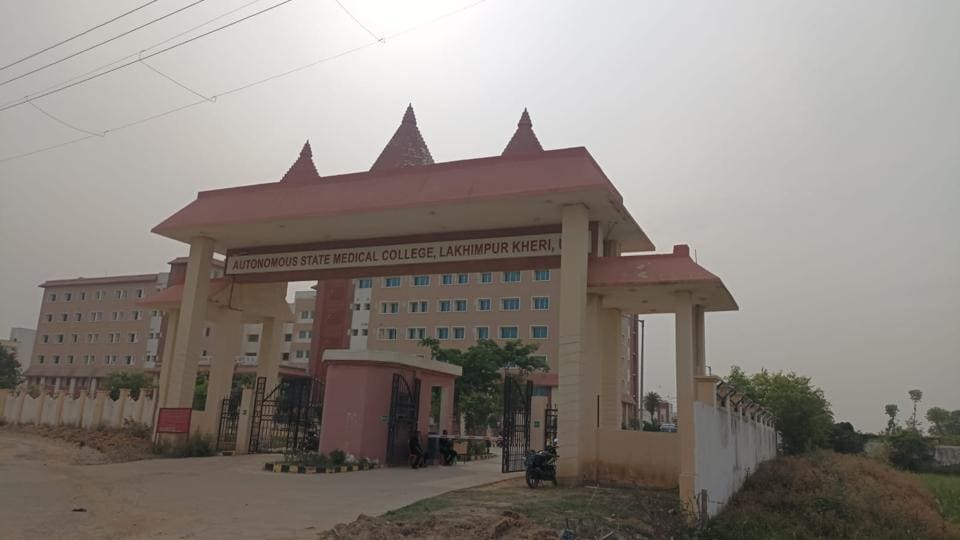
The ASMC, Lakhimpur Kheri, has over 50 faculty working against a requirement of 86, where at least 10 faculty have less than two years experience. With two MBBS batches admitted, the college is now applying for a letter of permission (LoP) before it admits the third consecutive batch for 2026-27. This will require faculty strength to go up to 110. The medical college is short of the minimum requirement for the present two batches.
Principal Prof Vani Gupta said, “The recruitment process is conducted regularly to fill vacancies.”
The medical college is located in Saidapur Bhau village about 20 km from the city area. The hospital building, which is coming up, will be over 10 km from the medical college, making it difficult for students and faculty to travel between classes and clinical work/learning. At present, the hospital wing is situated in the MCH hospital, about 12 km from the ASMC campus.
According to National Medical Commission (NMC) norms, a medical college, hostels, and teaching hospital must be on a unitary campus or in a maximum of two campuses. If the college and hospital are on two separate plots (campuses), the travel time between them must not exceed 30 minutes.
The college is in a village and the hospital is in the city area, over 10 km away. This distance may be covered in 30 minutes.
“But keeping in view the increase in traffic load every year, (covering) this distance will be only possible on a bike and not by car or college bus,” said a doctor working here.
Currently, the medical college hospital sees a patient footfall of about 3000 in the OPD. Over 500 surgeries are performed monthly. This is in addition to a dozen delivery cases a day.
The Madhav Prasad Tripathi Medical College and Hospital, Siddharthnagar, too, requires 93 faculty but 59 are working here. There are three professors against a requirement of 23 professors. The department of radiology has faculty but no MRI. The anaesthesia department has one faculty. The hospital gets an average 1500 patients daily, but major surgeries are hampered despite five modular and one customised operating theatre.
ASMC Siddharthnagar was established in 2021 to provide tertiary-level health care to the district and areas nearby and reduce the shortfall of doctors in the state. But the medical college struggles to find faculty to meet the minimum criteria.
Sample this. Two months ago, the medical college advertised over 40 faculty positions, got eight applications and ultimately two came forward to join.
“If the interview process is fast, it will help get more faculty,” said Dr Rajesh Mohan, principal, ASMC Siddharthnagar.
The medical college has three professors, seven associate professors, 93 resident doctors and 22 senior residents, (half serving their bond period).
Officials said patients of heart attack are stabilised and referred in case the treating doctor has any doubt. The hospital wing does not have a regular anaesthetist as just one has been deployed from the health department (by the chief medical officer, Siddharthnagar). This number isn’t enough to run critical care, ICU or other such facilities that require 24x7 monitoring. A junior resident has been trained in anaesthesia, who supports a couple of surgeries. Forensic and pharmacology lack faculty.
Gorakhpur is the closest referral centre from Siddharthnagar. Hence, patients who are referred to Gorakhpur from Siddharthnagar have to travel at least 75 km.
The Maharaja Suheldev ASMC in Bahraich gets patients from the district and other places, including Shrawasti, Balrampur, Gonda, Sitapur and other districts neighbouring Nepal. The average patient registration is between 2500-3000 with up to 35 surgeries done and 20 deliveries, both normal and caesarean. Doctors here are treating patients with basic requirements for seasonal illnesses.
Professors are working in the departments of orthopaedics, medicine, paediatrics and anaesthesia, but more faculty are required to increase PG seats. The faculty strength is 60, including 10 on contract service, while 110 are needed, according to NMC standards.
Vice principal Dr Malik Shahnawaz Ahmed said that clinical practice is done at Maharshi Balark hospital, about two kilometres from the medical college campus.
“The patient load is such that often the number of ultrasound (tests) goes over 200 in a day. The college is abiding by all regulations prescribed by NMC,” Dr Ahmad said. The college needs MRI equipment which has been sanctioned but is yet to arrive.
In phase one, medical colleges were established in Basti, Bahraich, Ayodhya, Firozabad districts under the one-district-one-medical-college (ODOMC) programme by the state government.
DISTANCE BETWEEN MEDICAL COLLEGES AND HOSPITALS
At a majority of the ASMCs, the medical college and hospital campuses are at a distance from each other. In Lakhimpur Kheri, the distance is 23 km at present. With a new building, this will come down to 10 km. The NMC gives first preference to developing both the medical college and hospital on a single campus or at a distance that can be covered within 30 minutes.
At Basti, the distance is about five kilometres while in Bahraich it is two kilometres.
“Having a college and hospital nearby is the dire need if training, particularly bed-side teaching (case discussion) and emergency training, is to be done. It is possible to rush for emergency/disaster management and handling of road traffic accident cases only if the doctor stays nearby. If this is not done by the time the doctor, who is under training, reaches the hospital, primary management is done by the available staff,” said Dr NS Verma, retired faculty from King George’s Medical University who was also nodal officer for NMC.
Experienced faculty does not want to stay in Tier II, III cities
These medical colleges frequently advertise faculty positions, but applicants do not turn up to join and those who appear for the interview are not sure about joining. ASMC Basti had advertised 57 positions for the teaching faculty earlier this year but only seven applicants came forward, practically leaving no choice before the college authorities for the selection.
At ASMC Siddharthnagar, 40 posts were advertised and eight were selected but only two joined.
Principals have been given the power to select and appoint faculty on contract so that there is no delay in conducting any procedure.
“We have been delegated the power. We have made such an arrangement that I can issue an appointment letter within a week of the interview. But frankly speaking, the letter of appointment will be issued only if applicants are there and they appear for the interview. No one wants to stay in peripheral districts leaving Lucknow. They are ready to compromise on salary too, but either the post should be in Lucknow or close to Lucknow,” said one of the ASMC principals.
Appointment of permanent faculty takes months from the date of advertisement. For contractual faculty, the minimum time required is a week from the interview.
REFERRALS AND PROTOCOLS
Obtaining a referral from ASMCs is easy, but following the same is difficult as often a higher centre is required. The 108 ambulance service follows protocol to take the patient to the nearest higher government medical facility. So if a patient is referred from Basti medical college to KGMU or RMLIMS in Lucknow, the ambulance service will take the patient to Gorakhpur, the nearest higher centre, about 70 km away, and not to Lucknow about 200 km away. The patient either goes to Gorakhpur and gets another evaluation and treatment or affords a visit to Lucknow for medical treatment.
RESIDENT DOCTORS LEAVE WITHOUT NOTICE
Medical colleges often face disinterest from resident doctors, many of whom are serving the mandatory bond period after completing their course from a government institute where education is far less expensive than at a private medical college.
But the disinterest is resulting in alleged mismanagement.
On April 14, resident doctors on emergency duty abstained from work. The move put the entire emergency wing in the hands of para-medical staff for about two-hours before the principal rushed senior faculty and other residents on duty. Since principals are in a dilemma, they do not appoint a replacement.
“What if I appoint another resident on contract and the one who went on leave comes back? How will I justify the payment for two as the contracted one will work for at least three months,” a principal said.
CAN ADDED PERKS BRING RELIEF?
Offering a solution to hold back faculty and improve teaching and training quality, principals of ASMCs are now demanding additional allowance to make the faculty stay in the peripheral districts.
Earlier, ‘rural allowance’ was given to doctors joining the Uttar Pradesh University of Medical Sciences, Saifai, Etawah. But this allowance, which is still being given to medical faculty in rural areas of Rajasthan, was stopped in UP in 2023. Now, principals are demanding the allowance be resumed to attract quality teachers for ASMCs.
The UP University of Medical Sciences is also planning to write to the state government to restart the allowance/incentive. Some ASMCs have also demanded a rural service allowance for their faculty. This amount earlier at UP University of Medical Sciences was over ₹1 lakh.
CHANGE IN BYE-LAWS
In November 2025, the directorate of medical education had asked all the principals at ASMCs to send proposals to change bye-laws keeping in view the frequent issues that college faces. The demand was to be sent at the individual college level. The principals were asked to send proposals detailing which portion of the bye-laws they need to change and what impact the change will bring. But this process of changing by-laws, which could have answered many issues, is yet to see an impact.