
 E-Paper



DTR to get third rhino rehabilitation area soon
“A 55-square kilometer area, comprising Sujauli forest range and Trans-Gerua of Katarniaghat Wildlife Sanctuary and some part of adjoining Sohagibarwa sanctuary in Maharajganj district had been earmarked for the purpose,” field director, DTR, Sanjay Kumar Pathak said.


The Dudhwa Tiger Reserve (DTR) will soon get its third rhino rehabilitation area (RRA-3).
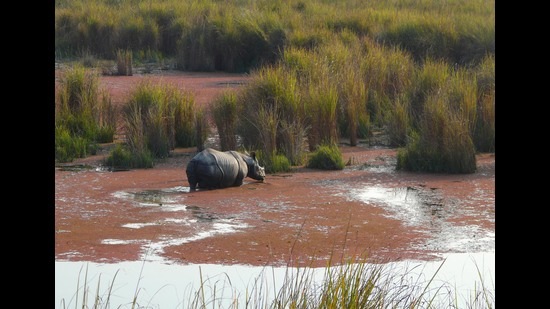
“A 55-square kilometer area, comprising Sujauli forest range and Trans-Gerua of Katarniaghat Wildlife Sanctuary and some part of adjoining Sohagibarwa sanctuary in Maharajganj district had been earmarked for the purpose,” field director, DTR, Sanjay Kumar Pathak said.
“The whole of proposed forest area with adequate grasslands, wetlands and waterbodies is suited to the rhino population. A security audit of the area would be carried out by a committee of experts, which would be finalised by UP chief wildlife warden,” he added.
“After the clearance by the security audit committee, trans-location of rhinos-either from Dudhwa or through new arrivals from rhino parks would be carried out,” he said.
The rhino rehabilitation programme in Dudhwa is part of the national conservation strategy for rhinos, adopted in 2019.
The rhino rehabilitation programme in U.P. was first launched in Dudhwa Nation Park in 1984 when five rhinos from various parts of the country were relocated in a specially designed 27-square kilometer fenced area named rhino rehabilitation area (RRA) in south Sonaripur range of the park.
Owing to natural habitat and enriched flora and fauna of Dudhwa, the rhino population has risen to more than 40 during the recently concluded rhino census in just 31 sq km area.
To infuse gene-pool diversity and to accommodate growing rhino population, a second rhino rehabilitation area (RRA-2) was developed in Belrayan range of the park with four rhinos, where habitat conditions were identical to the RRA-1, officials said.
“This too added to the glory of Dudhwa when the rhinos in their new location not only adapted to their new surroundings but gave birth to calves,” they added.
When it starts, the third rhino rehabitation programme in Katarniaghat Wildlife Sanctuary, would add a new chapter in U.P.’s rhino conservation strategy as it would be the largest rhino rehabilitation area of the state with its total area stretching to 55 square kilometers. The other two rhino areas RRA-1 and RRA-2 are 27 square kilometers and 14 square kilometers only.
One-horned rhinos (rhinoceros unicornis), popularly known as Indian rhino have a sound presence in Kheri’s Terai land of district Kheri. Even the rhinos from neighbouring Nepal seek shelter in this area owing to its congenial habitat conditions, officials said.


