


India v New Zealand T20I series: A trial run with mixed results
India have looked beyond their first-choice bowling attack, but not all experiments paid off.

 Prefer HTon Google


India have spent this T20I series against New Zealand looking beyond their first-choice bowling attack. Jasprit Bumrah rested; Kuldeep Yadav and Varun Chakravarthy kept out of the playing eleven; Axar Patel shouldering much of the spin responsibility; opportunities for Mayank Yadav, Prince Yadav, and Bhuvneshwar Kumar.
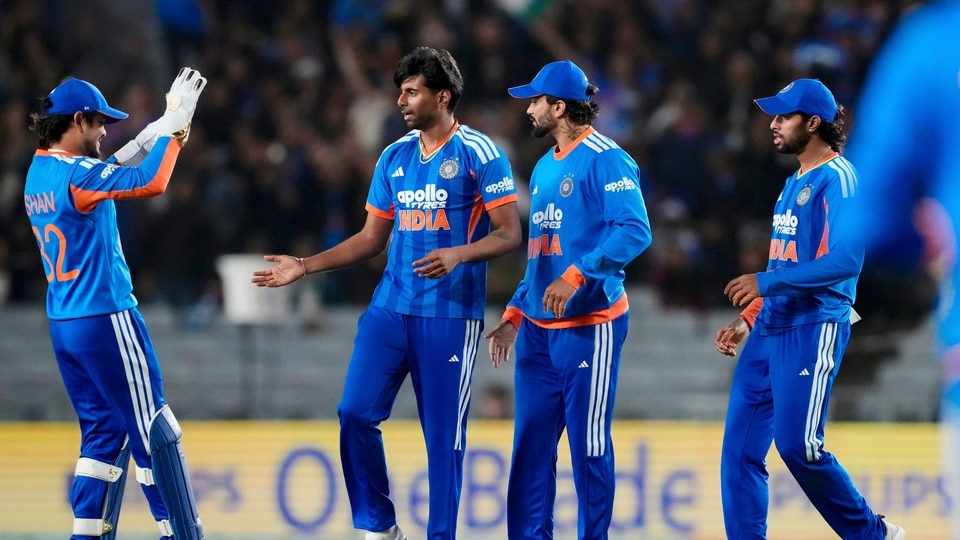
Nitish Kumar Reddy, meanwhile, has been given the chance to establish himself as a seam-bowling allrounder. It has been an exercise in building options rather than chasing results, and the returns have been uneven. India won’t mind that though, considering the series has been won in comprehensive fashion.
Arshdeep Singh, unsurprisingly, has emerged the clearest success. In a series where the bowling combinations have constantly shifted, the left-arm seamer has provided consistency that India can rely on, maintaining his discipline despite the demands of different phases, showing an ability to operate with the new ball and at the death without losing sight of his plans. His variations and control — especially over those yorker-length deliveries -- have been particularly valuable in this series where New Zealand’s batters have come down hard on anything slightly off.
The only Indian bowler to average less than 10 runs per over this series, Arshdeep's performances have also reinforced his importance to India's T20 structure. While the management have been busy assessing alternatives, he has continued to offer the assurance of an established international bowler. The challenge for India is to find others who can complement that reliability.
The auditions among the reserve fast bowlers have produced less definitive answers. Mayank and Prince have been given valuable exposure, an opportunity to understand the demands of international cricket and demonstrate that they can be trusted beyond their IPL credentials. Bhuvneshwar's return has served a different purpose. The experienced seamer needs time and opportunities to rediscover his rhythm, and the series has provided a platform for that process.
The most difficult examination, however, has been that of Reddy. India are keen to develop him into a genuine seam-bowling allrounder, a role that would give the team considerable flexibility. A player capable of contributing meaningful overs while strengthening the batting order is an attractive proposition in T20 cricket.
But Reddy, whose economy is 11.53 this series, has struggled to make a convincing case for the role. He has missed yorkers, often messed up his lines, and has lacked the consistency needed to establish him as a dependable option.
India can afford to persist with the experiment, but the series has offered a reminder that building an allrounder is hard work, and quite unforgiving against an opposition like New Zealand. The 64-run hiding at Auckland underpinned the need for Reddy to improve his control and develop a clearer bowling identity before he can become the sixth option the team would ideally like him to be.
The decision to keep Kuldeep and Varun out of the attack has been central to India's approach. It’s an attempt to understand how India’s bowling combination functions without its two most potent specialist spinners. Patel has consequently become the principal spin option, his ability to operate in the Powerplay and adapt to different situations making him particularly useful.
"Sometimes being defensive can also be an attacking role. You know what I mean? So, there are different situations which we need to handle. Axar is somebody who bowls in the Powerplay and whichever over he's given, he executes it very well," said spin coach Sairaj Bahutule after the Auckland T20I.
"When you have Varun as well as Kuldeep in the wings, they too are ready to bowl at any stage. They play a different role in conditions like this. But there is a lot of clarity given to them in terms of what is expected from them."
The direction was always evident — Patel offers control and flexibility, while Kuldeep and Varun bring different wicket-taking dimensions. India are not trying to find substitutes for their frontline spinners so much as establish that they have enough variety to construct an attack around whichever combination a match demands.
There is also a wider logic to this exercise. A team aspiring to remain competitive across formats and conditions can’t depend indefinitely on a settled group of first-choice bowlers. Injuries, workload management and changing conditions will inevitably demand alternatives. Giving those alternatives meaningful exposure now is preferable to discovering their limitations when an ICC tournament is at stake.
Not every experiment has worked, and Reddy's struggle is perhaps the most obvious example. But Arshdeep's consistency and Axar's adaptability have been reassuring, while the opportunities given to the reserve pacers have added to India's understanding of their options.
This series hasn’t necessarily produced a ready-made second bowling attack. It has, however, helped India identify where their depth is encouraging and where it remains a work in progress. A final attempt at that beckons in the fifth T20I at Hamilton on Sunday.


