
 E-Paper



Is Raja Karuppasamy's Modha Rathri the Mouna Ragam for this generation?
Anishma Anilkumar's Mutthu and Revathy's Divya are in direct conversation with one another in their despair and ultimately, in their reconciliation.

 Prefer HTon Google


Modha Rathri, the new Tamil film by debutant director Raja Karuppasamy, is about a forced marriage. Told with a lot of wit and humour, it is an otherwise sordid tale which has a woman at the centre of the story- with little or no agency. Mutthu (Anishma Anilkumar) is smiling awkwardly as she is decked up as a bride, but it will be soon revealed that she is planning to elope with her lover. As the night progresses, she finds out that the plan was not meant for her in the first place and that, she, at the end of the day, must accept her husband- a respectful and compassionate man named Maruthu (Rishikanth).
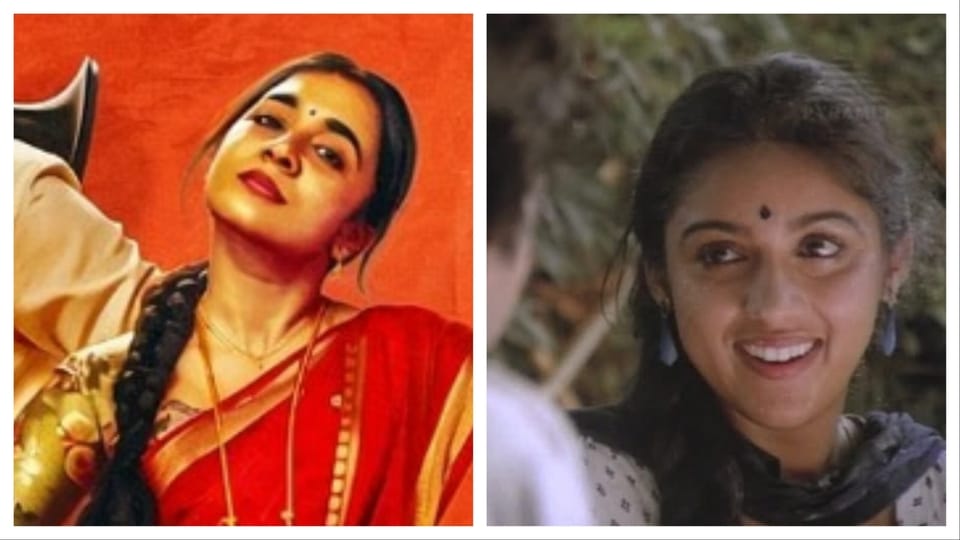
Mutthu mirrors Divya
Mutthu in many ways is reminiscent of Divya in Mouna Ragam. The Mani Ratnam film, released exactly 40 years ago, was his third Tamil film which also revolved around the institution of marriage and a woman's agency around that world. Revathy played Divya as a woman hiding secrets of her own, one who reluctantly agrees to the arranged marriage with Chandrakumar (Mohan). Only after their marriage, she has the courage to reveal that she had planned to elope with her lover Manohar (Karthik), but that resulted in tragedy as he was killed in a police encounter. Divya is moody, impulsive, angry and obstinate. She refuses to please, her face a black canvas for all the rage to settle in.
Mutthu, in bridal costume for half of Modha Rathri's runtime, is also seething with rage and humiliation. She finds herself trapped with a man who she barely knows, and in one scene, breaks out in an impromptu dance when pushed too far. It is staged as a humorous scene but this is no joke, Mutthu cannot bear to pretend that this is how her life is going to look like, where every decision that has led up to this point in her having no say about her choice of a partner. Mutthu also has her impulses but as the film progresses, she is presented with no other option but to accept how the man who she loved in the first place, is not the right match for her. She shrinks into silence for the later half of Modha Rathri, even as the background grows louder and crazier with her family finding out about her plan to elope.
Mouna Ragam and Modha Rathri are films that see a woman trapped under the institution of marriage, where she has to obey and listen to her family as per expectations for the sake of her own future. Mutthu's reality is in conversation with Divya's, as the identity of both women are largely drawn in connection with her husband. If Divya's audacity to ask for divorce and stand by her words shock us still, them Mutthu might be a reflection of that stubborn silence where she will escape no matter what. But can she escape? How far can she run? Modha Rathri becomes a stark reminder of how patriarchal Indian society operates within generations, devoid of any where both sides of the family gathers and gossips and shamelessly suck any form of privacy that the two newlyweds deserve.
In Modha Rathri, Mutthu and Maruthu barely know one another, but that's of no importance for the family. They must consummate their marriage on their first night together and the veiled disrespect shown by the families at both ends as they gather outside their room and attentively look for cues from outside. Modha Rathiri views this with a carefully balanced tone, peppered with humour, but there's something inescapably miserable about the despair that Mutthu feels in that situation.
The ideal husband prototype
In both Modha Rathri and Mouna Ragam, Karuppasamy and Ratnam present the male protagonists as kind, compassionate and perceptive people. Chandrakumar is Divya’s patient and understanding husband, who sees her as a woman free to take control of her own life and does not threaten her when she announces her decision to divorce him. In the same manner, Rishikanth infuses Maruthu with dollops of concern, so much so that it is him who helps Mutthu execute her plan to run away with her lover. In both Chandrakumar and Maruthu, the arc of a sensitive, caring husband is complete. The woman disrupts, leavea, and ultimately returns, while the man patiently waits.
Final thoughts
In the gap between these two films, 40 years have passed, but it seems the husband has stayed just as good and noble. He is, in many ways, a man who is marriage material. A man who is the dream husband. The definition of a green flag. One to choose over the careless lover. Thankfully, they do not come across as stock, designed-to-impress figures. Modha Rathiri is more perceptive in understanding Maruthu as it reveals, with sensitivity and care, the tragic past of his own romance, that led him to leave India and settle elsewhere, completely by himself. Modha Rathri updates the male protagonist with a touch of genuine care and concern, and in doing so, ultimately suggests that marriage is not always bad. Modha Rathri ends with the image of a real sense of happiness, one where both Mutthu and Maruthu see each other for the first time as flawed individuals tied for love. Mouna Ragam ends similarly, as Divya runs back to Chandrakumar and tears the divorce paper.
It is not the most progressive departure, as both films continue to draw the line when it comes at imagining where would these women be outside their marriage. She has no alternate choice because the existing one is so idealistic to look at, that it must be perfect. Her lover or her husband, the choice defines her always. It is never her own place in the home or in the world outside. Mutthu's rant at the end is short-lived, because even as she complains of trying her best to excel in studies and hoping for a better life, the beginning of a new day would confine her identity to wife, and in the next couple of years, a mother. It is a closure that insists that both Divya and Mutthu must outgrow their youthful impulses and accept their new reality, one that is palatable by the socio-economic reality.

Get more updates from Bollywood, Taylor Swift, Hollywood, Music and Web Series along with Latest Entertainment News at Hindustan Times.


