E-Paper



How are Houthis able to penetrate Saudi Arabia’s air defences?
The Houthis’ missile and drone attacks have struck Saudi targets despite the kingdom’s advanced defences.

 Prefer HTon Google


The Houthis in Yemen have repeatedly targeted Saudi airports and energy facilities despite the kingdom’s advanced military capabilities, raising questions about the group’s missile arsenal, attack tactics and the availability of air-defence interceptors.
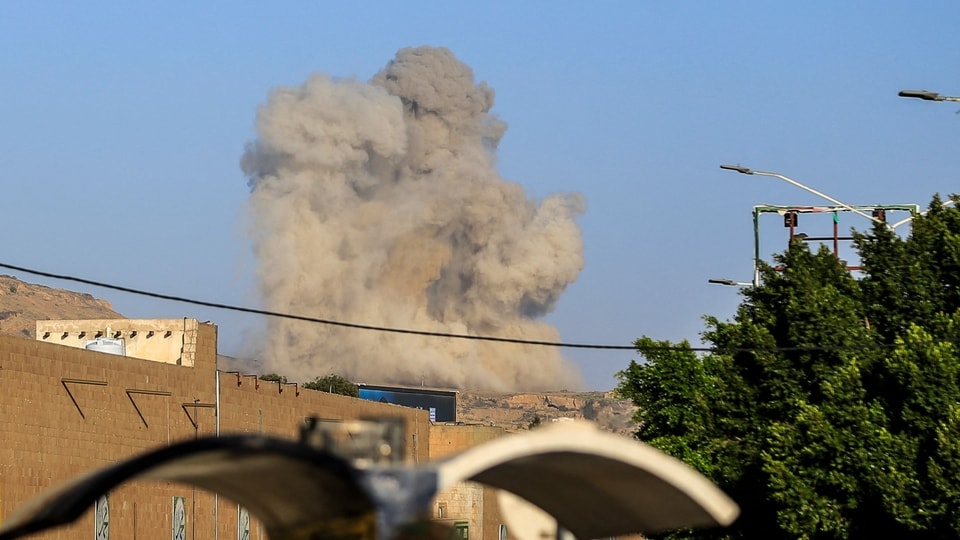
The attacks intensified over the weekend, when a strike on King Khalid International Airport in Riyadh killed at least 13 people and injured more than 300, according to reports from Saudi Arabia. An Indian national injured in the October 10 attack later died, the Indian Embassy in Riyadh said. A further attack on Sunday killed one person at the airport, while Saudi authorities reported additional incoming missiles and drones on Monday.
Saudi Arabia said its air-defence systems had intercepted incoming projectiles, even as some attacks reached their targets. On Monday, Saudi Energy Minister Prince Abdulaziz bin Salman vowed a “serious” response to the attacks, saying: “The events of recent weeks are serious. Our response must be equally serious.”
The attacks come as Riyadh backs a military offensive by Yemeni government forces against the Houthis, who have made advances along the Red Sea coast.
Here is what is known about the group’s weapons, how its tactics challenge Saudi Arabia’s defences and whether the kingdom faces limitations in its ability to intercept further attacks.
What weapons do the Houthis have?
The Houthis have developed a substantial missile and drone arsenal since taking control of Yemen’s capital, Sanaa, in 2014. Their capabilities have expanded from relatively short-range projectiles to weapons capable of striking targets hundreds or thousands of kilometres away.
According to Al Jazeera’s October 11 report, the group possesses ballistic missiles, cruise missiles and attack drones. Its reported arsenal includes the Palestine-2, a medium-range ballistic missile believed to have a range of around 2,000km, and the Toufan, which analysts associate with Iran’s Ghadr missile family.
The Houthis also possess shorter-range Burkan and Badr missile variants, which have been used in attacks across the Saudi border.
The precise weapon responsible for each recent strike on Saudi facilities has not been independently established in the reporting available. It is therefore important not to attribute the Riyadh airport attack to a specific missile without further evidence.
Nawaf Obaid, a senior fellow at King’s College London’s Department of War Studies, told Al Jazeera that the Houthis’ missile arsenal was largely derived from Iranian weapons technology, with some Chinese technological influences. He said the group had shown limited evidence of significant indigenous technological innovation, with local production concentrated on certain lower-end missiles and drones.
Iran has repeatedly denied allegations that it supplies weapons and training to the Houthis. Nevertheless, analysts have linked Iranian assistance to the development of the group’s capabilities.
How are Houthi attack tactics challenging Saudi defences?
The Houthis’ ability to combine different types of weapons is one factor that could complicate interception.
Ballistic missiles, cruise missiles and drones differ in speed, flight characteristics and the ways in which air-defence systems detect and track them. A coordinated attack involving several types of incoming weapons can place competing demands on radar systems, command networks and interceptor missiles.
The Associated Press reported on October 12, citing two regional officials, that an initial Saudi investigation into the Riyadh airport attack indicated that multiple drones had been launched before a combination of cruise and ballistic missiles reached the airport. The investigation was also examining why the defensive systems had not provided an earlier warning.
The findings were preliminary and based on officials who spoke anonymously. They do not establish that the same tactic was used in every recent attack.
The group has also demonstrated that it can continue launching attacks despite years of Saudi-led airstrikes against its positions in Yemen.
The significance of such attacks is not limited to the physical damage caused. Strikes against airports can interrupt civilian aviation, while attacks or threats against energy infrastructure can affect confidence in the security of a major oil exporter.
Why are Saudi Arabia’s air defences struggling?
Saudi Arabia operates advanced air-defence systems, including the US-made Patriot and Terminal High Altitude Area Defence (THAAD) systems. However, possessing sophisticated equipment does not guarantee that every incoming projectile can be intercepted.
One challenge is the size of the country. Saudi Arabia must protect a vast territory containing airports, oil installations, military facilities and population centres. Concentrating defensive resources around one location can leave other sites with less protection.
Nawaf Obaid told Al Jazeera that occasional penetration of Saudi air defences was to be expected given the kingdom’s size and its border with Yemen. He noted that Saudi forces had intercepted many Houthi attacks, even as some projectiles reached their targets.
Another concern is the availability of interceptor missiles.
The Associated Press reported in September that Saudi Arabia was running low on missile interceptors and had sought defensive assistance from regional and Western partners, citing two regional officials. The report linked the pressure on supplies to the wider war involving Iran and the expenditure of interceptors by the United States and its allies.
The shortage matters because advanced defensive systems rely on finite stocks of missiles. Interceptors must be available in sufficient numbers to respond to repeated attacks, and replenishing supplies can take time.
However, the reported shortage does not mean Saudi Arabia has exhausted its defences or that every recent interception failure resulted from a lack of ammunition. The precise number of interceptors currently available to the kingdom has not been publicly established in the reports cited here.
Saudi Arabia also faces a strategic choice over where to deploy its systems. Protecting Riyadh’s airport and major energy installations may require additional resources, but diverting those resources can leave other potential targets less protected.
Who are the Houthis, and why are they targeting Saudi Arabia?
The Houthis emerged from Yemen’s Zaydi Shia community and became a major force in the country’s civil war. They seized Sanaa in 2014, prompting the internationally recognised Yemeni government to seek external military support.
Saudi Arabia led a coalition intervention in Yemen in 2015 aimed at restoring the government’s authority. The ensuing conflict devastated the country, while years of Saudi-led airstrikes failed to dislodge the Houthis from their main strongholds.
The latest escalation follows renewed fighting along Yemen’s Red Sea coast. Yemeni government forces, backed by Saudi air power, have launched an offensive against Houthi positions after the group made advances near the Bab al-Mandab Strait, a strategically important passage linking the Red Sea to the Gulf of Aden.
The Houthis have described their attacks on Saudi Arabia as retaliation for Saudi military operations against areas they control in Yemen.
In a statement reported by the BBC on October 12, Houthi military spokesperson Yahya Saree said the group had launched missiles and drones against Saudi airports and energy facilities in response to Saudi airstrikes. The group has also warned airlines and passengers against using Saudi airports and airspace, with exceptions for travel to and from Mecca and Medina.
The attacks put pressure on Riyadh by targeting infrastructure central to its international connectivity and economic ambitions. They also risk widening the conflict, given Saudi Arabia’s role in the wider regional confrontation involving Iran and the United States.
Can the Houthis sustain the attacks?
The scale and duration of the Houthi campaign remain uncertain because the group’s total missile and drone inventory is not publicly known.
Saudi-led coalition strikes have targeted what the coalition describes as Houthi military infrastructure, including weapons depots and drone-production facilities. Such attacks could reduce the group’s ability to sustain long-range operations, particularly as it continues fighting on multiple fronts inside Yemen.
Al Jazeera quoted defence analyst Wolfgang Pusztai as assessing that the Houthis might have only a limited number of short-range ballistic missiles remaining. If accurate, that could constrain their ability to conduct large-scale attacks involving numerous missiles and drones.
However, a limited supply of certain missiles would not necessarily eliminate the threat. The group could continue using other weapons or concentrate its remaining capabilities against selected targets.
The Houthis are trying to pressure Saudi Arabia into halting its air campaign, while Saudi strikes are intended to weaken the group’s military capabilities. The extent to which either side can sustain its operations will depend on its available weapons, supply networks and battlefield position.
The outcome will also depend on whether Saudi Arabia can disrupt the Houthis’ launch capabilities, improve early warning and maintain sufficient interceptor stocks while defending its most important facilities.