E-Paper



For new drugs, scientists turn to the microbes inside the body
Researchers have now linked specific gut bacteria to cholesterol, to memory loss with age and to the response to cancer immunotherapy.

 Prefer HTon Google


For nearly a century, medicine has drawn some of its most important drugs from microbes. Penicillin came from a mould, and the first statins, the cholesterol-lowering drugs now taken by hundreds of millions of people, were isolated from fungi in the 1970s. A run of studies over the past year points to a different source: the bacteria living in the human gut.

If a gut bacterium makes a molecule that acts on the liver, brain or immune system, that molecule is a candidate drug, and so, potentially, is the bacterium itself. Researchers have now linked specific gut bacteria to cholesterol, to memory loss with age and to the response to cancer immunotherapy. Most of the evidence comes from mice.
Also Read | Antibiotics can disrupt your gut bacteria: Biologist explains 5 digestive changes you may notice
A statin-like molecule made in the gut
The latest, published in Nature on October 7 by a team from Sun Yat-sen University in Shenzhen, concerns Bacteroides uniformis, a bacterium found in most human guts. It makes pentadecanoic acid, which blocks HMG-CoA reductase, the liver enzyme that makes cholesterol and the one statins block. Liver cells respond by putting more LDL receptors on their surface, and these pull LDL, or “bad”, cholesterol out of the blood.
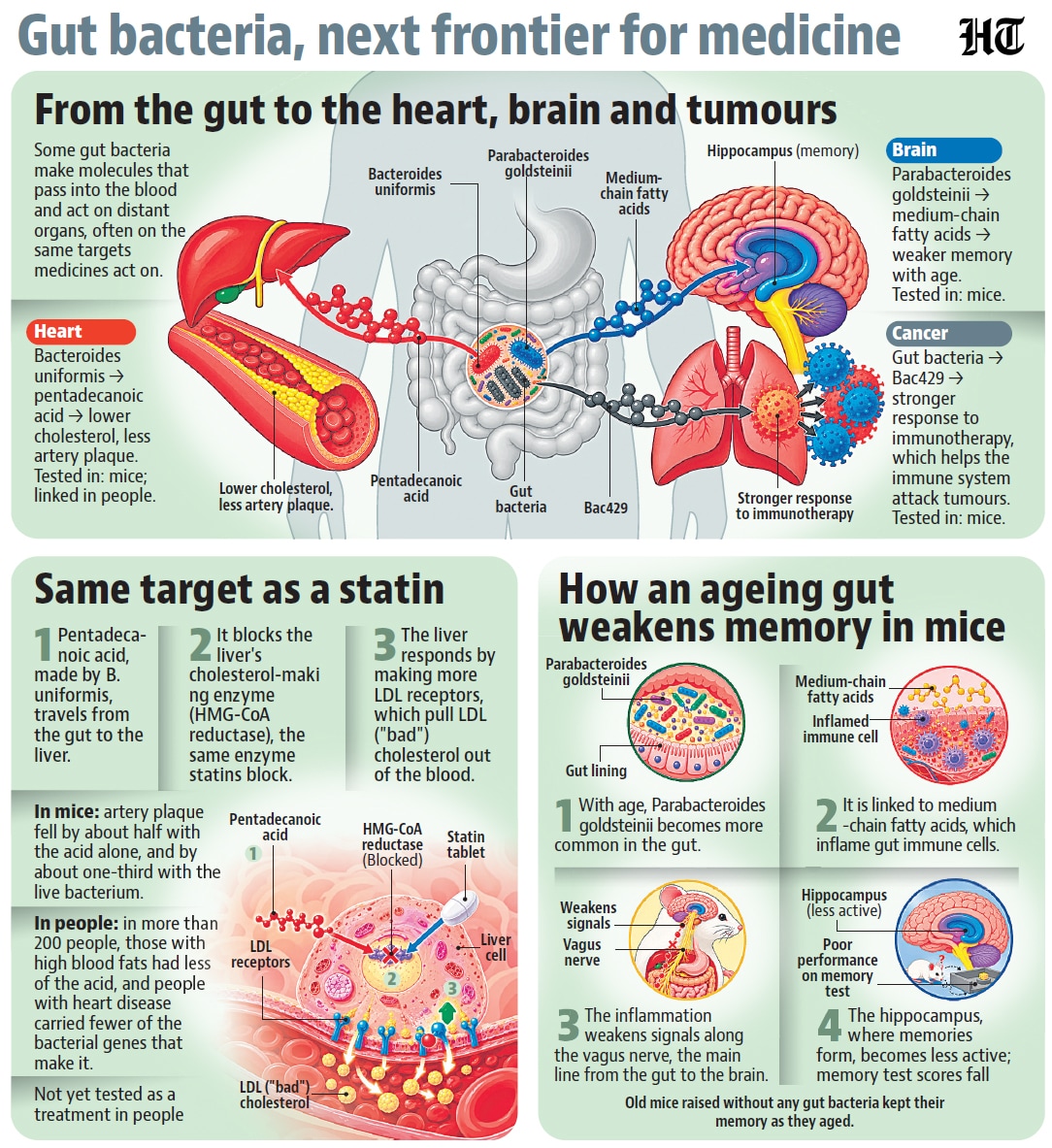
In mice engineered to develop atherosclerosis (fatty plaque in artery walls), the live bacterium shrank plaque by about a third, and the acid on its own halved it. In blood and stool from more than 200 donors, people with high blood fats had less of the acid, and those with heart disease carried fewer of the bacterial genes that make it.
Statins already work by the same route. The difficulty, said Dr Ambuj Roy, professor of cardiology at the All India Institute of Medical Sciences (AIIMS), Delhi, is adherence. “There is data to show that only 20% of people who should be on a statin, take statin in the long term,” he said. That – and statins’ plateau effect where they don’t help beyond a particular level -- is why science has been looking for alternatives.
Also Read | Scientifically Speaking: You are what your gut microbes eat
An ageing gut and a fading memory
The cholesterol work is hardly the first sign that the answers to some diseases may lie in the gut. In March, a team at Stanford Medicine and the Arc Institute traced a similar chain from the gut to the brain, reporting in Nature that the bacterium Parabacteroides goldsteinii becomes more common in ageing mice. Its rise is linked to medium-chain fatty acids that inflame immune cells in the gut wall. That inflammation weakens signals along the vagus nerve to the brain and reduces activity in the hippocampus, where memories form. “The timeline of memory decline is not hardwired,” the Standford lead author Christoph Thaiss said.
First evidence in patients
Both chains so far rest on mice, but in cancer the gut’s influence on treatment has already been tested in patients. In a trial reported in Nature Medicine in January, researchers gave patients capsules made from screened donor stool alongside immunotherapy. Of 20 people with lung cancer, 80% responded, against the 39–45% typical with immunotherapy alone. Of 20 with melanoma, 75% responded, against a typical 50–58%. The trial, however, had no comparison group, and a randomised trial across Canada is now testing whether the gains hold.
The capsules carry a donor’s whole gut community. A more refined approach uses defined mixes of laboratory-grown strains. Dr Govind Makharia, professor of gastroenterology at AIIMS, Delhi, expects mixes to be the norm. “A single bacterium doesn’t work generally; it has to be a cocktail of bacteria,” he said.
Also Read | From digestion to immunity, your gut may influence healthy ageing: Here are 7 things you need to know
The Indian gut question
B. uniformis is “almost there in every human gut”, including Indian ones, Makharia said. In August, though, researchers at the National Centre for Cell Science in Pune found 14 new gut bacterial species in eight tribal communities, and found that Indian strains differ genetically from Western ones. Whether Indian B. uniformis makes as much pentadecanoic acid has not been measured.
For the cholesterol finding, Roy said he is watching for the studies in humans now.
Vital explains the science and the conversations at the frontier of healthcare and wellness. It isn’t medical advice — what to do with it is a conversation for you and your doctor.