
 E-Paper



Russia's latest moves in eastern Ukraine take centre stage
Late on Monday, the Kremlin said Putin planned to officially recognise separatists in eastern Ukraine, a move that would likely torpedo European-mediated peace talks and further escalate tensions with the West.

 Prefer HTon Google


Hours after United States (US) president Joe Biden indicated a willingness to meet Russian president Vladimir Putin if Russia did not proceed with an invasion -- Russia said it was “premature” to talk about any specific plans for a summit -- Moscow stepped up its political offensive, inched towards recognising eastern Ukrainian provinces as independent republics, and the military situation on the ground in Ukraine took a turn for the worse.
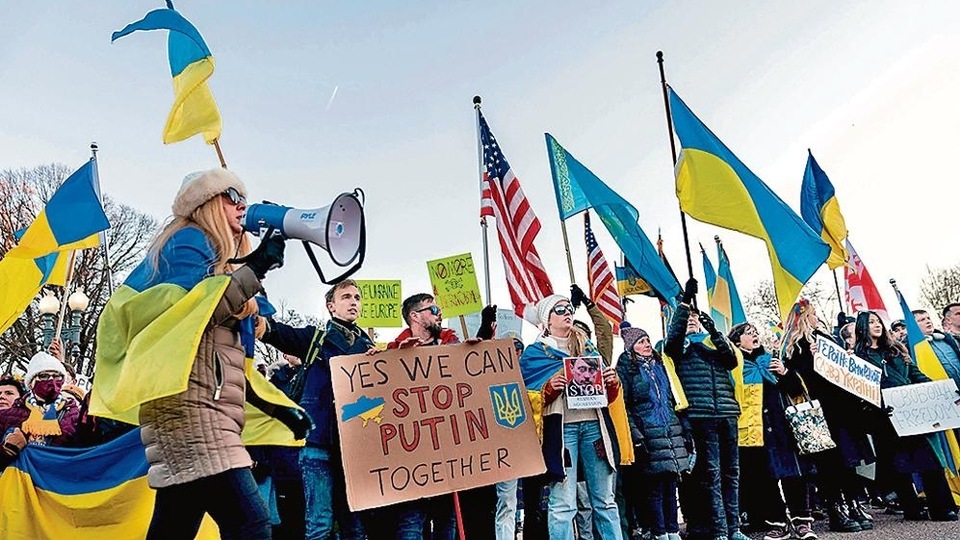
Late on Monday, the Kremlin said Putin planned to officially recognise separatists in eastern Ukraine, a move that would likely torpedo European-mediated peace talks and further escalate tensions with the West.
The US earlier claimed that Russia’s actions and statements were a part of the script that Washington had consistently warned would be a part of Russia’s plan to invade Ukraine. But even as an escalatory dynamic commenced on the ground, diplomatic doors remained open, with US secretary of state Antony J Blinken and Russian foreign minister Sergey Lavrov scheduled to meet on Thursday.
Explainer: What will Russian recognition of breakaway Ukraine regions mean?
On Monday, Putin held a televised meeting with his top national security officials, where they alleged that Ukraine was committing a “genocide” against Russian-speakers in eastern Ukraine. Putin said he would consider appeals by Russia-backed separatist leaders of eastern Ukrainian provinces to be recognised as independent republics. The heads of Donetsk and Luhansk in the Donbas region had, soon before Putin spoke, gone on Russian television asking Russia to recognise their independence. This follows a resolution in the Russian parliament last week urging the Russian president to recognise the two regions as independent republics. The US has warned that this would mean the “wholesale rejection” of the Minsk agreements. The Minsk agreements, signed after the conflict in Ukraine in 2014-15, provides a framework for peace and rests on power-sharing between Kiev and the Russia-backed eastern provinces.
Putin also reiterated his demand related to “security guarantees” as “task number one”. Russia has demanded that the North Atlantic Treaty Organisation (NATO) step back from its military presence and engagement in eastern Europe; it has also sought a binding pledge that Ukraine would not become a NATO member. While clarifying that Ukraine’s membership is not on the agenda at the moment, the US and NATO have rejected Russia’s security proposals, making it clear that NATO would not shut its doors or step back from eastern Europe.
Putin’s statements on Monday coincided with enhanced confrontation on the ground, with Russia claiming it destroyed two Ukrainian armoured personnel carriers (APCs), “evacuating saboteurs from the battlefield” and killing five – a claim Ukraine rejected. While acknowledging the situation as “extremely tense”, Russia blamed it on shelling by Ukrainian forces against locals in the Donbas region – which, the US claimed, was exactly the kind of “false pretext” it has been warning that Russia would use to invade. Russian forces are also staying on in Belarus, continuing with their “joint exercises”, beyond the stipulated end-date of the exercises – a move that the US claims is a part of the series of provocations that Russia has embarked upon as a prelude to its aggression in Ukraine.
Responding to Russian claims and allegations, Ukraine’s foreign minister Dmytro Kuleba tweeted, “No. Ukraine did not attack Donetsk or Luhansk, send saboteurs or APCs over the Russian border, shell Russian territory, shell Russian border crossing, conduct acts of sabotage.” He added that Ukraine also did not plan any such actions and asked to Russia to stop its “fake-producing factory now”.
Follow Live updates on Russia-Ukraine crisis
On Monday, US national security advisor Jake Sullivan told NBC that Russia was planning an “extremely violent invasion” of Ukraine, and that in the preceding 24 hours, there had been “further moves of Russian units” to the border as it was getting into a position to attack. He also warned that US had intelligence that there were plans to “repress…crush…harm” Ukrainians. The US has sent a formal letter to the United Nations (UN) alleging that it has information that Russia has a list of Ukrainian citizens it plans to kill and detain after its invasion – an allegation that Russia has rejected as “absolutely made up” and “fake”. On Sunday, secretary of defense Lloyd Austin had said he did not believe Putin was “bluffing”, and secretary of state Blinken had said that all of Putin’s moves confirmed what US had told the UN Security Council would be Russia’s script to invade Ukraine.
Even as the political-military situation took a turn for the worse on Sunday and Monday, diplomatic efforts continued. The initiative to hold a Biden-Putin summit was taken by France, and is a part of intense diplomatic activity in Washington DC, Paris, Brussels, Munich, Kiev and Moscow – with American and European leaders stepping up warnings about Russian invasion, while simultaneously maintaining channels of communication with Putin.
In a statement, France said that both Biden and Putin have agreed to the “principle of a summit”. This followed French president Emmanuel Macron’s calls with both the US and Russian president on Sunday and Monday. In a statement, the White House said that the US was committed to pursuing diplomacy “until the moment an invasion began”. It referred to the Blinken’s scheduled meeting with Lavrov, “provided Russia does not proceed with military action”, and added, “President Biden accepted in principle a meeting with President Putin following that engagement, again, if an invasion hasn’t happened. We are always ready for diplomacy. We are also ready to impose swift and severe consequences should Russia instead choose war. And currently, Russia appears to be continuing preparations for a full-scale assault on Ukraine very soon.”


