
 E-Paper



Modi, Biden stress food, energy security at ‘I2U2’
During its first leaders' summit, the grouping of India, Israel, the UAE and the US (I2U2) on Thursday unveiled initiatives focused on food security and clean energy, including a $2 billion programme to develop food parks across India and a $330 million hybrid renewable energy project in Gujarat.


The grouping of India, Israel, the UAE and the US (I2U2) unveiled initiatives focused on food security and clean energy during its first leaders’ summit on Thursday, including a $2 billion programme to develop food parks across India and a $330 million hybrid renewable energy project in Gujarat.
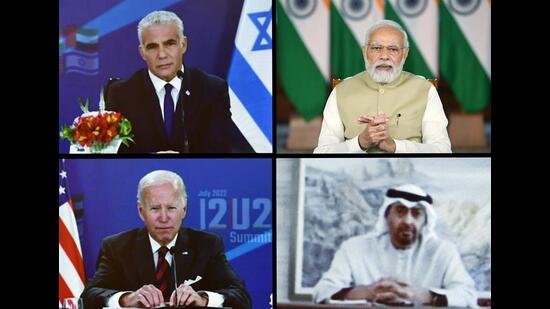
Prime Minister Narendra Modi joined his Israeli counterpart Yair Lapid, United Arab Emirates (UAE) President Mohammed bin Zayed al-Nahyan and US President Joe Biden for the virtual I2U2 Summit less than nine months after the grouping was conceptualised last October. The meeting was held during Biden’s visit to Israel, part of his first tour of West Asia since becoming president.
The initiatives reflected the focus of the four countries on mobilising private sector capital for economic cooperation in the six target areas of food security, energy, water, health, transportation and space. Besides the two projects unveiled at the summit, officials said the four countries are considering several other specific projects.
India and the US are now part of two four-nation groupings — I2U2 in West Asia and the Quad in the Indo-Pacific — with similar objectives, including the creation of sustainable infrastructure and acting as a counter to China’s growing assertiveness.
Biden and Lapid raised the war in Ukraine in their opening remarks, especially in the context of food and energy security, while Modi emphasised that I2U2 has a “progressive and practical” agenda and is a good model for “practical cooperation in the face of increasing global uncertainties”.
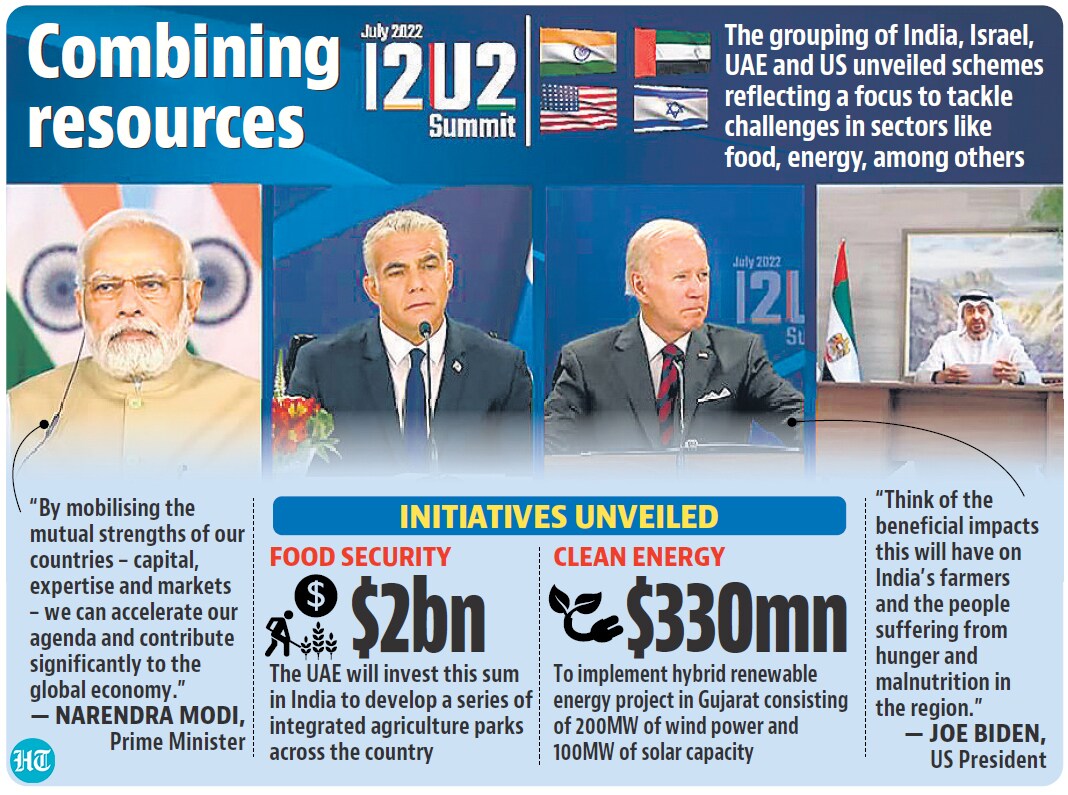
Modi also noted the four countries have a roadmap to move forward on specific joint projects, and said: “By mobilising the mutual strengths of our countries – capital, expertise and markets – we can accelerate our agenda and contribute significantly to the global economy.”
Biden said the food parks have the potential to sustainably increase India’s food yields threefold in five years. “Think of the beneficial impacts this will have on India’s farmers and the people suffering from hunger and malnutrition in the region,” he said.
In an apparent reference to China’s Belt and Road Initiative, Biden pointed out there is an enormous need globally for infrastructure “done the right way, transparently [and] in partnership” with communities. “Right now, there’s a vacuum... this group is going to work to identify new infrastructure projects that we can invest in and develop together,” he said.
The UAE will invest $2 billion to develop a series of integrated food parks across India, using state-of-the-art climate-smart technologies to reduce food waste, conserve fresh water and employ renewable energy sources, according to a joint statement issued by the four leaders.
India will provide land and facilitate the integration of farmers into the food parks, which will initially come up in Gujarat and Madhya Pradesh. The US and Israeli private sectors will provide expertise and innovative solutions for the sustainability of the project. “These investments will help maximise crop yields and, in turn, help tackle food insecurity in South Asia and the Middle East,” the statement said.
In the field of clean energy, I2U2 will implement a $330 million hybrid renewable energy project in Gujarat consisting of 200 MW of wind power and 100 MW of solar capacity complemented by a battery storage system. The US Trade and Development Agency funded a feasibility study for this project.
UAE-based companies are eyeing opportunities to serve as knowledge and investment partners, while Indian firms are keen to join the project to contribute to the country’s goal of achieving 500 GW of energy from non-fossil fuel sources by 2030. “Such projects have the potential to make India a global hub for alternate supply chains in the renewable energy sector,” the statement said.
The leaders said these are the “first steps in a long-term strategic partnership to promote initiatives and investments that improve the movement of people and goods across hemispheres, and increase sustainability and resilience through collaborative science and technology partnerships”.
They said they will leverage established markets to build “more innovative, inclusive, and science-based solutions to enhance food security and sustainable food systems”.
Foreign secretary Vinay Kwatra said I2U2 will mobilise private sector capital to modernise infrastructure and connectivity, develop pathways for low carbon development of industries, improve public health and access to vaccines, enhance physical connectivity between countries in West Asia, find new solutions for waste treatment, connect startups to I2U2 investments, promote critical emerging and green technologies, and explore opportunities in fintech.
Noting that India has products, services and platforms to offer in fintech, Kwatra told a media briefing that Modi highlighted the scope for expanding India’s UPI payment system to I2U2 areas.
The food corridor project will be shaped to benefit India’s small and marginal farmers in India and the food parks will have a set of objectives, including reducing trade barriers between I2U2 economies, harmonising food safety and quality standards, and exploring opportunities to export perishable food products globally, he said.
The corridor will facilitate access to strategic markets in West Asia, starting with the UAE, and could lead to significant job creation in India, he said. Though efforts will be governed by the private sector, all stakeholders will be taken on board and fully consulted before the project is implemented, Kwatra added.
While referring to the impacts of the war in Ukraine, Lapid said, “Its effects on cost of living [have] been immediate and dramatic and, of course, this has political implications.” Biden said countries have to find new ways to deal with contemporary challenges such as the climate crisis and “growing food insecurity and volatile energy markets made worse by Russia’s brutal and unprovoked attack against...Ukraine”.
Sameer Patil, senior fellow at the Observer Research Foundation (ORF), said the new initiatives leverage Israel’s strength in agriculture and food processing technology and the potential of the UAE as a hub for export of food items. “These are the most tangible benefits for India arising out of the Abraham Accords that reshaped West Asian dynamics,” he said.


