
 E-Paper



Gurugram building safety: How excavation on one plot can put neighbouring homes at risk, explained
The tilting of residential buildings in Sector 31 and Sushant Lok-I within days of each other has renewed concerns over construction safety in Gurugram

 Prefer HTon Google


In Gurugram’s Sector 31, a four-storey residential building developed cracks and tilted towards an adjoining plot amid excavation work, prompting the evacuation of four families. According to Hindustan Times, police also issued precautionary evacuation notices to residents of three neighbouring buildings after cracks measuring around 1 to 1.5 inches were reported. Construction on the adjoining plot was halted.
Earlier, on October 19, an under-construction five-storey building in block C of Sushant Lok-I developed cracks and began tilting after excavation for a basement on an adjoining plot. At least 12 families were initially evacuated, with subsequent reports putting the number of displaced families at 14 across four buildings.
The Department of Town and Country Planning (DTCP) put the building-plan approval for the adjoining plot on hold and directed its owner to take steps to stabilise the damaged structure, the report said.
The two incidents have brought renewed scrutiny to how excavation is planned, supervised and monitored, particularly in residential areas where buildings stand close together, and changes in soil conditions can affect neighbouring foundations.
Vivek Singh Rao, architect and chairman of the Indian Institute of Architects’ Gurugram chapter, said structural information about neighbouring buildings should be considered when a no-objection certificate (NOC) is issued for construction. He said excavation should be supervised by architects and undertaken with due regard to the foundations of adjoining structures.
“The excavation should be carried out under the supervision of architects. Digging should not be carried out below the plinth level of the adjacent house. Columns should be cast before digging the plot so that support is given to adjoining structures,” he said.
Also Read: Gurugram’s flooding crisis, Can PPPs and municipal bonds fund the infrastructure the city needs?
Rao said assessing existing structures and planning the excavation sequence were essential to reduce the risk of damage to neighbouring homes.
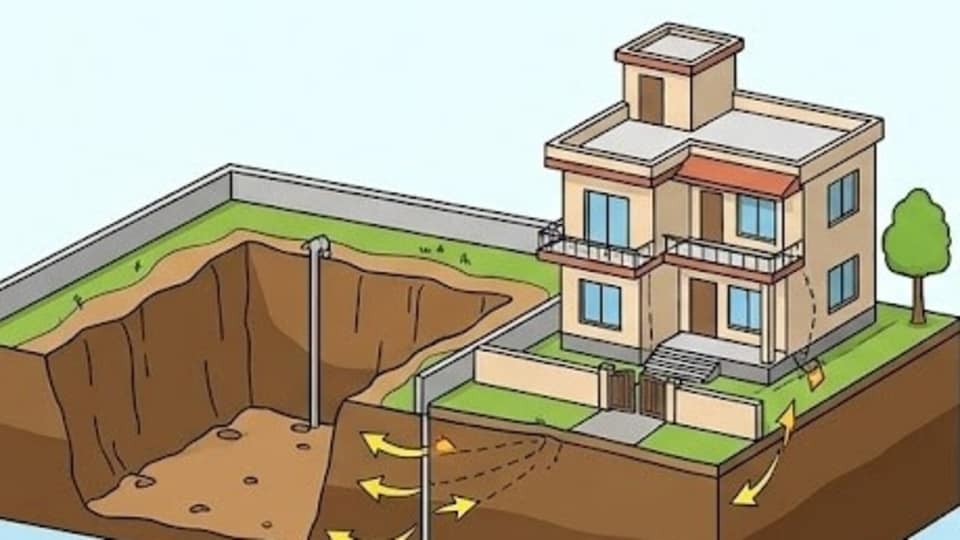
How can excavation damage neighbouring buildings?
Excavation for a basement or foundation can disturb the soil supporting neighbouring buildings. If digging is deep, occurs close to an existing structure, or is undertaken without adequate retaining and support measures, the surrounding soil can move towards the excavated area.
This movement can affect the support beneath a neighbouring building’s foundation. If one part of the foundation settles or shifts more than another, the resulting differential settlement can put stress on walls, columns, beams and floors. Cracks may appear, doors and windows may become misaligned, and the building may begin to tilt.
The extent of the damage depends on several factors, including soil conditions, the depth and method of excavation, the type and condition of existing foundations, groundwater levels and the effectiveness of shoring or other support systems.
A structural engineer must assess the site to determine whether excavation caused the movement, whether other structural weaknesses contributed to it, and whether the building can be stabilised. Visible cracks alone do not establish the full extent of damage or determine whether a structure is safe to occupy.
Also Read: ‘No natural drainage, high-rise model’: Why Gurugram floods every year, former HUDA chief explains
A recurring problem, not an isolated incident
Gurugram has witnessed similar building-safety scares in the past. In June 2023, a four-storey building in U Block of DLF Phase 3 tilted by as much as eight inches after excavation began on an adjoining plot for a basement. Residents were evacuated, nearby houses were cleared as a precaution, and two machines were deployed to support the structure. DTCP issued notices to the owners of the affected building and the adjoining plot and ordered a structural assessment.
Following that incident, the department issued directions to developers and contractors in licensed colonies to take adequate precautions during excavation. Officials said digging should be undertaken in the presence of an architect and structural engineer, with appropriate safety measures in place.
The department also announced a survey of multi-storey buildings, particularly stilt-plus-four structures on smaller plots. In 2020, buildings in Sectors 27, 46 and 47 were also reported to have tilted after excavation on neighbouring plots.
Building code places responsibility on architects
Praveen Chauhan, district town planner (planning), Gurugram, said rules for safe construction were already in place under the Haryana Building Code, 2017. He said architects were responsible for ensuring that construction complied with approved building plans and was carried out under their supervision.
“The architects must ensure that all construction activities take place under their supervision. Under the self-certification policy, the architects are responsible for safe construction in accordance with the building plan. In case rules are not followed, action would be taken against the architects concerned,” he said.
Under the self-certification system, compliance with approved building plans and professional oversight are important safeguards. However, the recent incidents highlight the need to examine not only whether a building plan has been approved but also whether excavation and foundation work are being carried out safely on site.
A building’s safety cannot be considered in isolation from construction on adjoining plots. Where basement excavation is proposed close to an existing structure, the condition of that structure, the depth of its foundation and the proposed excavation sequence need to be assessed before work begins.
Residents seek accountability and independent assessments
The incidents have also raised concerns among residents and homebuyers about the risks posed by construction activity on adjoining plots. Evacuations can leave families without access to their homes, belongings and essential documents, while uncertainty over repair costs, alternative accommodation and liability can prolong their hardship.
Nilesh Tandon, former RWA president of Fresco Apartment in Sector 50, said the safety of residents in neighbouring homes should not be left to chance when excavation begins.
“Before digging starts, the authorities must ensure that the condition and foundations of adjoining buildings have been assessed and that adequate support measures are in place. If negligence is established, responsibility must be fixed and the affected families compensated. Residents should not be forced to leave their homes because basic construction safety precautions were ignored,” he said.
Amit Jindal, RWA president of Vipul Greens in Sector 48 and a homebuyer, said building safety must be monitored beyond the boundaries of an individual plot.
“Homebuyers invest their life savings in a property, but they remain vulnerable to construction activity next door. We need independent structural audits of affected buildings, transparent disclosure of the findings and strict enforcement of excavation norms. Authorities must also ensure that displaced families receive timely assistance and that responsibility for repairs and other losses is clearly established,” he said.
In Sector 31, residents have sought a time-bound, independent structural audit to determine whether the damaged building can be repaired or needs to be demolished. They have also sought clarity on who will carry out the repairs and bear the cost.
In Sushant Lok-I, DTCP directed the owner of the adjoining plot to engage an empanelled structural engineer to recommend measures to stabilise the affected building. The department also barred the registration of sale deeds or individual floors in the damaged building until further orders.
Structural assessments should establish the extent of the damage, determine whether movement is continuing and examine the foundations and soil conditions. They should also assess the excavation site, including the depth of digging, retaining arrangements and measures taken to protect neighbouring structures. The findings should guide decisions on stabilisation, repairs, retrofitting or demolition.
Prevention must begin before excavation
Experts say the risk of damage can be reduced by assessing neighbouring structures before excavation begins and ensuring that work follows an appropriate engineering plan. Depending on site conditions, this may require retaining walls, shoring, bracing or underpinning, along with excavation in controlled stages.
Architects and structural engineers should supervise work within their respective professional responsibilities, while developers and contractors must ensure that prescribed safety measures are followed. Monitoring for ground movement and cracks in adjoining buildings can help identify problems early and allow work to be stopped before damage worsens.
Authorities also need a clear response mechanism when a building shows signs of movement. This should include prompt evacuation where necessary, restricting access to unsafe structures, independent technical assessments and a defined plan for stabilisation and rehabilitation.


