E-Paper



Mumbai redevelopment: Why housing society maintenance bills may rise after homeowners get possession of new flats
Mumbai real estate: Redevelopment offers bigger homes and modern amenities, but homeowners must prepare for higher monthly maintenance bills, say experts

 Prefer HTon Google


For Sagar Patil and his family, the redevelopment of their old residential building in Mumbai’s Borivali brought a significant upgrade in their living conditions, but it also came with a higher monthly maintenance bill. Before redevelopment, the family paid around ₹1,500 per month for their one-room kitchen apartment, measuring approximately 300 sq ft, in a building more than 40 years old. The building underwent redevelopment around three months before the COVID-19 pandemic hit in 2020.

After redevelopment, the family moved into a 1 BHK apartment measuring 420 sq ft in a modern residential complex with amenities such as a double-height lobby, an air-conditioned lobby, a podium, a gym, a swimming pool and valet parking. The monthly maintenance bill, however, rose to ₹5,500, reflecting the increased cost of maintaining these facilities and managing the redeveloped property.
While the Patil family is now paying nearly four times its earlier maintenance bill, it is satisfied with the overall outcome of the redevelopment. The family received a substantial corpus from the developer, which it expects will help cover maintenance expenses for the next seven to eight years.
The redevelopment also transformed a property that had limited resale and rental prospects into a more valuable asset. According to the family, the old apartment in the dilapidated building had virtually no resale value, and finding a tenant was difficult. Today, the redeveloped 1 BHK apartment could fetch approximately ₹1.20 crore if sold, while its rental value is around ₹30,000 to ₹35,000 a month. For the family, the higher monthly outgo is therefore balanced by an improved standard of living, better amenities, and a significant increase in the property's marketability.
Also Read: Mumbai redevelopment: Why some flat owners choose not to move back after redevelopment is complete
Why do maintenance costs increase?
According to real estate experts, the increase in maintenance costs after redevelopment depends on the amenities provided, the size of the building, the number of apartments sharing common expenses and how the society manages its facilities.
Expenses can include electricity for common areas, lifts, water pumps, fire safety systems, housekeeping, security personnel, garden and podium maintenance, swimming pool operations, and gym upkeep. Buildings with mechanical or automated parking systems may also incur additional expenses for operating and maintaining the equipment, as well as for trained personnel or attendants. Air-conditioned lobbies, extensive landscaping, and larger common areas can further increase electricity and housekeeping bills. These costs are generally recurring, and homeowners need to account for them even if they do not use every facility in the building, experts said.
Something like a swimming pool or a heated swimming pool can make a huge difference when it comes to the monthly maintenance expenses of a housing society, said Sanjay Ahuja, a real estate consultant from Mumbai's Bandra-Khar belt.
"Buildings having a hot water swimming pool will have a higher maintenance cost as it requires energy to maintain the water temperature, apart from the costs of filtration, cleaning, chemicals and equipment maintenance. The extent of the increase depends on the size of the pool, the heating technology used, operating hours and the number of apartments sharing the expenses. Something small like this may increase your maintenance by ₹1 or ₹2 per sq ft on a monthly basis," Ahuja said.
Expenses increase after a housing society is formed
According to experts, the transition from a developer-managed project to a residents’ society is another factor homeowners should understand.
During the initial period after possession, the developer may provide maintenance support or contribute towards expenses under the terms of the redevelopment agreement. However, once the society is formed and the managing committee assumes responsibility for the building, residents may have to cover the actual costs of operating and maintaining the premises.
"We suggest that homebuyers take the final call on a home purchase after understanding the factor of maintenance as well. In standalone buildings, monthly maintenance may be lower; however, in gated communities, it may be higher. Homebuyers should ask for per sq ft maintenance or monthly maintenance before finalising their purchase," said Devendra Singh, a real estate consultant from Mumbai.
Kamlesh Iyer, a resident of Nagpur, said their housing society ended up spending almost ₹5 lakh to replace the doors of their automatic lifts after the developer handed over charge to the society post-redevelopment.
"We had a few frightening incidents where residents, including young kids, got stuck inside the lift due to sudden power cuts, and the absolute panic of being trapped in a dark, solid metal box was deeply traumatising for them. That is when our society decided that passenger safety and peace of mind had to come first. We reached out to a reputed elevator brand to replace the old setup with transparent glass doors in the lift. For our 8-storey building, the entire upgrade across all floors costs the society around ₹4- ₹5 lakhs in total. It was a significant investment, and we had to ask all the members to give the money from their pockets, but seeing the bright hallways from inside the cabin completely eliminates that claustrophobic feeling, and everyone feels so much safer now," said Iyer.
Also Read: What is driving the growing interest of large corporates in Mumbai's cluster redevelopment projects?
Mumbai's redevelopment market
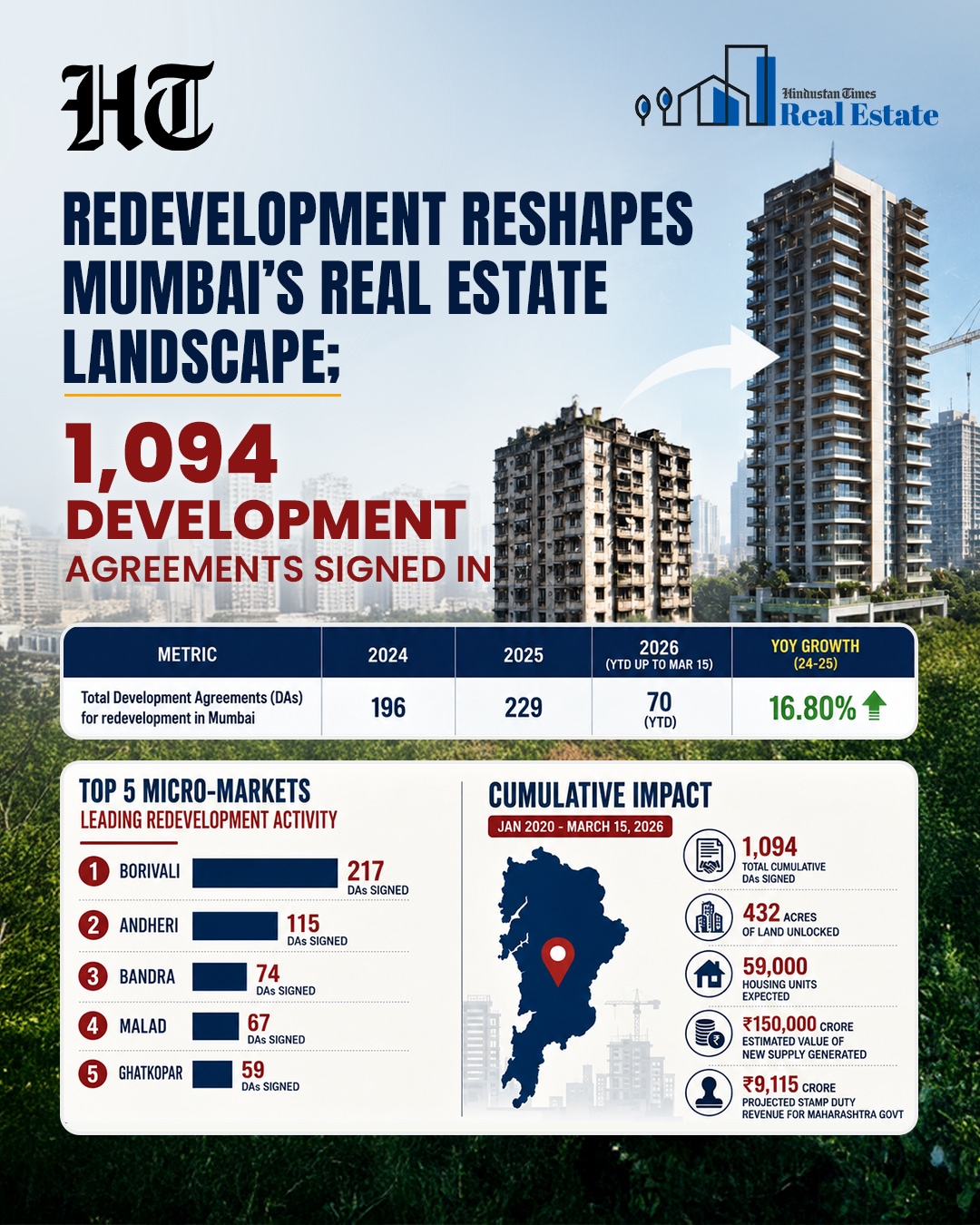
Mumbai real estate market's redevelopment segment has reported more than 1,000 projects since 2020, comprising 13% of the city's overall residential supply and 15% of housing sales, according to a report released by JLL India and NAREDCO on September 3.
Five locations, including Borivali, Malad, Andheri, Vikhroli, and Goregaon, account for around 36% of all projects since 2020. The western suburbs dominate, accounting for 35-45% of both launches and sales (2025-H1 2026).