
 E-Paper



World's oldest shipwreck, as ancient as Great Pyramid, found near Turkey's Kekova Island
Though the ship's wooden structure has completely dissolved over the years, ceramic pots lying on the sea floor helped archaeologists establish a time period.

 Prefer HTon Google


A recent shipwreck discovery, reportedly the world's oldest, close to the shore of Kekova Island in Antalya, Turkey has sparked a frenzy of delight among archaeologists. Dated between 4,400 and 4,700 years old, this particular ship wreckage has been placed in the Early Bronze Age, around the same time that the Great Pyramid in Egypt was being built. This incredible feat has led scientists to label this the oldest shipwreck ever discovered.
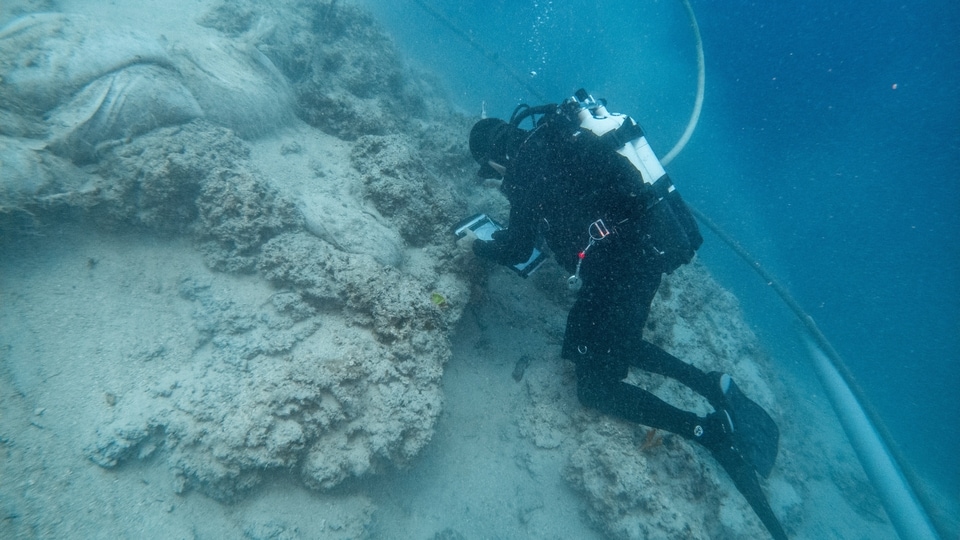
Though the ship's wooden structure has completely dissolved over the years, ceramic pots lying on the sea floor, their contents and decor, helped archaeologists establish a time period for their finding, reported BBC.
Using clay pots to date the ship
About 10m in length, the structure is believed to be a cargo vessel conducting trade across the Mediterranean Sea. The ship's artefacts, on the other hand, lie scattered across an underwater slope, just 30m beneath the waves.
Despite the absolute decay of wooden elements in the ship's structure detracting the use of radiocarbon dating, archaeologists have instead been able to use 30 ceramic storage pots (called amphorae) to accurately date the ship.
A distinctive design pattern marked by two handles, a ridge in the middle and a flat base when linked to corresponding prevalent style patterns placed these post among artefacts unearthed in Egypt and the Middle East 4,400-4,700 years back.
Also Read I What is the origin of Paris? The discovery of a 20-metre ancient wall may solve centuries-old mystery
While carefully scrutinising the amphorae after recovery from the seabed, Dr Karin Sowada, an archaeologist from Macquarie University, Australia, noted her surprise at how intact some of them remained while others still carried a viscous, glossy residue.
"I looked inside and nearly fainted. I could not believe how much [residue] was visible. It wasn't just like spots…. a lot of this material was still remaining," she told BBC.
"It's possible that [the residue] could actually be the result of reuse of the jars. I mean, these jars are huge - they're not things that you just ship away and then never see again. People would have emptied these jars on arrival and potentially used them for many, many, many years."
Sowada's team is currently inspecting the exact contents that may have been carried in these amphorae. Olive oil, wine, and tree resins are all believed to be possible contenders in this selection.
‘Time capsule at bottom of sea’
As per archaeologists' understanding, the ship offers insights into how trade was conducted in the ancient world. Shipwrecks were a common occurrence, particularly around the Kekova Island, thanks to strong currents and heavy wind.
This particular ship is believed to have started its voyage from somewhere along the eastern coast of the Mediterranean and carrying goods either to the ancient city of Troy, in what is now north-western Turkey or to the Minoan people in Crete.
"The shipwreck is a time capsule at the bottom of the sea," Prof Hakan Öniz, from Akdeniz University in Turkey, who led the Mediterranean Archaeology Association expedition, told BBC.
"We are the first humans who [have] touched these objects after 5,000 years. We are always thinking of the sailors... the producers of the amphora and the person who carried the amphora on their shoulders to the ship, and the women who were waiting for their husbands, and they unfortunately couldn't go back."
Also Read I Review: The Dig by Sowmiya Ashok
This latest discovery has opened the floodgates for claiming the title of the oldest shipwreck ever discovered, beating the record previously held by 4200-year-old wreckage discovered off the coast of Dokos, an island in southern Greece.
Though dated to merely 2,400 years back, wreckage found in the Black Sea off the coast of Bulgaria is still the oldest shipwreck to have been discovered without all of its wood having perished.


