
 E-Paper



Delhi govt’s winter action plan targets sources at correct time, but mirrors Grap
The November-February window is also the window when meteorological conditions are the most adverse for good air in Delhi.

 Prefer HTon Google


The Delhi government on Monday announced its “Winter Action Plan 2026-27” to control air pollution in the Capital, including higher parking fees, a ban on vehicles registered outside Delhi that do not meet BS-VI emission standards, staggered timings for Delhi government and municipal employees, reduced staff strength in offices from November to February, and restrictions on construction.
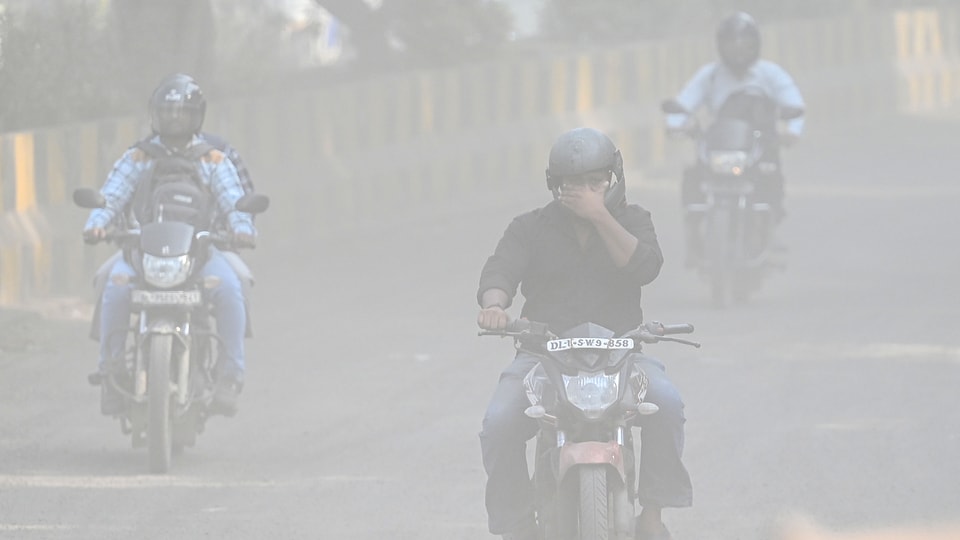
The question is how much these measures can improve Delhi’s air.
An HT analysis of public data shows that these measures target both the period when Delhi’s air quality is generally at its worst and several major sources of pollution. But the analysis also shows that most of the measures are already part of the Graded Response Action Plan (GRAP) and were implemented during roughly the same period last winter. Their impact this winter (like it is every year) will depend on how consistently and strictly they are enforced. Here are some charts that show this.
These measures target the worst air-quality window...
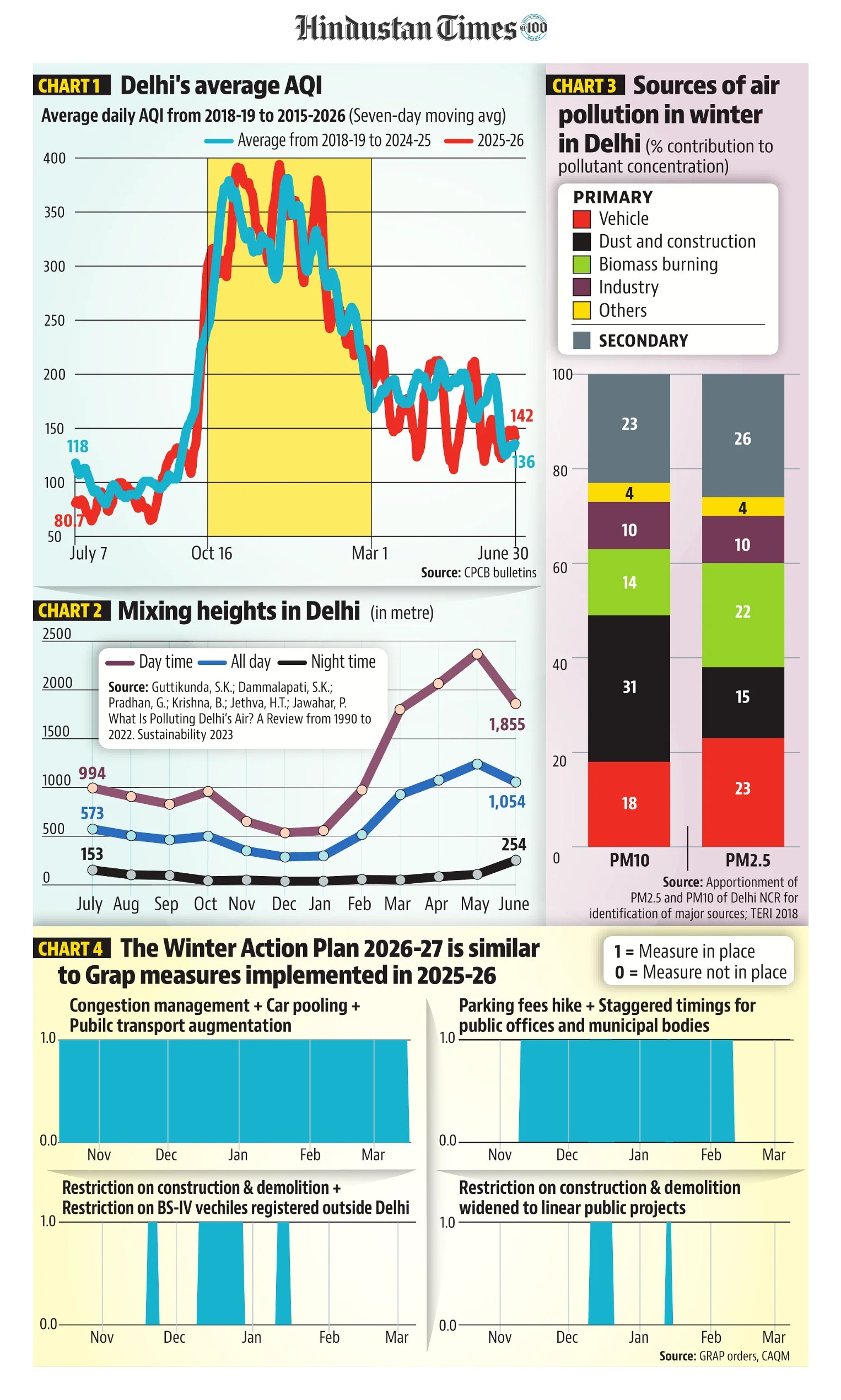
Delhi’s average AQI over the past eight years shows a clear seasonal pattern. There is an almost precise window in the calendar when Delhi’s AQI breaches the 200-mark: mid-October to February-end. The measures with the widest window cover these very dates.
The November-February window is also the window when meteorological conditions are the most adverse for good air in Delhi. Temperatures are the lowest around the November-to-March period and the mixing height (the height up to which pollutants can disperse) is the lowest in the November-February period. This means that the only way to control air pollution is by decreasing the mass of emissions. Hence, the restrictions make sense in this window.
(See charts 1 and 2)
…and the biggest sources of pollution
Studies examining pollution sources across large parts of the city are now several years old, but they continue to provide an indication of what Delhi’s biggest sources of air pollution are.
Among primary particulate matter (small particles formed directly from a source of emission instead of the chemical transformation of primary particles), the biggest winter pollutant in Delhi, the biggest sources are vehicles, biomass, and dust and construction taken together, according to a TERI study published in 2018. Since the Delhi government has limited control over biomass burning, particularly stubble burning outside the Capital, its measures therefore focus substantially on the other sources: vehicles, road dust and construction. (See chart 3)
Also Read | 'No PUC, no fuel' rule, 150 more e-buses on roads: How Delhi govt plans to curb winter pollution
But Winter Action Plan is just Grap by other means
The discussion above shows that there is nothing inherently wrong with Delhi government’s winter action plan. But what is worth noting is that most of the measures listed are already available to the Commission for Air Quality Management in National Capital Region and Adjoining Areas (CAQM) under GRAP.
The only significant difference is that the Delhi government has now announced fixed dates for several restrictions instead of waiting for CAQM to invoke them in response to worsening air quality. But this may not, by itself, produce a substantial change. The measures announced Monday for 2026-27 were implemented on roughly the same dates in the 2025-26 winter. They were just implemented under GRAP and through orders issued by the CAQM. As the first chart shows, those measures did not bring any meaningful change in Delhi’s winter air quality. (See chart 4)


Stay updated with all top Cities including, Bengaluru, Delhi, Mumbai and more across India. Stay informed on the latest happenings in World News along with Delhi Election 2025 and Delhi Election Result 2025 Live, New Delhi Election Result Live, Kalkaji Election Result Live at Hindustan Times.


